
Omen, the directorial debut from Congolese rapper Baloji, is not a horror movie in any real sense, though you’d be forgiven for believing otherwise at a glance. It’s got its fair share of signifiers which one might associate with the “folk horror” movement: there are rituals, and talk of curses, and some pretty terrific and flamboyant costumes (there is also, I suppose, the title, which I assure you has nothing to do with Damien Thorn). There is also a palpable sense of dread, as its characters find themselves in over their heads in some truly harrowing situations. But despite a healthy magical realist streak, the stakes here are more emotional than supernatural. This is, at its core, a story about the stress and anguish of trying to navigate the politics of a complicated and at times hostile family. On second thought, maybe it is a horror movie.
Omen is divided into four rough chapters bearing the names of different characters, but our main protagonist is Koffi (Marc Zinga), a Congolese-Belgian expat who returns to his home country to introduce his family to his pregnant (white) fiancee. Koffi’s citified demeanor sticks out like a sore thumb in the poor mining community where he grew up, but it’s clear that he was something of a black sheep even before he left: a large birthmark on his face has saddled him with the family nickname “Devil’s Mark,” and most of his relatives seem to at least half-seriously believe him to be a vessel for demons. This is why, when an inopportune nosebleed spatters onto the face of a young nephew (Koffi has high blood pressure), his family freaks out and summons a witch doctor to perform an impromptu exorcism.
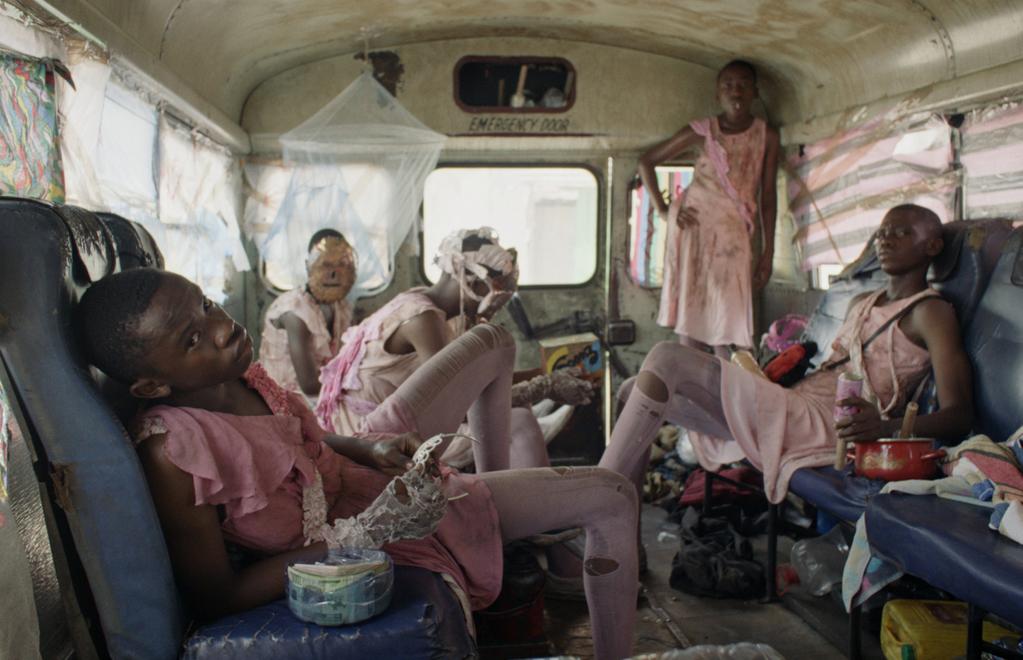
This is the point where, if Omen were a folk horror movie, things would start to get gruesome. Instead, Koffi’s fiancee simply pries the ceremonial mask off of his head after the ritual, and the couple retreat to the home of his more progressive-minded sister. This is where the narrative fans out its focus to three other characters: said sister, Tshala (Eliane Umuhire), whose more liberal lifestyle comes with its own risks; their conservative mother, Mujila (Yves-Marina Gnahoua), whose life is shaped by her relationship with her little-seen husband; and street orphan Paco (Marcel Otete Kabeya), who leads a cross-dressing wrestling gang and lives in an abandoned school bus. All of them, like Koffi, are seen by society as “witches” in one way or another, and while none of the four have mystical powers (probably), all must tangle with this designation in modern society.
Omen is one of those movies whose low budget only enhances its scope and atmosphere. The film at times seems to take place in a sort of dream state which can only partly be explained away by cultural differences– take, for example, the burly cemetery worker who spontaneously bursts into a soprano aria– yet the ramshackle surroundings place the proceedings firmly on terra firma. We know that Koffi is not a demon incarnate, but everything is so eerie– and the danger so real– that somehow we can never quite discount the possibility (Koffi is a perfect audience surrogate, just removed enough to see everything as strange as it is, but still comfortable enough in his old hometown to be grounded). In one show-stopping scene, Paco remembers the loss of his younger sister as a modernized version of the “Hansel and Gretel” story, complete with a witch (whose blank face and glowing eyes are truly unsettling) and a shack adorned with cotton candy. Whatever happened to Paco’s sister probably didn’t happen exactly like that, but it’s telling that even Paco’s fantasy version is grounded in homemade aesthetics.
Of course, even if there’s no actual witchcraft going on, it seems like Koffi and his family have their share of curses. All three of the family members we spend time with clearly live in the shadow of their patriarch (we only actually see Koffi’s father once, and then only in flashback and from the mustache down). All three actors expertly communicate their plight; Umuhire is radiant and wildly charismatic, and Zinga is immensely relatable as the fish out of water. Even if a viewer has no experience with the culture and customs of the Democratic Republic of Congo (as I will admit I do not), the dynamics on display here will be more than relatable.
Structurally, Omen could perhaps do with a little tightening up; a third-act time jump is abrupt and somewhat disorienting, and Paco’s relationship with the rest of the narrative sometimes feels tenuous (though the way in which he ultimately connects with Koffi is tremendously affecting). But this is the sort of film whose atmosphere is as important as its plot, and the dreamy haze of Omen is unlike much I’ve seen recently. I was not previously familiar with Baloji’s work as a musician, but Omen proves him to be an artist with a singular voice, and I look forward to seeing where he goes next– in any medium.
Omen
2023
dir. Baloji
90 min.
Screens Friday, 5/31 through Monday, 6/3 @ Brattle Theatre – click here for showtimes and ticket info!