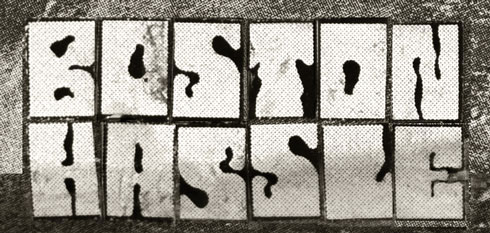

It is difficult to know where to begin when reviewing Megalopolis, the decades-in-the-making passion project which Francis Ford Coppola has finally willed into existence through barrels of wine money and (undeniably justified) hubris. It’s easy to talk about purely in behind-the-scenes, metatextual terms, but we could do that before it came out. Conversely, it’s tempting to play dumb and attempt to review it as if it’s just another film, but the context of Megalopolis’ creation is so interwoven into its fabric that one can’t extract it without killing the patient. It exists to be discussed, yet is almost impossible to describe in such banal terms as “good” or “bad.” It’s a film which has been metastasizing in its creator’s brain since before I was born (Coppola is said to have completed a 300-page draft as early as 1982). How the fuck am I supposed to unpack it in a matter of days?
One thing I’m not going to do is attempt to summarize the plot, which very much reads like the product of decades of constant revision. What you need to know is that Adam Driver plays Cesar Catalina, a brilliant celebrity architect/wizard with the ability to freeze time, mastery of a mysterious new element called Megalon (no relation to the kaiju), and a sweeping, utopian vision for the future of the city of New Rome. New Rome is, for all intents and purposes, modern New York, but filtered through a lens of Ancient Rome, made literal via Omni Theater-like narration from Laurence Fishburne (Fishburne, who also plays Catalina’s chauffeur and confidant, has a particular gift for this sort of material, having previously transmuted the hyper-stylized dialogue of the Matrix films and TV’s Hannibal into something conversational and almost folksy). The ruling class style themselves as emperors; pop concerts play out as bread-and-circus spectacles; everyone wears flowing clothes and silly haircuts; and so forth.
Catalina sits at the crux between dueling factions battling for control of New Rome. On one side is embattled, no-nonsense Mayor Cicero (Giancarlo Esposito) and his idealistic daughter Julia (Nathalie Emmanuel); on the other, the powerful businessman Hamilton Crassus III (Jon Voight) and his venal nephew, Clodio Pulcher (Shia LaBeouf, in a role I’d bet was at one point earmarked for Coppola’s nephew Nicolas Cage). Somewhere in the middle of all this are a virginal, Swiftian pop singer named Vesta Sweetwater (Grace VanderWaal), a heavy named Nush “The Fixer” Berman (Dustin Hoffman, visibly confused), and Wow Platinum, a vampy, Machiavellian finance reporter/influencer played with gusto by Aubrey Plaza.

That is pretty much all I can tell you about the plot of Megalopolis, not to avoid spoilers, but because untangling all of the film’s various layers of intrigue and digression would require a very large bulletin board and several spools of thread. Megalopolis is best viewed not as a story, but as a window into its legendary creator’s brain. This is a film both unsubtle (“So much injustice on the streets,” Julia observes as an enormous, anthropomorphic statue of Justice collapses in exhaustion against a building) and impenetrable; it’s clear to me that Coppola has very specific ideas for the future of society, yet despite the film’s numerous monologues on the subject I could not begin to articulate what they are (I sense it might help if I’d read Ayn Rand, but given that our time on this earth is precious and fleeting that is simply something I am never going to do). Narratively and thematically, Megalopolis is a mess.
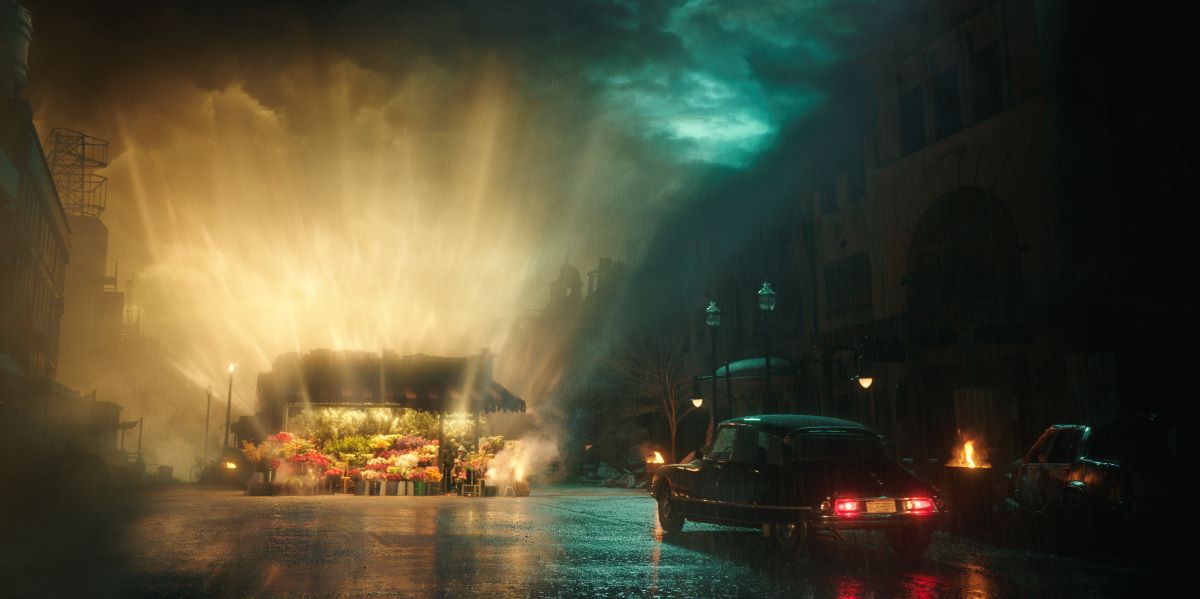
Yet there is genuine beauty here, not just hidden within the mess (though there are plenty of striking images), but in the mess itself. Few filmmakers in history have ever worked on such an enormous canvas without the interference of studio moneymen; the closest comparison might be Coppola’s one-time sidekick George Lucas, who essentially self-funded his Star Wars prequel trilogy, but even Lucas surely had to devote a portion of his vision to merchandising potential and fan service (you cannot tell me that the inclusion of Boba Fett in Attack of the Clones was a purely artistic decision). Coppola makes no such concessions. There is no post-credits sequence; the film’s many loose ends are the organic result of a fevered creative brain, not deliberate seeds for a planned cinematic universe. For better and for worse, this is 100% Coppola’s undiluted vision.
One curious revelation is how much inspiration Coppola seems to have drawn from Godfrey Reggio, the gnomishly eccentric filmmaker whose ‘80s arthouse staple Koyaanisqatsi was distributed under Coppola’s American Zoetrope shingle. There are a few shots here which could have been taken directly from Koyaanisqatsi– montages of bustling pedestrians, the sun sweeping across New Rome– but I was even more reminded of Reggio’s later work, such as last year’s long-short-whatzit Once Within a Time. Like Reggio, Coppola’s view of the world is at once childlike and galaxy-brained; he seems to despair the state of the human race, yet holds a near-impossible optimism for the future.
Also like Reggio, Coppola giddily plays with form, at times tugging at the very seams of narrative filmmaking. Some of his swings are breathtaking, such as an interlude in which a creation myth is played out in body paint on a group of contorting actors. Others fall flat, including the much-ballyhooed “live participation” element in which the on-screen Driver interacts with a live actor in the theater itself. I’m told that this sequence was a showstopper when the film premiered at Cannes, with the questions being asked by an American Zoetrope representative. It was a showstopper at the Assembly Row AMC as well, but in a more literal sense: the film itself stopped, the houselights flicked on, and a theater employee awkwardly read a single question into a microphone. On screen, Driver took several seconds to answer, possibly to digest the employee’s question, but more likely because they mistimed the cue. After the exchange, the lights went back down, and there was a smattering of polite, confused applause. It didn’t work, in other words, but I do have to hand it to Coppola, at 85, to suddenly decide to try his hand at William Castle-style hucksterism.
There is so much going on in Megalopolis that it is difficult to know what to grab onto. For me, though, the film snapped into focus during a seemingly inconsequential scene maybe a third of the way in. Catalina, on his way into a gala function, is beset by paparazzi. As I watched Driver stammer his way through his responses to their questions, I realized there was something in his demeanor– somewhat dazed, half-glib, yet entirely earnest– that was distinctly familiar. Specifically, I’d heard it an hour before, during the livestreamed Q&A with Coppola which was beamed in from the New York Film Festival immediately before the screening. The session was primarily a monologue, with Coppola’s ruminations on the film and its production only occasionally interrupted by asides from Robert De Niro and Spike Lee (neither of whom have anything to do with Megalopolis, and mostly seemed to be there to support their friend). In the interview, as in the film, Coppola came off as something of a crackpot visionary, maybe right, maybe crazy, possibly both.
I’m not sure the extent to which either man is aware of it, but Adam Driver is playing Francis Ford Coppola in Megalopolis, just as surely as if it were a biopic. Catalina’s Megalopolis is Coppola’s Megalopolis, a massive, seemingly impossible project, the completion of which depends upon its creator’s ability to bend the very forces of nature. Much of Megalopolis is, once again, nonsense, but taken in this light– a desperate plea for its own existence, from an artist who knows that it is his last, best shot– it becomes almost heartbreaking. It’s not what it says, or even the way that it says it; it’s the very fact that it’s gotten to say it at all.
Megalopolis
2024
dir. Francis Ford Coppola
138 min.
Opens in theaters everywhere Friday, 9/27. The “Ultimate IMAX Experience” (with live actor participation) will screen at 6:45pm on Friday, 9/27, and Saturday, 9/28 at AMC Assembly Row.