
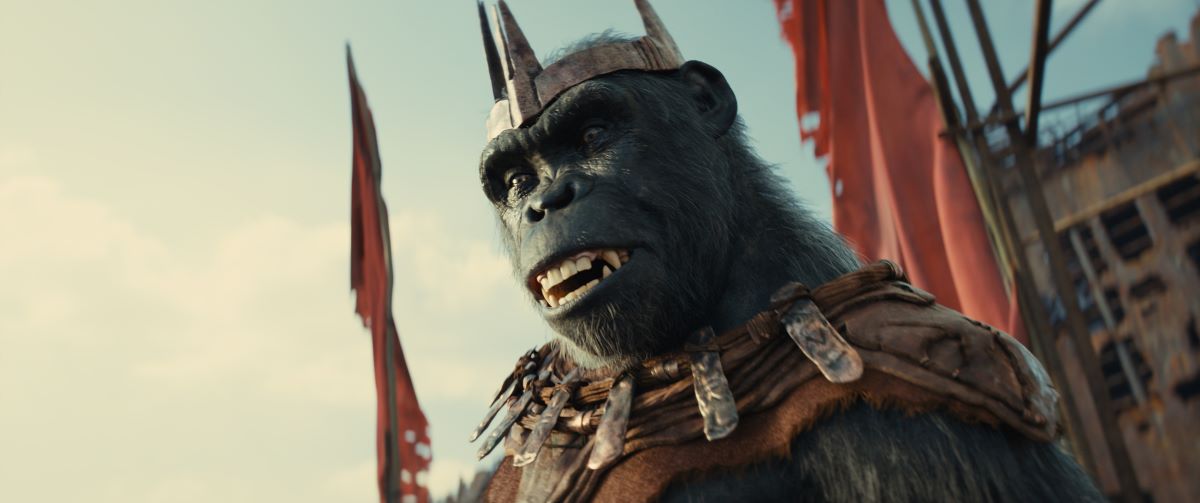
Kingdom of the Planet of the Apes is a grand-scaled and morally ambiguous continuation of the beloved Planet of the Apes reboot, and a solid standalone feature. Set generations after Andy Serkis’s original trilogy, in which apes took over the planet under the honorable Caesar, Kingdom follows Caesar’s descendant Noa (Owen Teague) as he lives amongst his people in the Eagle Clan. While initially peaceful and prosperous with only the vague threat of echoes – the current term for humans who live in the shadows and have long since devolved from the virus spread in earlier films – keeping Noa and his family alert, his home gets unexpectedly destroyed, his father killed, and his people taken by a ruthless war-mongering clan claiming to invade in service to Caesar himself. Now the only non-captive survivor of the attack, Noa sets out on a quest to free his family. On his way, he meets two unlikely companions: Mae (Freya Allan), nicknamed Nova initially, a human who’s followed Noa for some time and appears far more intelligent than the species’ current de-evolutionized track springs, and Raka (Peter Macon), a virtuous orangutan who is also the only faithful Caesar follower left who reminds Noa of Caesar’s true motto: “Ape no kill ape. Ape no kill human.” Together, the trio embarks on a treacherous journey across the wildlands to save Noa’s family from the responsible clan’s tyrant of a leader, Proximus Caesar (Kevin Durand), before they all die or Proximus achieves his far more sinister goals of utilizing human-created mass-destructive weaponry to wipe the rest of humanity out. Humans are not the major enemy this time: history repeats only now on four arms instead of two legs.
Kingdom demonstrates that plenty of life remains in this franchise, even if this fourth entry is the now-quadrilogy’s weakest. Though sludgily paced, the story stands strong because of sufficiently layered plotting and good character work. The narrative is grandiosely filled with moralistic integrity from start to finish, starting with a tragic close-out of Caesar’s reign to transition into this new era where apes are now the dominant species. Viewers are trailed along pristine forests, undisturbed ecosystems, solid familial bonds, and harmonious ways of living through the Eagle Clan as they strive to live in tune with nature and each other in every way possible. Humans are set up for the first time as the true losers, as most have devolved and now live in wandering herds or the shadows – silenced much like they silenced the ape generations before. Watching Noa’s beautiful life turn upside down by other apes, though reminiscent of ape-to-ape conflict seen in past entries like Matt Reeves’ Dawn of the Planet of the Apes, is thus surprising and especially heart-shattering because they claim to do it in honor of the original Caesar. These new enemies spark a compelling muddling of Caesar’s legacy within this already freedom-threatening conflict, which now falls to his descendants to vindicate as ape colonizers have twisted his words for their malice.
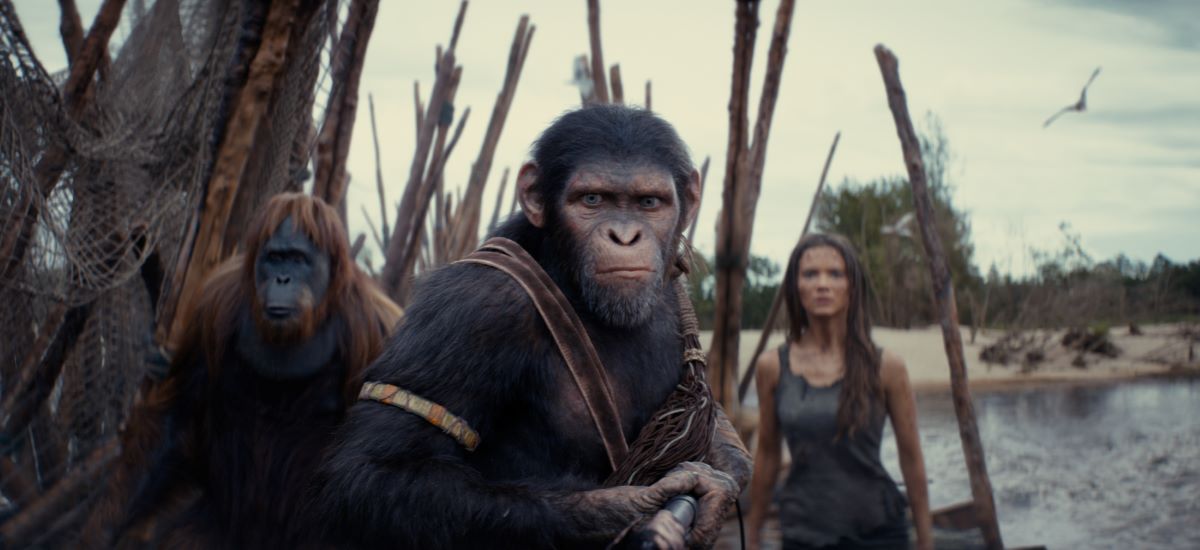
Mae’s inclusion as the only ape-adjoining human character establishes a layer of bubbly conviction in this primarily ape-centric fight. While she helps Noa in his quest, she simultaneously represents those who initially silenced apes and humans’ current state in the world. She helps those who took her world away while they allow a remnant of their past captivity to join, creating an intriguing dichotomy that unfolds devilishly as her true capabilities as an intelligent human become apparent. This is especially true when her true revelations get revealed, as the never-ending paradox of the human psyche revealed in her complex motivations clouds her and the team’s path, only further intensifying their odds.
Speaking of characters, every character here is well enmeshed into the larger narrative and solidly filled by their performers. While Noa is no Caesar (yet), he is an empathetic and emboldened figure morphed by the traumas he witnesses. Teague fills him with the emotional naivety necessary for the position he’s forced into, as this is the first time Noa has ever experienced such loss. Durand fills Proximus with an overpowering, corrupt sense of life-long dread; he’s big and bad in size, voice, and demeanor, making him another solid villain to add to the franchise’s roster. Allan fills Mae with cautious curiosity, presenting a woman constantly in survival mode who struggles to determine her place in the world, which creates striking similarities between her and Noa. The rest of the characters feel believably present and grounded in this natural world, strengthening the film’s applicability to real futures and the cyclic nature that comes with being sentient.
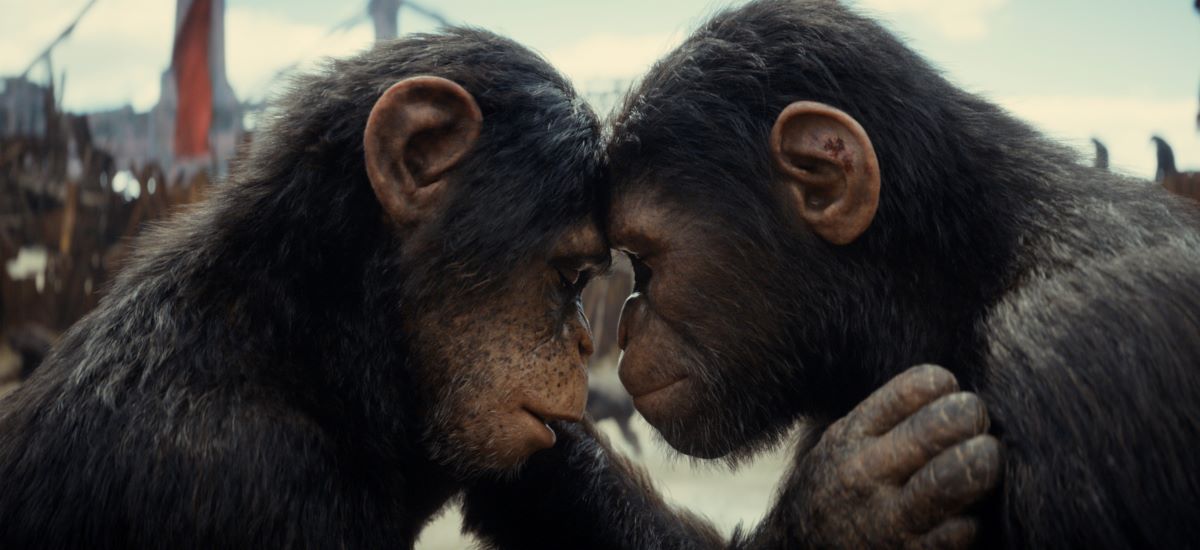
The visuals are also the best in the franchise to date. With even the tiniest wisps of ape hair appearing textured, every bit of CGI and cinematography is grandly enveloping. While the original trilogy also proudly boasts visual flare, the seven-year gap between Kingdom and the series previous entry, War for the Planet of the Apes pays off: every shot is breathtaking, every computer-generated piece is indiscernible, and the action is explosive. The sound design is also well crafted, except when the dialogue is either too mumbly to comprehend or too quiet to hear, but these moments are few and far between.
The film’s only major flaw is its length – Kingdom is 40 minutes too long. While there are no specific moments that linger, everything is overly stretched out. Silences are two seconds longer than necessary; dialogue and time between line deliveries are slow; every movement or action takes at least a second more to perform than it would in reality, from small hand gestures to massive explosions. These significantly weigh down the film’s impact because even when the stakes are high, the acting is stellar, and the visuals mystify Kingdom trudges. If the film were more finely shaven before release, it would match the action-packed emotional heft of the franchise’s most substantial entries. As it is, it is still an intelligent and entertaining continuation, just less so than it could have been.
Overall, Kingdom of the Planet of the Apes is an exciting return to the Apes franchise. Its length restricts it from reaching the heights of the franchise’s most substantial entries, but well-traced characters, sweeping visual scope and scale, and a solid grasp on what an ape-dominated world could look like compensate for the film’s length. For Apes fans and action/sci-fi fans alike, Kingdom will not disappoint.
2024
dir. Wes Bell
145 min.
Opens Friday, 5/10