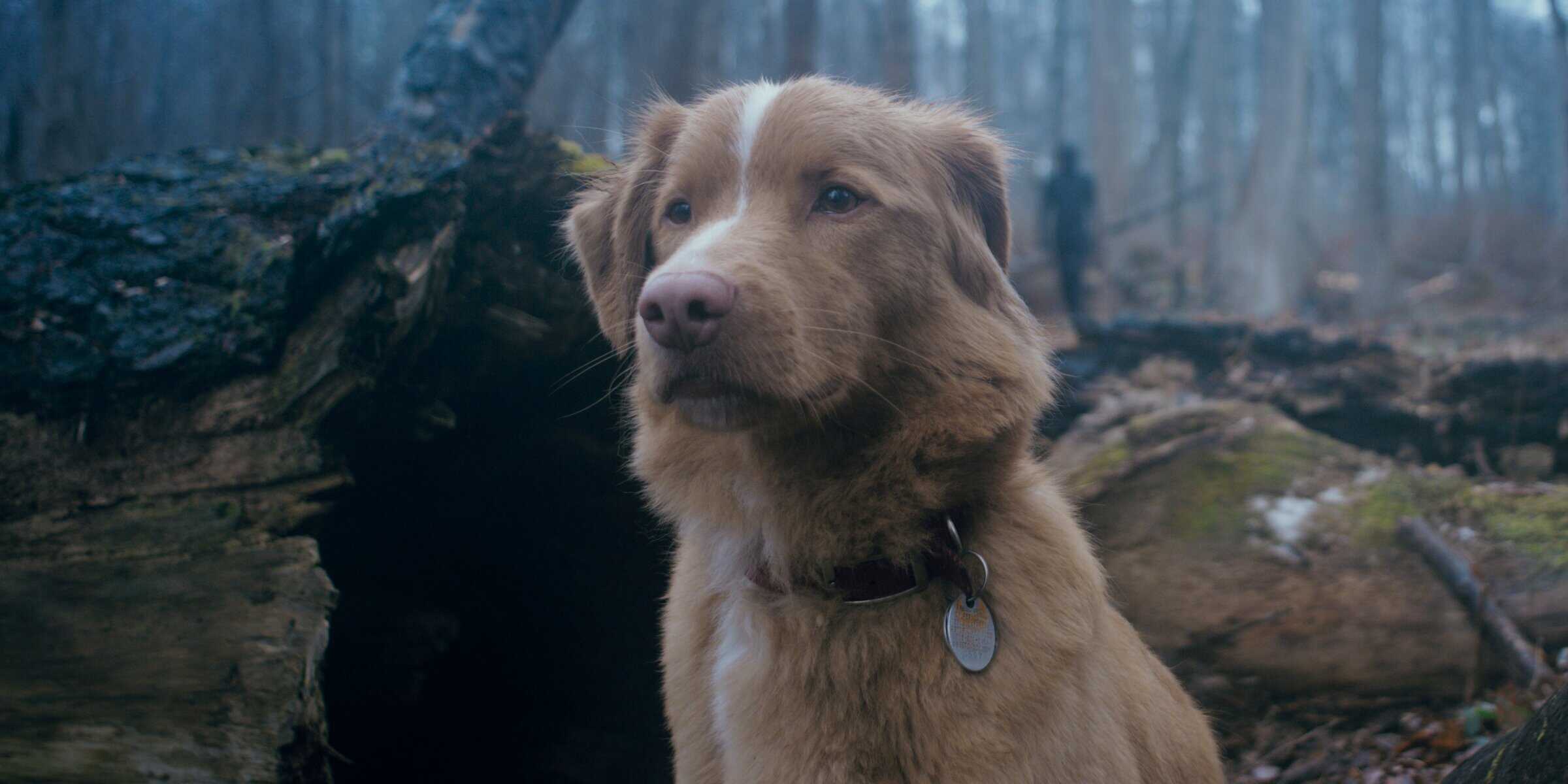
Good Boy is a thrilling, conceptually ambitious, and visually unique horror film about a haunted house from a dog’s perspective. It’s both an astoundingly creative horror subversion and a heartbreaking separation between a human and their unquestionable best friends. It’s as much about loss, familial trauma, and loyalty as it is about a dog seeing a ghostly, muddied figure crawl around. Indy (played by director-co-writer Ben Leonberg’s adorable retriever of the same name), a loving house dog, lives with his sickly owner, Todd (Shane Jensen), in New York City. Afflicted with a rare genetic lung disease, Todd has such bad suffocation episodes that his sister, Vera (Arielle Friedman), has to constantly check in on him. After his most recent and most costly breathing fit, and tired of the daily suffering, Todd decides to go to his and Vera’s grandfather’s abandoned rural house—a place well known for being haunted both in and outside the family, despite Todd’s disbelief in such superstitions. Upon arrival, Indy notices things Todd can’t even see or hear: movement in the shadows, a dog whimpering elsewhere in the house, faint grovelly grunts, black sludgy hands passing through dim corners, and more begin to haunt Indy’s senses. As he begins piecing together the home’s paranormally repetitive past—finding bits of what may have happened to Bandit and envisioning Todd’s grandfather (Larry Fessenden) suffering a similar affliction years earlier—all he can do is whimper, bark, and physically be there with Todd. With nothing but his heightened senses, he must either watch his friend be consumed by the demon or save his best friend from his destined doom.
There are so many treats which Good Boy allows viewers to sink their teeth into that it’s hard to pick where to start. Aside from the top-notch darkened, dog-eye-level visual spectrum with which viewers see almost as little as the dog can (making it all the more scary) and chillingly creative jumpscares, Good Boy finds the universality in people’s interpersonal issues, and how they themselves need to want help in order for their lives to improve. For example, after the movie’s suffocation episode opener, Vera continuously checks in on Todd over the phone as Indy stares on worryingly, both adamant about Todd’s safety especially after he explains his whereabouts: “You just have to promise me that at the first sign of relapse [at Grandpa’s house], you’re gonna get in that car and you’re gonna come home.” As many would, Todd merely shrugs it off, unworried about such “relapse” because “I needed a break” away from the city and his old, dysfunctional life: “Oh, Vera,” he says over and over. Todd’s dynamic with Vera, thus, becomes that of any close relationship where one party struggles with such a large, damaging issue that it leaks into everyone else’s lives. With Indy, it’s similar, but differently given he’s physically present but unable to communicate. As he yelps for Todd’s attention only to get “Not now, boy,” over and over, he can do even less to help Todd and more to feel like a nag. It’s a tough position to be in.

If Todd’s “relapse” feels more reminiscent of a drug addiction given the wedge he drives between himself and his loved ones, though, that’s because the external effects are the same. Todd’s reaction and his and others’ word choices, like referring to his episodes as relapses, make his lung disease feel like it could be anything else as well, from addiction to depression. He doesn’t work, he sits around watching TV, he walks and loves Indy, and coughs lying down when he can’t do those other things. There’s even an instance where he’s deliriously wheezing with bandages in his arm almost like he just took heroin. In many such cases, those who want to help become increasingly desperate to ensure the afflicted’s well-being as health continues slipping for whatever reason. In reaction, the afflicted only grows tired of feeling “every day like a patient,” as Todd himself says—thus making self-isolation in seeking a return to normalcy all the more desirable, and that’s exactly what Good Boy understands. “Let’s make a new rule,” a frustrated Todd says to Vera on their umpteenth phone call. “Until I come to you with some kind of crisis, you just lay off. Think you can handle that?” But what Todd doesn’t realize, as is the case for so many others, is that his refusal for help now only seals his fate—an unfortunate slip into the familial pattern that, even without a literal demon waiting to suck your soul dry as soon as it can, is inescapable after a point.
As Indy sees flashbacks of Todd’s grandfather coughing up blood cross-crossed with the demon’s present-day, house-blackening actions, the demon comes across crueler, Todd’s now-expected fate feels all the more tragically predictable, and Indy stands as one of the Good(est) Boys out there. Vera explains how their grandfather like many in his generation dealt with his non-demon issues: “Well, that’s how grandpa’s generation did it, you know? Put on a happy face, even when you’re rotting from the inside out, right?” When Indy flashes back as dear ol’ granddad’s dog Bandit to see granddad coughing blood with no such “happy face” in site before screaming at Bandit to “Run!” as the demon arrives, viewers are both frightened and enlightened about Todd. He’s doing the exact same thing as his grandfather—avoiding his genetically passed down medical issue—which allows the demon to creep in. Regardless, though, as the true main character, Indy presses on. With every kick away, Indy only runs back to Todd; at every cough, he winces in worry; at every demon sighting, he does his best to warn Todd and protect them both. But as Indy eventually sees for himself, no one can help unless the help is wanted.
Thus, Good Boy is both Good at scaring and shattering the heart. Viewers are left as helpless as our noble Indy is when he’s told “You’re a good dog” one last time; it’s hard not to feel at least near-teary eyed seeing Indy learn his doing what he could just wasn’t enough. Pondering the isolationist patterns of those with disabling illnesses and addictions in a fur-covered haunted house, Good Boy is a morosely terrifying piece about why dogs truly are the best: they’ll do whatever they can for us, even when ghosts stop them from doing so. While the human actors could’ve significantly improved upon their performances and not every sequence feels finally consistent, Good Boy’s mostly gutwrenchingly unsettling. For dog film fans, horror fans, and those looking for something fresh, Good Boy has got plenty of bones to chew on.
2025
dir. Ben Leonberg
73 min.
Now playing @ Landmark’s Kendall Square Cinema, Alamo Drafthouse Boston Seaport, and all local AMCs
Streaming on Shudder and AMC+ 10/24