
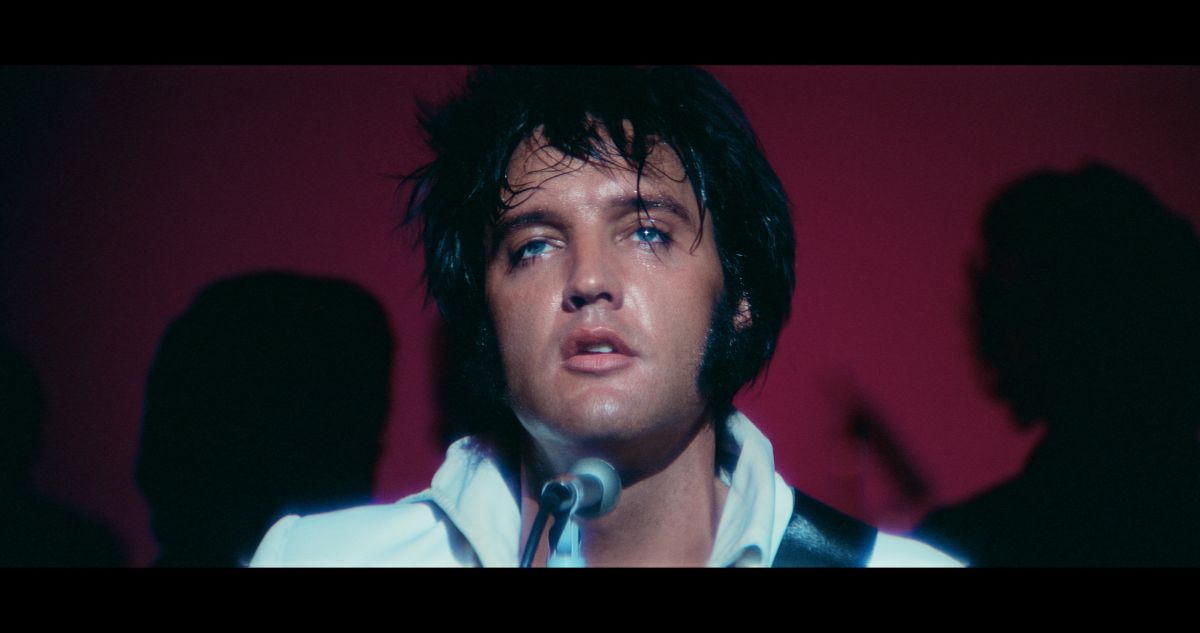
When I reviewed Baz Luhrmann’s hypermaximalist biopic Elvis in 2022, my primary qualm (apart from Tom Hanks’ inexplicable movie-monster performance as Colonel Tom Parker) was the lack of actual Elvis contained within it. Luhrmann succeeded, to be sure, in renewing the King’s mythos for another generation, thanks to Austin Butler’s indelibly wiggly performance and an all-out sensory assault approach to editing which essentially recreated the symptoms of Elvismania in its viewers’ central nervous systems. But in Luhrmann’s attempt to update the King’s mystique to Zoomer sensibilities, Presley’s actual music fell by the wayside; most of the soundtrack is so thoroughly chopped and screwed that one might walk out of the movie without a clear sense of what an Elvis record actually sounded like. Elvis the myth might live on, but will the music?
Luhrmann’s latest film, a companion piece of sorts to his last one, serves as a corrective of sorts to this problem. Constructed from hours of previously unseen performance footage from the King’s Vegas residency, EPiC: Elvis Presley in Concert is a sort of concert film that never was. Think of it as an “Elvis 201” course for new fans converted by Luhrmann’s biopic. If Elvis served as an introduction to the idea of Elvis, EPiC offers a taste of the real deal.
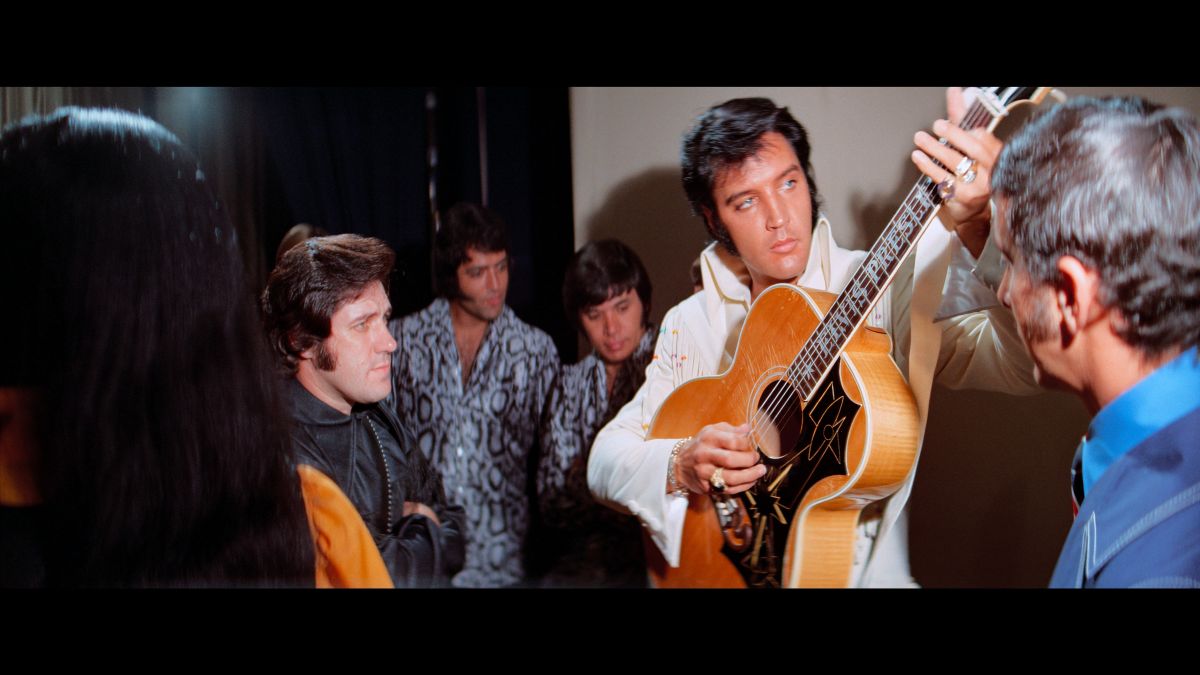
The first act of EPiC follows the same manic structure of the feature film, a barrage of images and soundbites summarizing the first couple decades of Presley’s career: his classic sides at Sun Records, his era-defining waist-up performance on Sullivan, his Army service, his string of dumber-than-dumb movies, and, finally, the comeback which would lead to his extended stay in Las Vegas. Information-wise, there isn’t much here that will surprise someone who’s seen Luhrmann’s film (let alone a seasoned Elvis fanatic), but a good deal of the footage itself has rarely seen the light of day. Much of it is silent 8mm home movie footage, stabilized and enlarged to IMAX size (the effect is a little like the restorations of the Patterson-Gimlin bigfoot film, but with better hair). The video is accompanied by audio from Elvis, presumably sourced from interviews and press conferences, stitched into a single monologue to allow the singer to essentially narrate his own posthumous documentary.
This is all reasonably entertaining, but it effectively serves as a “previously-on” recap to contextualize the performance. Thankfully, the performance itself is truly remarkable— that is, if “performance” is the right word for it.
Earlier I described EPiC as a more unadulterated Elvis experience than Elvis, but in a way that actually isn’t true at all. Most of the concert footage, which Luhrmann discovered while preparing his earlier film, was itself sourced from home movies and b-roll, and as such was captured without sound. EPiC, then, is a bit of a Franken-Elvis affair, pairing the restored footage with preexisting audio elements from the same time period. It’s a work of cinematic sleight of hand, aided both by technological advancements and good old-fashioned Kuleshov trickery.
Perhaps the greatest compliment I can bestow upon EPiC is that, had I not told you all of the above, you probably would never have noticed. Luhrmann and his team of studio wizards (many of whom have also worked with Jackson) have spent years ensuring that their years of work are all but invisible, and the lack of seams is a testament to their craft. There are moments, to be sure, which in retrospect don’t hold up to scrutiny— fades between concert and rehearsal footage with no break in the audio, and cuts where Elvis’ costume mysteriously changes like the Happy Days extras in the “Buddy Holly” video. In the moment, however, it’s difficult to perceive the film as anything but a document of one of the 20th century’s greatest performers. The result is simply a great concert film— even if the concert, as such, never actually occurred.
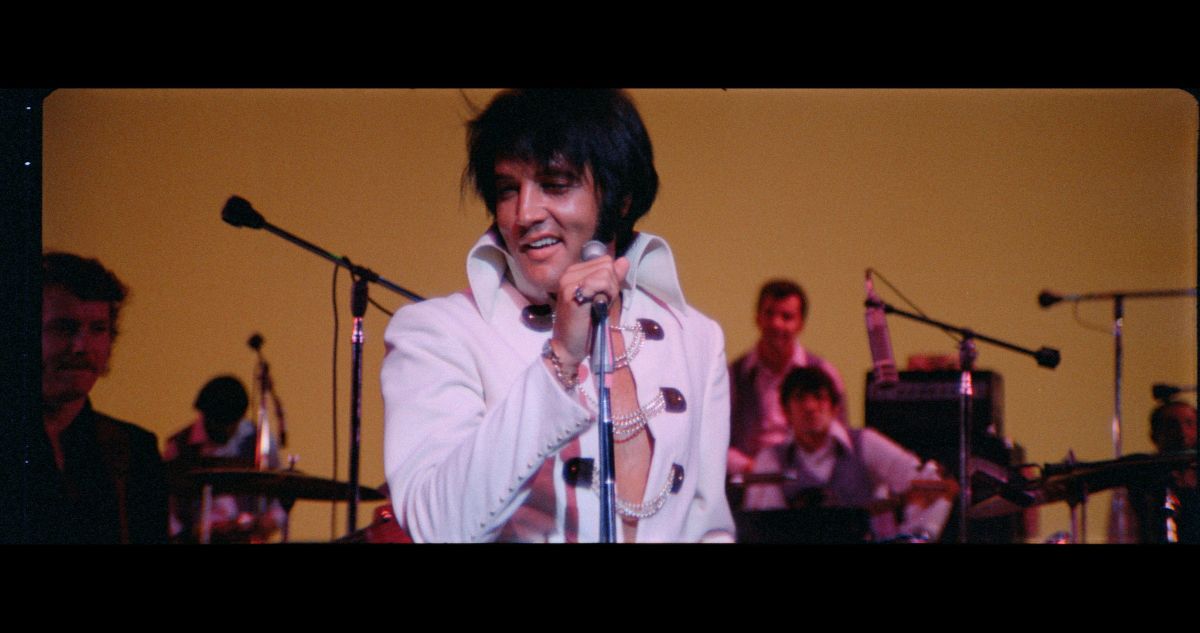
So let’s say, for the sake of argument, that you haven’t read anything about EPiC, up to and including this review thus far, and walk into the theater with no concept of how the sausage was made. What you’re left with is a snapshot of a storied artist at a particular turning point in his career. Hipster orthodoxy has long held that Vegas Elvis is an inferior beast to Sun Elvis, a bloated, commercialized burlesque of a once-dangerous phenomenon. EPiC, however, presents compelling visual evidence that the man still had it. There are shots of Elvis, stalking the stage as his band vamps behind him, with a downright menacing look in his eye worthy of his most punk-rock disciple, Cramps frontman Lux Interior (in fairness, this may just be because Elvis and Lux were on some of the same drugs). Elvis sings songs by Dylan and the Beatles and Paul Simon, which on paper should be cringeworthy, but isn’t; Elvis and his backing band find the soul in these numbers, and you can tell he truly connects with the lyrics. The Elvis of Las Vegas might not have been the symbol of rebellion he had been in his youth, but man, he was still something.
Of course, this is still a Baz Luhrmann picture, and as such there are plenty of moments which traipse right up to the line of being much too much. While the presentation of the music is largely faithful to how it would have been heard at the time, there are a few spots where Luhrmann can’t resist throwing on a little creepy-trailer-music echo. A performance of “Polk Salad Annie” is inexplicably peppered with ghostly images of Elvis as a child, fading in and out of each other like some demented PowerPoint presentation. And the whole thing ends with a poem by fucking Bono of all people, a solid two decades after such a thing could be deemed remotely acceptable.
There’s plenty more that could be said about EPiC, but, in the end, most of it would be beside the point. At this point in time you probably already know whether the idea of an IMAX Elvis concert film is something you would want to see. Even if you don’t, however, you may find yourself caught up in the experience. Elvis is one of those singular entertainers, like the Beatles or Franz Liszt, whose mere presence inspired physical mania, and while I personally did not tear out my hair watching EPiC, it provides close enough of an experience that it’s hard not to understand why one might have. The question of “Is Elvis alive?” has been asked constantly, with varying degrees of seriousness, more or less since the moment the King was found dead on his throne. Thanks to Baz Luhrmann’s efforts in the 2020s, it’s clear he will live on for at least a little while longer.
EPiC: Elvis Presley in Concert
2025
dir. Baz Luhrmann
96 min.
Opens in IMAX Thursday, 2/19 @ AMC Boston Common & Assembly Row
Opens in standard digital 2/27 @ Coolidge Corner Theatre and elsewhere