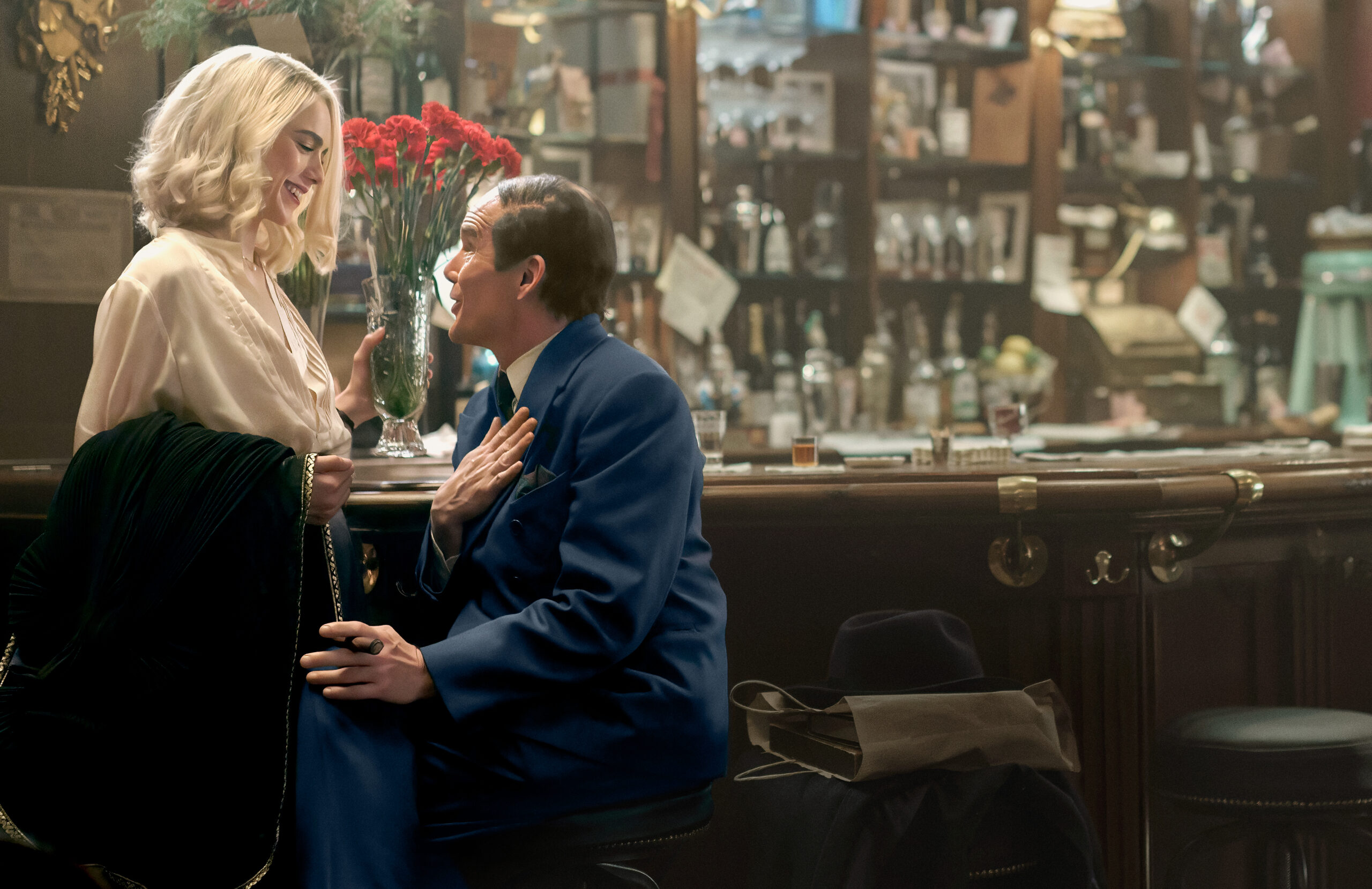
Blue Moon is a funny, depressing, cathartic, and intimate look into the life of American musical comedy lyricist Lorenz “Larry” Hart (Ethan Hawke)—famous for songs such as “Lover,” “My Funny Valentine,” and, most notably given this film’s title, “Blue Moon”—or rather, a look at him reflecting over his sorrowfully unremarkable life in a bar. Linklater’s instinct for capturing the unyieldingly organic shines through, in large part, thanks to Hawke’s magnetic, zippy, and unpredictable performance as the oft-forgotten lyricist. On March 31, 1943, the night the famous musical Oklahoma! opened across the U.S.—created by the real musical partner Hart worked with for 24 years, Richard “Dick” Rogers (Andrew Scott), alongside soon-to-be more famous (and also real) lyricist Oscar Hammerstein II (Simon Delaney) with none of Hart’s involvement for the first time—Larry goes to the bar in the famous New York Theater District restaurant Sardi’s, where the Oklahoma! celebration will take place. Being well acquainted with the establishment’s fictitious bartender, Eddie (Bobby Cannavale), Larry approaches him and discusses, in exquisitely verbose detail, his life, his work, and an exciting romantic potential with his new protégée, Elizabeth Weiland (Margaret Qualley). While he’s a mightily entertaining speaker and comedically self-deprecating, as others like Rogers and Leiland pass through, his speeches slowly slip into feeling like cover-ups for insecurity. He drains the bar’s whiskey, spouting desperate pleas for recognition and love as he goes unnoticed—and unloved—yet again. Preceded by the morose imagery of his pneumonia-induced paralysis causing his eventual demise seven months later, Blue Moon paints the same-named song’s writer as “… the saddest man I ever knew,” according to then-famous cabaret singer Mabel Mercer. If only Hart could know his worth—both in song and in the painful relatability of his experiences and self-image—Linklater and Hawke elegantly translate.
Everyone is alone, to a certain extent. As close as humans can get with parents, kids, friends, pets, or partners, no one can experience our thoughts, exhale our breath, or be hurt by our feelings together with us. In many respects, Larry is portrayed as the loneliest among us, even though his isolation is partly self-imposed. As much as he’s a hoot and a holler, filled with media references recognizable even now—”Ooh, that’s my least vulnerable spot!” Larry says, almost hopping with giddiness at Eddie’s fake threat of a gun aimed at his dick—he anguishes in much self-doubt and pity: “Best line from Casablanca: ‘Nobody ever loved me that much.'” Most of his storytelling revolves only around his triumphs, his downfalls, and everything in between, whether professional or personal. There’s no room for anyone else, beyond being talked at almost hysterically: “I was already writing lyrics in my head! I couldn’t stop!” he says after insulting his old partner’s new (and most commercially successful) show. A chatterbox to the extreme, albeit one well-versed in the English language and media references. In this way, Larry’s a textbook entertainer, throwing words together shockingly or cleverly to grip his listeners, regardless of the subject. He’ll satirize anything from then-current World War II and cost-of-living issues to more personal matters such as belonging, sexuality, and self-respect. To him, that’s work—”except I’m not getting paid for it”—even if, for everyone else, he becomes increasingly vain. It’s hard not to see why he may be hard to love “that much,” and Hawke sells it with every line of overembellishment, his shortened gait, bald spot, and black-pitted eyes. The range between extreme satirization and open self-aggrandizement forces Larry’s dynamics to shift between giving entirely to others or taking entirely from them, depending on their relationship with him.

When it comes to the workers, particularly Eddie, he lets his mouth run on. The racist, sexist tendencies of a ‘40s white man ooze through. But it’s when he’s with his new interest, Elizabeth, or even with his old working partner, Dick, that he’s either more even-keeled or entirely devoted to listening—and his insecurities leak out the most. With Elizabeth, despite his belief in romantic potential between the pair, he’s just a listening ear, and she knows it. As she rambles on about an off-screen Cooper, hooking Larry in by saying, “[We had sex on] the night of my 20th birthday. Pretty dramatic. Actually, you could write a play about it,” and goes on about how she’d do anything for him, or about how she adores Rogers’ work and needs Larry to introduce them, Larry’s eyes simultaneously brighten at the sound of a new story and wilt as he realizes his genuine relationship to Elizabeth as a mentor instead of a lover: “You know I love you, Larry. Just not that way,” Elizabeth reaffirms to an almost tearful Larry. It doesn’t help that she and many others also presume he’s a homosexual, but that is merely another of the semi-closeted Larry’s many complex traits. His truly unloved existence comes through most in these moments, as his hopes and dreams continue to get crushed in his allowing others to step on and use him, even when they worry, which also becomes apparent with Dick Rogers.
Dick treats Larry like a problem case or a pitiful tag-along. It’s clear that, for a time, Dick did value Larry’s involvement and viewed him as both a mentor and close friend: “You’re my oldest friend. You’re unique…. You were the wise old man of the mountain” whose work “was always brilliant.” However, with every “brilliant” new idea or bit of banter Larry wants to pass onto Dick that night, Dick scoffs, shrugs him off, or reminds him of his current problems: “So, uh, you up for that? You feeling healthy? Is that something you could take seriously?” he asks in reference to Larry’s drinking problem up until now only referenced by Eddie’s hesitance to give Larry more whiskey shots. A disheveled, drunken, and not-so-subtly hurt Larry responds with fake assurance that he’s “on the wagon,” even as whiskey aroma pushes out of his mouth and he becomes increasingly irritable about Dick’s newfound success. As he insists he won’t go back to Doctor’s Hospital for further treatment—the very same institution where the real Lorenz Hart died shortly after that dreaded opening night—and implies that he and Dick “can do something so much more emotionally complicated than needing to pander [to mindlessly casual viewers],” his being washed up, forgotten, and bitter about such fate becomes clearest. As much as Larry seems a sore loser in his “pandering” about the show’s lack of integrity, the career blow’s pain after a quarter-century of working to little avail is a familiar pang many feel in life, whether they’re in Hollywood or elsewhere. Taking those significant risks usually doesn’t pay—the spotlight in any scenario is only so big—and Larry embodies the regret, isolation, and self-destruction that can come with such big misses.
Thus, while Blue Moon‘s single subject and setting can wear down Richard Linklater’s newest picture’s enjoyability with a slow, occasionally monotonous drawl to the tragic finish line, it’s predominantly a resonatingly interpersonal gaze into a man often forgotten in musical historical contexts, whose struggles touch beyond the picture’s big-screen limits. For fans of Linklater & Hawke, musical cinema, Margaret Qualley, and bittersweet dramedies, Blue Moon will surely touch the heart as much as it tussles in laughter and longing.
2025
dir. Richard Linklater
100 min.
See it in theaters now @ Capitol Theatre, Dedham Community Theatre, West Newton Cinema, and AMC Boston Common