“In the beginning was the Word, and the Word was with God, and the Word was God” opens the Gospel of John. Azrael, the American-Estonian co-production from E.L. Katz via Shudder, adulterates that famous literary opening and flips it upside down. The rapture took place — a zealous Evangelical belief that at Christ’s second coming, all Christians will be snapped away Thanos-style and taken to God while non-Christians will undergo a period of intense tribulations (the timeline of these events is as debated as “pop” vs. “soda”) — and a cultic community of votive mutes runs things now. The tongue urges sin, so they naturally remove the ability to speak from unwilling sinners (and leave scars in the shape of crosses on one’s neck in the process). You read that right: Azrael takes place in a post-rapture society. Oh, and there are burnt cannibalistic monsters and human sacrifices.
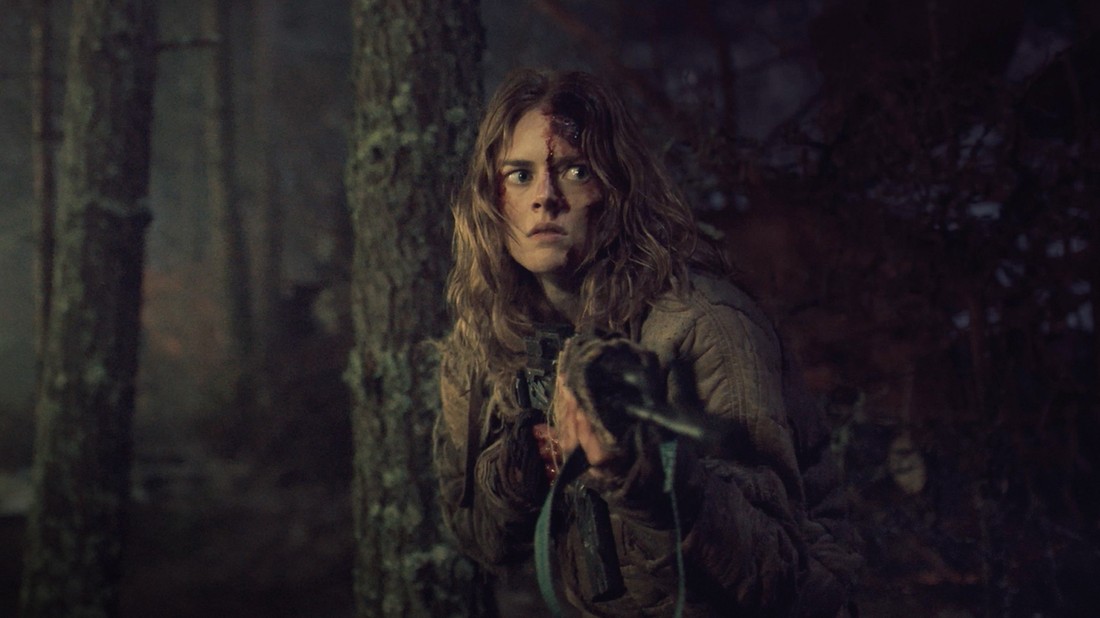
The religious allusions go deep (as the name of the film alludes). There’s even a scene in which Azrael (Samara Weaving) rises victorious out of a hole in the ground. She meets a man, the only speaking person in the film, seemingly from nowhere, who talks to her in a tongue she doesn’t seem to understand and dies to commence the third act. The man might be more John the Baptist than the Baptist himself. The wendigo-zombies hunt the humans like the Pharisees in John. There is even a Black man (Nathan Stewart-Jarrett), Azrael’s partner, nailed through the palms of his hands to a tree. The image could have provoked ingenious symbolism by bridging the cross and the lynching tree but is forsaken in actuality since the filmmakers appeared unaware of that potential.
Still, Azrael doesn’t tease a religious premise and yank the football away like much of modern horror; the horror in Azrael depends on its creative freedom with religious myth by begging the question “What if the Gospel was an apocalyptic action story separated from the Christological promise of eternal life?” The worship services superficially resemble Christian worship from our world only they lack sermons/homilies, the words of transubstantiation, and Gospel readings … so, the worship will feel off to viewers coming from Christian-influenced cultures, and that disruption generates most of the film’s attempted scares. A post-rapture society with no words and no Word.
Don’t get your hopes up, though. Azrael is significantly less cool than the premise sounds. Ready or Not obviously influenced Katz’s casting of Samara Weaving, since she plays basically the same role here to a weaker effect and under a different name: she runs around alone and in silence evading danger, trusting no one. It, too, is a very bloody film. Unlike her breakout performance, Weaving rarely feels like she is in danger, and the moments she does flee as quickly as she does. The action works in the sense that the choreography is, from a technical standpoint good… but to what effect? The action, without danger, grows into an unseemly bruise on the entertainment value. Seeing as she spends the whole film running from the same problem and shows minimal character evolution, it’s even tempting to wonder if the screenplay began as a short and some producer convinced IFC Films and Shudder it was something more than it was.
The Northern Estonian woods look like they might actually be haunted, and make for a great on-location shoot. And other than the film’s top-billed actors, most of the cast and crew come from the small Baltic country. Cinematographer Mart Taniel (November; The Invisible Fight), one of the country’s most commercially successful working DPs, clearly has more talent than this film knew what to do with. The quieter and darker the scene, the more his eye stands out. Still, there was something off-putting with the images. For a film with very few comprehensible words, Azrael makes little attempt to evoke the visual grammar of generations of silent films and, in another lost opportunity, regretfully shoots the film just like any other contemporary low-budget horror film.
Azrael
2024
dir. E.L. Katz
85 min.
Preview screening Monday, 9/23, 7:00pm @ AMC Boston Common
Opens for regular showings Friday, 9/27
Joshua Polanski is a freelance film and culture writer who writes regularly for the Boston Hassle and In Review Online. He has contributed to the Bay Area Reporter, Off Screen, and DMovies amongst other places. His interests include the technical elements of filmmaking & exhibition, slow & digital cinemas, cinematic sexuality, as well as Eastern and Northern European, East Asian, & Middle Eastern film.