
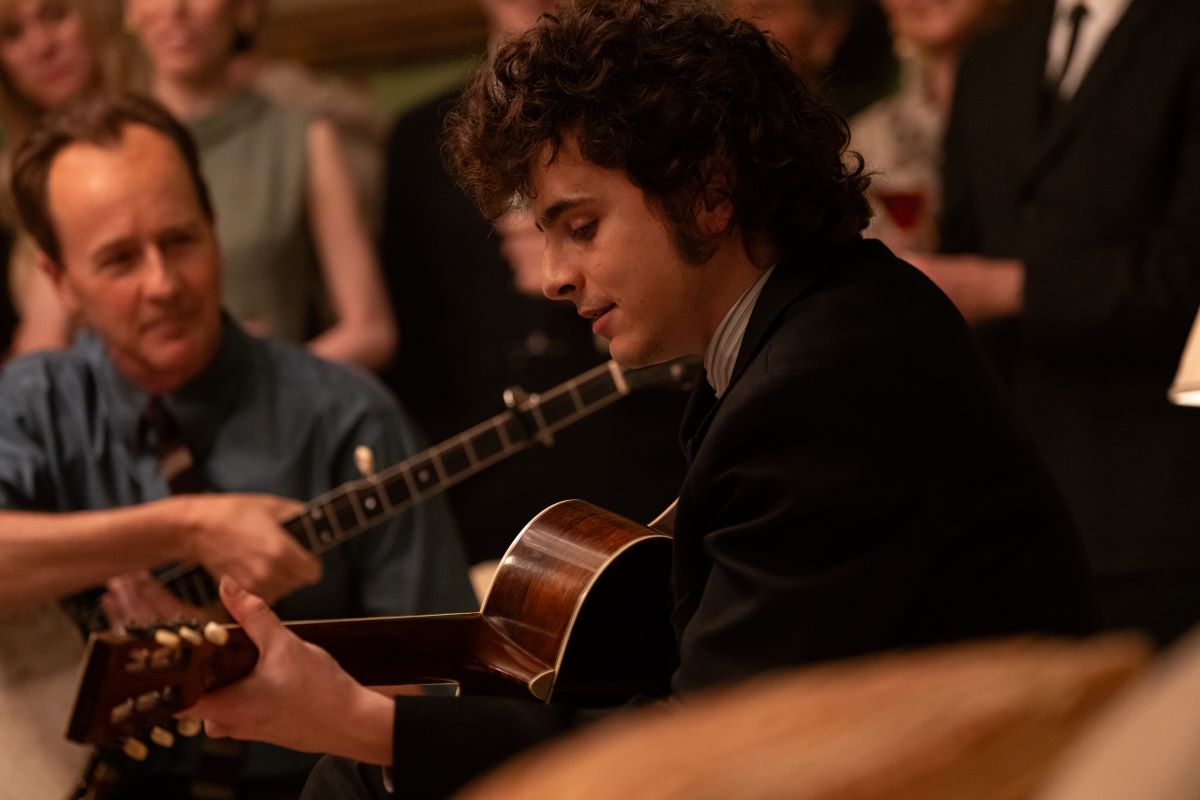
Cinematically speaking, Bob Dylan presents a seemingly unsolvable problem: despite being one of the most famous musicians of the past hundred years, the former Robert Zimmerman has spent so much of his career reinventing himself and hiding behind various guises that it’s hard to know who he is. Even David Bowie, for all his constant shape-shifting, always came off in interviews as an affable and generally knowable bloke; Dylan, by contrast, remains stonefaced and opaque, as diffuse in person as the metaphors in his lyrics. No less a talent than Martin Scorsese has spent two documentaries trying to untangle the Dylan enigma; the first, the two-part, four-hour No Direction Home, only gets through the first five years of the singer’s career, while the second, Rolling Thunder Revue, freely mixes fact and fiction (one of the interview subjects, former US Representative Jack Tanner, is actually a character created by Robert Altman for a 1988 TV miniseries). This problem is compounded for anyone attempting to make a Bob Dylan biopic; how does one dramatize a “true story” which is constantly being rewritten and redacted by its subject?
This is not, however, the biggest problem faced by A Complete Unknown, the steadfastly competent new Dylan biopic opening this week in theaters everywhere. Rather, it’s the fact that the Bob Dylan problem was more or less satisfactorily resolved nearly two decades ago. Todd Haynes, in his 2007 quasi-fictional whatsit I’m Not There, managed to craft a satisfying Bob Dylan biopic by fracturing both the biopic format and Bob Dylan himself. Rather than cast a single Dylan in a “definitive” narrative, Haynes cast six, ranging from Heath Ledger to Cate Blanchett to 13-year-old Black actor Marcus Carl Franklin. Each of Haynes’ actors represents a different aspect of Dylan’s legend, their segments deliberately contradictory. Haynes’ film was largely taken as a direct rebuttal to Walk the Line, director James Mangold’s crowd-pleasing 2005 biopic of Johnny Cash, and the glossy, neatly packaged story it presented. There could never be a “real” Bob Dylan biopic, I’m Not There seemed to say; his story could never fit into a traditional Hollywood narrative.
Of course, Hollywood remains Hollywood; an envelope labeled “Bob Dylan biopic money” was never going to remain on the table for very long. Seventeen years after I’m Not There, we finally have a “real” movie on the subject– directed by Walk the Line’s James Mangold, no less. It is a perfectly fine film about a cultural figure who, for all his highs and lows and assorted personae, could never in a million years be described as “perfectly fine.”
Like No Direction Home, A Complete Unknown confines itself to the first era of Dylan’s career, from his arrival in Woody Guthrie’s hospital room as a 19-year-old hitchhiker to his notorious “goes electric” set at the 1965 Newport Folk Festival. Our Dylan this time around is Timothée Chalamet, who can’t sing, yet perhaps sings too well to play Bob Dylan. Chalamet is no Cate Blanchett, but his pretty-boy blankness here works in his favor. Chalamet’s Dylan is, frankly, an annoying little shit, albeit one who happens to be gifted with the ability to pen some of the greatest songs ever written– a coffee house Lisan al Gaib, as it were. When he wants to, he exhibits flashes of a startlingly funny wit (when a hospital orderly admonishes him that Guthrie’s roommate needs rest, he looks at the comatose patient and deadpans, “I don’t think it’s workin’”), but he mostly slinks and slouches, smirking and loafing around his apartment and not taking out the trash even after his girlfriend reminds him. Like the real Dylan, it’s tough to tell what he’s thinking– and if he weren’t so supernaturally talented you probably wouldn’t be interested anyway.

This Side of Bob Dylan– that of the eternal Manhattan guitar-slinging fuckboi– is emphasized via the film’s obligatory Betty-and-Veronica love triangle. In one corner is Elle Fanning’s down-to-earth “Sylvie Russo,” a fictionalized version of Dylan’s real-life girlfriend Suze Rotolo (her name apparently altered at the request of Dylan himself). In the other, the equally great singer-songwriter Joan Baez, played well by Monica Barbaro. These relationships are necessary to the film, both because of the dictates of the form and because Dylan himself remains such a blank slate. It is disappointing, then, that neither relationship feels as fully fleshed out as it should. Sylvie is more or less the film’s perspective character, but after the initial romantic whirlwind she isn’t given much to do but sigh as her man outgrows their love and cry whenever she hears Baez on the radio (not to keep harping on I’m Not There, but Charlotte Gainsbourg’s character in that film, an amalgamation of Rotolo and Dylan’s first wife Sara, feels far more nuanced and lived-in with only a fraction of the screen time). Barbaro, for her part, nails Baez’s cool intelligence and angelic soprano, but she is primarily deployed to testify to Dylan’s brilliance; worse, the film occasionally intimates that Baez was a rider on Dylan’s coattails. One senses that Mangold is grasping for the grand central romance that gave Walk the Line its soul, but, Dylan being Dylan, there simply isn’t much to work with on that front.
Fortunately, Mangold does find heartbreak in this story, but it isn’t Sylvie’s, or Joan’s, or even Dylan’s as he holds vigil over his dying hero Guthrie (played in a moving, wordless turn by Scoot McNairy). Rather, it is that of elder folkie Pete Seeger, who serves as Dylan’s mentor and early cheerleader. Seeger, as played by Edward Norton, is both a true radical (we first see him defending his leftist politics before a McCarthyite judge, then leading reporters in a singalong on the courthouse steps) and a genuinely good and kind person; he loves Dylan as a protege, but also because he’s just an all-around sweetheart. Norton, who to my eyes is at his best when he’s playing comedy, portrays Seeger as a square but lovable dad to Dylan’s rebellious youth, who finds himself baffled and disappointed when his mentee begins to chafe at his “folk singer” label– think Salieri by way of Mr. Rogers. Even when we reach the pair’s inevitable clash at Newport, Norton hits notes of heartbreak rather than rage; he brings coffees to Dylan’s hotel room and begs him not to upend their little folkie community. We know, of course, that Dylan ignores him, and that both Dylan’s artistry and music history will be better for it, but in that moment, looking into Norton’s puppydog eyes, we understand where Seeger is coming from. This is A Complete Unknown’s greatest trick: it is a Bob Dylan biopic that almost makes us root for him to stay acoustic.
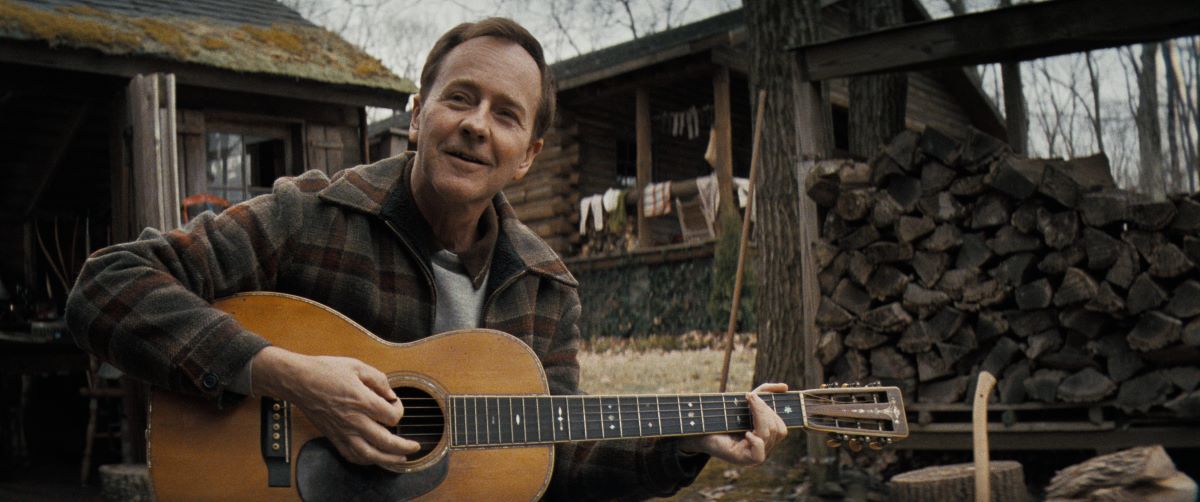
And it’s not without tricks! There is a reason, after all, that Walk the Line remains the go-to point of reference for this strain of middlebrow music biopic nearly two decades later: Mangold can sell this sort of material. Here, as in that film, the director knows exactly how to frame a rise-to-stardom story. He knows when to print the legend versus the truth, and he’s great at filling the margins with caricatures of various cult figures and peripheral characters (he even brings back Johnny Cash for good measure, here played in his amphetamine era by a scene-stealing Boyd Holbrook). He’s certainly a pro at restaging iconic concerts with enough gusto to make you run to Newbury Comics and buy a Greatest Hits album on 180g vinyl. To paraphrase another songwriter on Seeger: He sure gets you singin’ those songs!
All of this is to say that, as music biopics go, A Complete Unknown is fine. Perfectly fine! It’s a film you can bring your parents to and probably have a pretty great time (it’s certainly a safer bet than Babygirl or Nosferatu, though I suppose I don’t know your relationship with your parents). If I’m going hard on it, it’s only because it’s Dylan, man. I don’t even consider myself a “Dylan guy” necessarily, but I acknowledge that he represents one of the essential myths in the annals of American hipsterdom; to see him rendered in a medium as square as the conventional music biopic just feels fundamentally wrong somehow. A Complete Unknown amply achieves what it sets out to do, but it ultimately feels a little like a grade school translation of The Odyssey: the plot is there, but it’s missing the story.
A Complete Unknown
2024
dir. James Mangold
141 min.
Now playing @ Coolidge Corner Theatre, Somerville Theatre, and theaters everywhere

Hey Oscar, Thanks for your reviews. I agree completely with your assessment of A Complete Unknown. I feel it’s a glossy take on Dylan but can’t really crack the nut of its subject due to tge decades of obfuscation by endless articles, interviews and Dylan himself, all composting a big pile of confusion. It’s presented as “entertainment” but so much is “unknown” to reflect on the title. and thanks for checking in to my show most weeks, it’s nice to know some people actually pay attention… best, Fabio