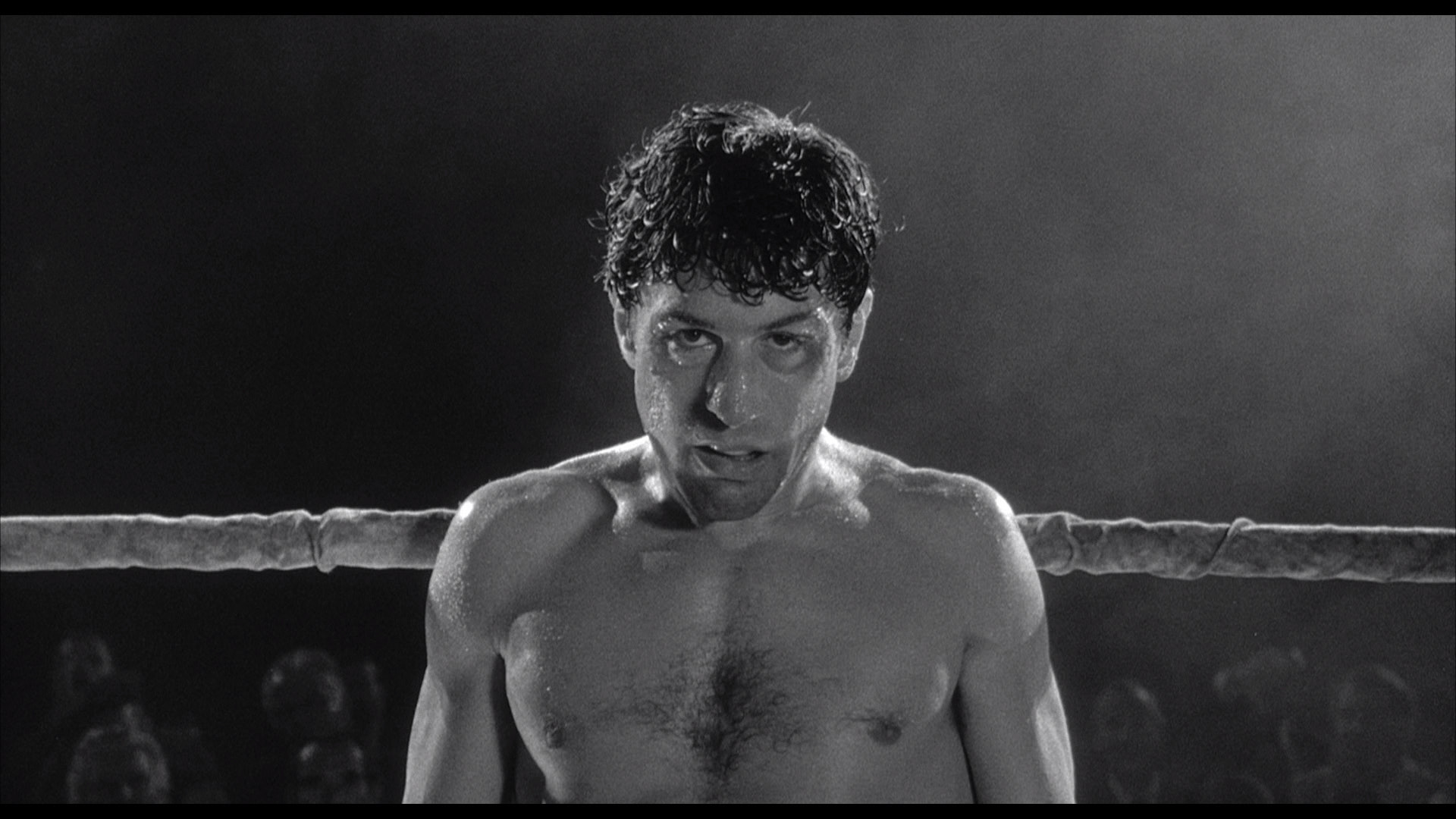
Jake LaMotta died last September in Aventura, FL. He was 95. As I watched Raging Bull for the second time, I was shocked to learn he lived to be that old after being reminded how awful he must’ve had it in the ring. LaMotta’s memoir is brought to life by Martin Scorsese, who, at that point, had directed Alice Doesn’t Live Here Anymore, Taxi Driver, and New York, New York. Four years before its release, we had the spirit-rejuvenating movie, Rocky. Raging Bull couldn’t be more different if it tried. Where one film has you cheering for Balboa, the other will have you hoping that others can get away from LaMotta.

The first act plays to Scorsese’s strengths; cursing, schmucks in New York, violence, and tough guys. No matter the scene, the audience is sucked into LaMotta’s world, which is easily recognizable. Only the toughest dogs get what they want, no matter what it is or how high the cost. Scorsese’s direction and control of both the fights and crowds is really something. LaMotta’s fights are raw and brutal. As he says in his opening monologue, he wants to entertain. This animalistic behavior is the best kind for viewers. Going to watch a match is a cathartic experience. It’s made even more cathartic because of the setting.Scorsese chooses to present LaMotta’s neighborhood as an out-of-the-ring playground, with neighbors yelling at LaMotta, cussing every other word, and managing some secret business others shouldn’t know about. It’s where it all happened, and after all, the Bronx is the Bronx.
Raging Bull asks you to go along for the ride with characters who are awful. Robert DeNiro’s performance is outstanding. Tough guys are easy to fall in love with them if done well. I’ve always admired DeNiro’s ability to perform a likable, hateful character. There’s never a moment where we see LaMotta think for others. He wants the gold, and he’s going to get it. He desires the world, and he does everything for it. I have mixed feelings about his decline from the world that made him who he is. Watching it unfold makes you think about the toxicity of that pursuit for entertainment, and what being the champion does to a person. The only way we can root for LaMotta is for him to get better, though we know it can’t be done. I’d be interested to find out how accurate the film is to real life. Scorsese and company read the memoir of the man extensively, and had communication with LaMotta himself.

The way the real LaMotta remembers it all is like a black-and-white film, as he describes it in the opening of his memoir. That’s not the only reason Scorsese chose to present it in black-and-white, but it does symbolize the haze of a man who has endured so much, both physically and mentally. The price to entertain the world and be one of the fighting giants pits a man against himself at many points in his life. LaMotta bobs and weaves as much as he can throughout Raging Bull, only to be knocked down hard when the hook comes swooping in. An iconic film in Scorsese and DeNiro’s filmographies, and a film that stands out in a time where boxing films were the rage.
Raging Bull
1980
dir. Martin Scorsese
129 min.
Screens Sunday, 1/28, 3:45 & 9:15 @ Brattle Theatre
Double feature w/ The Hustler
Part of the ongoing series: Who’s That Cutting My Film?