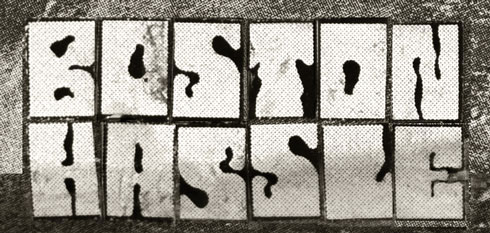
There is no such thing, in conception at least, as “background” in the films made by the legendary husband and wife team of French Germanophiles Jean-Marie Straub and Danièle Huillet. While not unbeautiful, the pair’s productions tend toward a flatness of both field and affect that allows for an interplay of equally important elements instead of a hierarchy of emphases embedded within an illusion of depth.
Gilles Deleuze cited the films of Straub-Huillet, along with those of Syberberg and Duras, as emblems of cinema’s singular capacity to deal concurrently but distinctly with audible and visible phenomena. There’s nothing inevitable about it, according to Deleuze–cinema doesn’t have to effect this separation, but where it appears it is a necessarily cinematic effect, unavailable to other media except by way of appropriation.
The resulting cycle of disruptions and resumptions of audiovisual synchrony allows for the elaboration of a complex counterpoint between narrative surfaces and the “underground” currents hidden in plain sight and sound alongside them. The HFA’s exhaustive retrospective – Not Reconciled. The Cinema of Jean-Marie Straub and Danièle Huillet – runs from now till the end of November, granting us access to the iconic filmmakers’ whole dizzying range of variations upon a decidedly idiosyncratic dialectic.
Straub-Huillet epitomized this dialectic not only in their art, nor in their politics (as expressed in their art), but also in how they performed their relationship as co-auteurs; a public partnership of hyphenate double-personae that, like the dialectic itself, seems to have been both confining and liberating. Straub–as garrulous and didactic as so many of the talking heads that appear in his films–tends to dominate the surface of the pair’s interviews, but Huillet’s facial expressions and occasional interjections sporadically re-route and revive exchanges that might otherwise wither into tedium.
Amongst the most dazzling – and representative – of the dozens of films featured in Not Reconciled is the couple’s first feature-length production, 1968’s Chronicle of Anna Magdalena Bach, a quasi-biopic that undermines the conventions of that most conventional of genres with refreshing yet radical simplicity. Rather than deploying J.S. Bach’s enormous musical output as background to, or ornament upon, a recounting of his life, it gives us, well, his music – recorded live, played on period instruments and performed in period costumes – AS his life, with occasional commentary and dramatizations serving a subsidiary, contextualizing role to the main event(s).
Later films, particularly those addressing history, myth, or politics, often do something similar with dialogue, which is generally delivered by non-professional actors with a deliberate, Bressonian absence of dramatic inflection intended to emphasize words and ideas over the potentially prettifying obfuscations of personal psychology. But Straub-Huillet’s well-earned reputation for intellectual rigor rarely prevented their works from commanding a powerful fascination, sure to be on ample display all autumn long at the HFA.
https://www.youtube.com/watch?v=jU-etI-18JQ
Not Reconciled.
The Cinema of Jean-Marie Straub and Danièle Huillet
9/16-11/28, 2016
Harvard Film Archive
Carpenter Center
24 Quincy St.
Cambridge, MA
02138