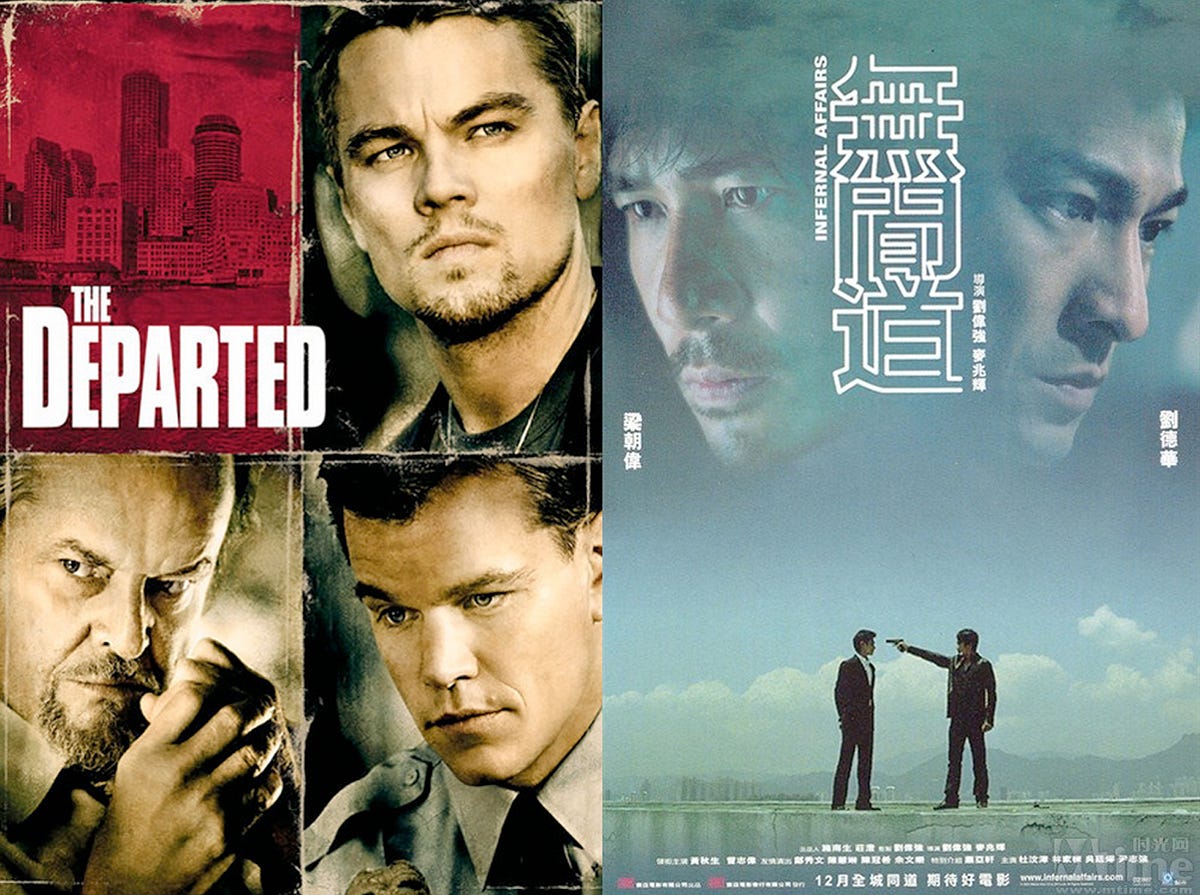
Both The Departed and Infernal Affairs are exceptional crime-thriller sagas revolving around undercover cops and cop-disguised gangsters. With Martin Scorsese’s Boston-based classic serving as an Americanized remake of the Hong Kong-produced Affairs, each film delivers a cultural, interpersonal, and religious weight to their characters actions that muddies who is the real good guy and bad guy of both films (though Departed answers that question much more clearly).
The two films follow virtually the same story. Affairs sees triad gang member Lau Kin-ming (Edison Chen in Kin-ming’s younger years and Andy Lau for the rest of the film) get sent into the Hong Kong Police Force as his triad boss Hon Sam’s (Eric Tsang) mole. Concurrently, a young cadet named Chan Wing-yan (Shawn Yue in his young years and Tony Leung for the rest) is “kicked out” of police boot camp—but in reality is recruited by Hong Kong Police Force’s Superintendent Wong Chi-shing (Anthony Wong) as the force’s undercover worker to infiltrate the region’s most notorious gangs. Ten years later, with Kin-ming now high up in the force and Wing-yan in the former’s gang as Hon Sam’s righthand man, a race to uncover each other before either the gang kills more police or the police apprehend Hon Sam and his crew ensues.
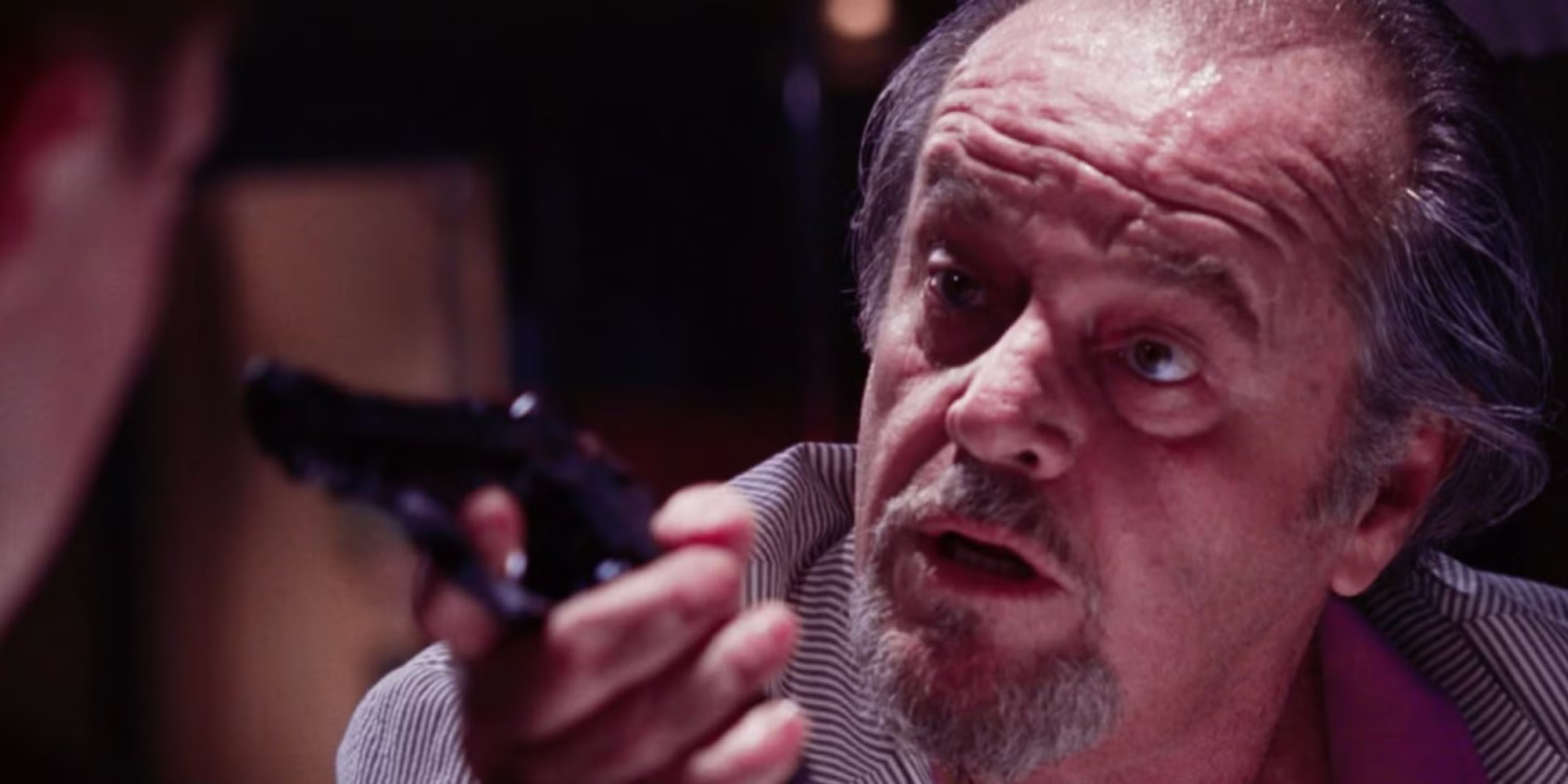
The Departed, meanwhile, is littered with Bostonian slang, accents, and locations, and follows two similar but messier undercover characters. Frank Costello (Jack Nicholson), a misogynistic, racist, and brutish drug dealer, sends in his youngest trusted follower, Colin Sullivan (Matt Damon) into the Massachusetts State Police force. He excels in all written, training, and field tests, eventually getting promoted from Trooper to Special Investigator. Meanwhile, Billy Costigan Jr. (Leonardo DiCaprio), who has deep familial connections with gangsters such as his notorious Uncle Jackie, attempts to join in clearing his own name and reputation, only to get aggrandized for trying before getting recruited as one of the force’s undercover agents to infiltrate Costello’s operation. In a similar game of cat and mouse, but this time with a lot more “you fucking cocksucka”s thrown around, Costigan and Sullivan must expose each other before larger disasters occur. Both films magnificently dot their characters’ journey the psychological tolls they face through such high-stakes chases, with Scorsese proving himself to be one of the only filmmakers worthy of crafting remakes of any kind.
There’s a lot to unpack with both films, but their themes are virtually the same in result. Both start by tying their respective gangs to religion, providing an immediate moral angst to each story unlike what is seen in other crime-thrillers. Affairs, after an on-text definition of the Eight Great Hells believed in Buddhism, starts with Hon Sam and his triad in a Buddhist temple, toasting to their futures through police recruitment: “I started this game five years ago in Tuen Mun’s Tai Hing Estate…. But after only a couple weeks, the cops started bothering us every day. Within one year, six of our brothers died. But Buddha spared me…! We have the power to take fate in our own hands.” As the camera pans over the dozen or so gang members to be recruited into Hong Kong’s police, including the young Kin-ming, Sam’s speech instantly weighs down on the main characters both in and outside the gang. Gang life itself is grueling, as gangsters have to risk their lives and livelihoods as Sam’s many henchmen do countless times in their many shady cocaine deals in back alley restaurants. Someone is going to go through continuous hell—viewers just don’t know who yet—and they do. As Kin-ming moves up in the force, gaining his fake colleagues’ trust, his immoral actions weigh him down, especially as major consequences arise from his actions; as Wing-yan moves through different gangs over a decade, the deeds he’s forced to undertake begin to wear down his conscience and recognizability as a law-abiding and enforcing cop. Each disguised player enters a world of cruelty either by choice or assignment, only to realize the cost later: the loss of any paradise or peace Buddha may promise as they each took fate “in our own hands” as the main duo’s morality grays.

In Departed, religion is set up as the facade main characters both rely on and take advantage of. Costello sees religion as a restrictive practise: “Church wants you in your place. Kneel, stand, kneel, stand,” he explain to a young Colin Sullivan. “You go for that sort of thing, I don’t know what to do for you. A man makes his own way. No one gives it to you. You have to take it.” Much like Affairs, both Sullivan and Costigan take control of their lives, but, unlike in Lau & Mak’s version, making one’s “own way” means a great deal more to Costigan than Sullivan or even Wing-yan and Kin-ming. His criminal connections immediately ousts him in the eyes of recruiters Captain Oliver “Charlie” Queenan (Martin Sheen) and Staff Sergeant Sean Dignam (Mark Wahlberg): “Uncle Jackie was a small-time bookie who tended bar at the Vets in Somerville. He got popped by Nicastro in ‘95…. So, tell anybody up at Deerfield… how your uncle met is demise like that? I got a question. How fucked up are you?” With such a now deeply ingrained self-image of his familialy endowed imperfections, Costigan spends his time desperately trying to prove himself as he entrenches deeper into Costello’s drug syndicate. He bends the law in the name of the law and, thanks to DiCaprio’s envelopingly tortured performance everytime he pleads “I’m not a fucking cop!” to his supposed partners in crime, subconsciously begs for people to see that he is most definitely a cop. As Colin works his way up into a nice position, upper-class apartment and new girlfriend in psychologist Dr. Madolyn Madden (Vera Farmiga), The Departed shows more distinctly who is good and bad, and how torturous being good can be.
This torture, like most other aspects of both Affairs and Departed, are shared. Both Wing-yan and Costigan struggle with their double identities. The former, in conversation with SP Wong, gets told straight up of his blurred moral compass and psyche: “How many times have you been arrested for assault…? You keep beating people up around you. Have you forgotten you’re a cop?” Already defeated by the decade of gritty undercover work he’s faced, Wing-yan looks at SP Wong with weathered, narrowed eyes as he exclaims: “You told me three years. Three years later, it’s three more years. Three years later, it’s three more!” Undercover work is expected to bring hardship both in and out of the field—the latter of which becoming less obviously pertinent upon Wing-yan’s ex’s arrival with a child implied to be his and an attempted romantic relationship with his psychiatrist, Lee Sum-yee (Kelly Chen)—and that’s clear from seeing Wing-yan’s greasy hair, rugged black clothes, and battle-worn skin of wrinkles older than he is. Costigan in Departed experiences the same struggles, though he has less trouble overtly expressing it in his enemy’s girlfriend’s therapy office: “I have panic attacks. I haven’t slept in weeks. I threw up in a trash bin on the way here,” he angrily confesses before demanding pills. As time passes and threats grow, Costigan grows more and more erratic to the point where his lack of sleep and trash bin vomit habits are the least of his worries. Though Wing-yan’s lean towards criminality is more subtle overall, he and Costigan share this ever-present darkness that can consume them if they’re not careful—unlike their filmic comrades who either cover up for themselves (Sullivan) or learn what it means to be good (Kin-ming)
Though Sullivan is a slightly more black-and-white antagonist, Kin-ming’s place in Affairs‘ story muddles as he deals with the personal and professional repercussions of his actions. At work, he causes deaths—none of which will be spoiled here—which, while for typical gangsters isn’t anything unusual, forces Kin-ming to contemplate his fate. On one hand, for example, it gives him a promotion and new expectations, such as marriage’s enforcement of his reliability in higher authority positions: “Marriage will help you settle down. It’ll give you a nicer image. You’ll have even more chances for promotion. Time to broaden your horizons,” a cohort from the Independent Commission Against Corruption explains. On the other hand, he deals with the direct consequences of his actions, such as his being eligible for promotion because of the deaths he causes, filling him with an existential dread as his deeds become coarser and crueler. However, what really makes him question himself is his girlfriend, Mary (Sammi Cheng). Writing a novel throughout the film, she occasionally asks him for advice about her morally ambiguous main character: “I know what my next novel will be about. A man with 28 personalities.… That means you he second he wakes up, he starts role playing. He starts to forget which one is the ‘real’ him.” As Kin-ming finds the character based on him, he ponders who the “real him” is as stakes continuously increase. Later, Mary asks again for advice on the morality of her main character: “the main character is pretty pitiful.… He needs to be happier. Should I turn him into a good guy? I mean, he’s a good guy, but he has done bad things. How does something like that end?” Foreshadowing Kin-ming’s dilemma when facing a difficult choice—either take down his old crime boss or further bleed the police force—pondering whether he himself should be turned into “a good guy… [who] has done bad things” becomes essential to his inner turmoils. While he eventually decides who he wants to be—”Mary. Sorry. I’ve chosen to be the good guy,” he insists in a voicemail to Mary—might it already be too late? Infernal Affairs begs such a question through both Kin-ming and Wing-yan, diluting who audiences should root for in exciting ways.
All these character defining moments and ventures, combined with breakneck action, tension-breaking humor, enticing visual flair, clever takedowns, and a plethora of stone solid performances in both laughter and graveness, makes both Infernal Affairs and The Departed enticingly cathartic crime-thrillers about losing oneself in their own law-abiding or -bending disguises. Though Affairs can be a tad melodramatic and unrealistic on the very rare occasion, and Departed often drags on, both films offer violent, impactful glimpses into the lives of crooked cops and coppered crooks. Together, they compliment their respective ideas from entirely different perspectives, demonstrating how differences in American and Hong Kong social norms can result in the same devastation. For Hong Kong cinema fans, Martin Scorsese fans, crime-thriller fans, or fans of either or both films’ respective casts, this double feature is worth a watch.
2006
dir. Martin Scorsese
151 min.
2002
dir. Andrew Lau & Alan Mak
101 min.
Screens Monday, July 28, 6:45 p.m. & 9:30 p.m., respectively, @ Somerville Theatre
Part of the ongoing repertory series: The Great Remakes