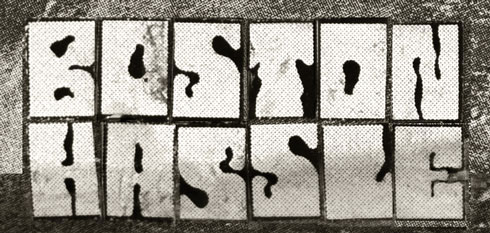
The Conformist (Il conformista) is an intriguing, unexpected, emotionally leaky, and chilling gaze into pre-World War II Paris and Benito Mussolini’s Italy, where fascism is fated to reign (or already does), and its biggest ally—conformity—is titled. With a touch of cinematographic obscenity, director-writer Bernardo Bertolucci presents this world of chic fashion, high-rise architecture, elaborate dance parties, and indirect political talk of the era—built on the deaths, suffering, and betrayal of anyone deemed unfit for Mussolini’s society—as abnormal and dystopian.
Unfortunately, while most may want to put fascism squarely in the past, it is rapidly resurfacing in the United States. U.S. President Donald Trump continues to usurp control of American governance, stripping our livelihoods in the name of turning the U.S. into a Christian, heteronormative, me-first, business-centric nation. ICE is killing protestors and disappearing people; healthcare and social services are getting increasingly slashed; minorities and the poor of all backgrounds continue being disowned and forgotten; and cost-of-living skyrockets are seeing millions suffer and die. With that in mind, Bertolucci’s The Conformist demonstrates what NOT to do in the face of tyranny in this beautifully shot, deliciously written, unsettlingly performed, and unnervingly realized vision of fascism from the perspective of a fascist bystander.
In 1938, Marcello Clerici (Jean-Louis Trintignant), an Italian mid-level Fascist agent, gets assigned to Paris to assassinate his former anti-fascist professor, Professor Luca Quadri (Enzo Tarascio). Agreeing to go under the ruse of a vacation with his wife Giulia (Stefania Sandrelli)—with whom he craves “the impression of normality” from, rather than love, companionship, or even lust—he travels to meet with his subordinate, Special Agent Manganiello (Gastone Moschin). What’s supposed to be a relatively clean hit turns into a complicated affair; upon arrival, Marcello begins a secretive, lust-filled relationship with Professor Quadri’s wife, Anna (Dominique Sanda), which eventually bleeds into his professional life, marital relationship, identity, sense of purpose, and, most importantly, his sense of belonging. As time goes on and the impact of Marcello’s failed mission and secrets metastasizes, he must find a new way to fit in without accosting himself—finding cowardice and self-preservation the easiest way forward as history changes around him.

Almost everyone, regardless of their background, wants to fit in. They want to feel like they identify with something larger than themselves, or have at least some people they can connect with. The Conformist demonstrates how that need, unfortunately, often trumps morality through its cowardly protagonist. From the beginning, Marcello shows a singular need: he craves normalcy. As he confesses to a blind, fellow-fascist friend named Italo Montanari (José Quaglio) that “in the morning, when I’m dressing, I look at myself in the mirror, and I feel my reflection is different from everyone else’s,” conforming to the social majority’s will appears the closest thing to connection and stability he can attain.
At another early point with the same friend, that “different” feeling Marcello experiences oozes again when fervently listening to the blind Montanari’s wise answer to what normal looks like: “A normal man? For me, a normal man… is glad to find people who are like him, his equals. That’s why he likes crowded beaches, football, the bar downtown…. He likes people similar to himself and does not trust those who are different. That’s why a normal man is a true brother, a true citizen, a true patriot” (“A true fascist,” Marcello adds in). Marcello makes a negative connection between fascism and belonging, seeing ruthlessly discriminatory nationalism as his “true” key to fitting in. While for most, belonging is a normal need or desire, a flashback sees a young Marcello (Pasquale Fortunato) sexually assaulted as a child and believing he murdered the perpetrator (even though he finds later on his assaulter still walks)—normalcy is the escape he needs to forget his trauma and guilt. Thus, because fascism is in fashion, becoming a member of the secret police, attaining a wife with or without love, and having a family, means normalcy.
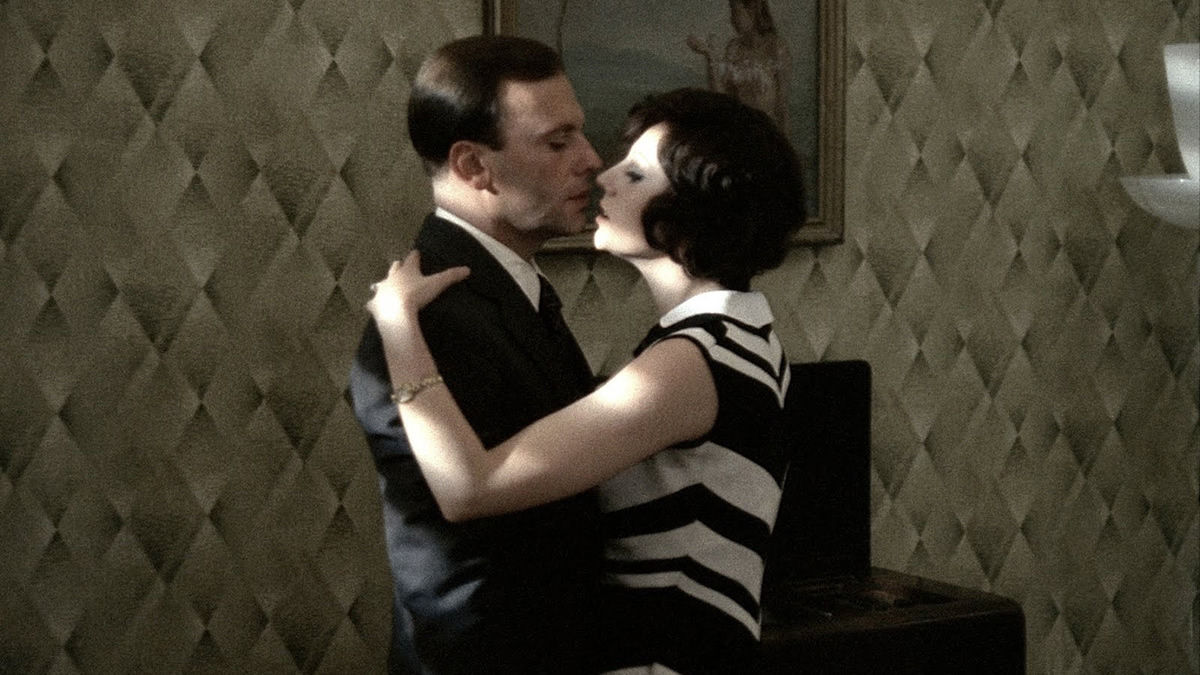
But orders become more intense and his wrongdoings more serious, which he only doubts when Anna enters the picture. Initially, meeting her dressed as a prostitute brought in for questioning—where they incessantly gaze into each other’s pupils despite the interrogation—they meet again under more conventional circumstances at an in-home dinner with Marcello, Giulia, Anna, and Professor Quadri. Picking up her hostility, he asks her if she’s the same prostitute and why “you’re so hostile,” to which he gets no reply and “because I’m sincere,” respectively. She isn’t lying; throughout, Anna holds herself with a confidence Marcello only dreams of, comfortable in her own skin and sexual ambiguity as she tries seducing Giulia once or twice later on. Seeing Marcello’s self-proclaimed “desire to find her again,” she also allows their relationship to develop, hoping Marcello will let her husband escape Mussolini’s secret police scot-free. At another dinner between the main four, Marcello seems to crack as he gives his gun back to Manganiello in the kitchen hallway of the restaurant, insisting he can’t kill his past professor. The light appears to shine on Marcello.

Unfortunately, Anna’s sincerity and Professor Quadri’s pleading aren’t enough. On the day of the Quadris’ departure, Marcello ultimately gives in to the conforming power of fascism and allows the executions to happen; having given Manganiello their departure time and location, he merely watches as Anna screams outside his car as she and the professor get slaughtered. His cowardice shines in full color. Even Manganiello, who gets his hands properly dirty, calls it out: “How disgusting. I’ve always said so. Make me work in the shit, sure, but not with a coward…. If it were up to me, I’d stand them against a wall. Better yet, eliminate them when they’re born.” While fascism itself isn’t necessarily what Marcello’s loyal to—”I want to see how a dictatorship falls,” he says later to a now bag-eyed, generally exhausted-looking Giulia in 1943 when Mussolini’s regime collapses—he doesn’t care to stop it. He didn’t care for Anna or Professor Quadri as soon as they became obstacles to his safety; he doesn’t care for Giulia beyond the “stability [and] security” she provides; he doesn’t care for the unspeakable acts the regime allows, only hinted at throughout Conformist. Bertolucci thus demonstrates how such complicity is the ultimate evil of fascism. There’s a reason why Hitler, Mussolini, Stalin, and living dictators continue finding power. With so many who are content with doing nothing, blending in with whatever comes their way, all fascists have to do is brush it all off as nothing serious—much like the Trump administration is doing now. If we all act as Marcello does, then evil can destroy however it wants. Whether we live in fear, complicity, or ambition for the benefits we can reap from it, fascists thrive on populations thinking they can’t (or, worse, don’t need to) do anything to stop treachery. They want us to be cowards; they want us all to be Marcello Clerici.
Thus, along with immaculate performances all around, polished production from beginning to end, and (mostly) firm pacing that keeps everything enticing, The Conformist is an equally entertaining, refined, alarming, and thought-provoking political drama about fascism’s easy rise. For Italian-French cinema fans, Bertolucci fans, and those wanting to understand current geopolitical tensions better, The Conformist offers much to mull over, whether as food for thought or as a means of seeking answers to today’s dangers.
1970
dir. Bernardo Bertolucci
113 min.
Screens Monday, 1/26, 7:00 p.m. @ Harvard Film Archive
Part of the ongoing repertory series: From the Collection: Antonioni / Bertolucci / Olmi