Singin’ in the Rain was the ultimate triumph of Metro Goldwyn Mayer’s Freed Unit, which itself was the ultimate triumph of the Great American Musicals that dominated American movie screens in the middle decades of the 20th century. Amid the heady euphoria of America’s victory in World War II, before Elvis’s gyrations shattered the world and ushered in an edgier, more cynical rock ‘n roll counterculture, producer Freed (who wrote the lyrics for many of the songs featured in Singin’ in the Rain, including the title number) commandeered a ragtag group of talented misfits who created a string of films that will remain legendary. Meet Me in St. Louis, The Band Wagon, Easter Parade, An American in Paris: these Technicolor visions combined high art, pop culture and a sly camp sensibility in a way that has been endlessly imitated and parodied, but never replicated.
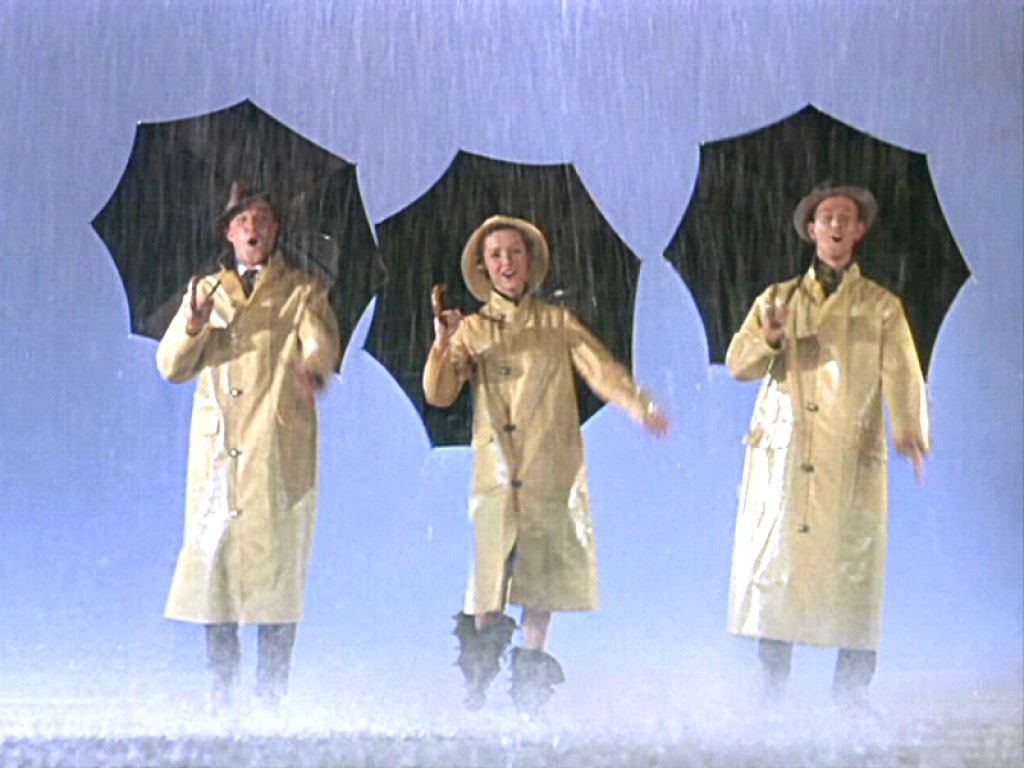
Singin’ in the Rain, however, shines brighter than all of them. It is widely considered to be the greatest musical Hollywood ever made, but I’d go one step further. It is the greatest film ever made, period. To me, it is perfect. I cannot imagine a single thing that could be changed or improved upon. Like Salieri observes about Mozart’s music in Amadeus, to make the slightest alteration would cause the whole structure to collapse. It is perfection, soaring with the soul-freeing grace of Gene Kelly hanging onto a lamppost. It shows no signs of the brutality and ruthlessness of the studio system that created it. Whenever I feel sad, I remember that Singin’ in the Rain exists, and I feel better. It is the purest expression of joy ever captured on film.
The movie is set in a delirious, candy-colored phantasmagoria of 1920s Hollywood, viewed through the rose-colored prism of the 1950s. MGM was at the height of its powers, and its lavish attention to production design is on full display. Silent movie star Don Lockwood’s (Kelly) career is soaring when that newfangled invention, “talking pictures,” threatens to change the industry forever. When interviewed by a Louella Parsons-esque gossip columnist, a grinning Lockwood declares that his motto is “Dignity, always dignity.” Cue a montage of him in a series of degrading, dangerous roles. The Freed Unit musicals often had moments of subversion like this, in which Hollywood looked at itself through a kaleidoscopic mirror and commented on the artifice of it all. These moments, however, were cushioned by the aching sincerity of the films’ romantic plots, lush orchestrations and sentimental lyrics.
Lockwood’s best friend and long-suffering sidekick is Cosmo Brown (Donald O’Connor) who epitomizes the smile-through-the-pain, “that’s showbiz, kid” ethos that powered the Freed Unit. In his legendary number “Make ‘Em Laugh,” O’Connor turns his own body into a living punching bag to illustrate the point of the lyrics: all is fair in entertainment. It was a motto that the stars of the Freed Unit lived and died by in an era of perfectionism and grueling work schedules. Ordinary people became stars who became mythical personas, bearing little resemblance to the cruel realities on the ground. Any pretensions of being “a dancer with grace,” O’Connor sings, are immediately smacked down to earth by “a great big custard pie in the face.” Indeed, Lockwood’s screen partner, the pretentious diva Lina Lamont (Jean Hagen, in a scenery-feasting role) gets a cake in the face courtesy of Kathy Selden (Debbie Reynolds), a chorus girl Lockwood takes a liking to. The pie is meant for Lockwood, but he dodges it with the panache of Bugs Bunny. This scene encapsulates the movie’s philosophy. There’s no difference between “real life” and a slapstick comedy. Lockwood knows his role and how to play it. Lamont, however, is too stuck-up to see that she’s just another performer in the farce of life. To quote The Band Wagon, another Freed Unit musical in which show business gazed at its navel, “The world is a stage, the stage is a world of entertainment.”
When Lockwood and Selden meet-cute after some death-defying stunts from Kelly on a streetcar, their dialogue once again suggests a blur between the artifice of showbiz and “the real world.”
“You’re nothing but a shadow on film,” Selden says. “You’re not flesh and blood.”
Kelly spends the rest of the movie proving he’s flesh and blood. The raw masculinity of his dancing contrasted with the elegance of Fred Astaire, and much of the film is carried by his firecracker charisma and charm, especially when contrasted with Lamont’s Miss Piggy-like hysterics. A series of wacky hijinks ensue with the new sound technology, and Lockwood and Lamont’s sound film The Dueling Cavalier appears to be a total flop. Then, Lockwood, Brown, and Selden have an idea: To turn The Dueling Cavalier into a musical: The Dancing Cavalier. The end result is the most glorious, orgiastic excess of creativity ever committed to celluloid: the daring, dramatic, surreal “Broadway Melody” sequence.
Many Freed Unit musicals had such dreamlike ballet sequences which offered a detour from the story into a realm of limitless creativity, ruled by the emotions suggested by the dance, scenery and music. Often, they were like stepping into paintings. The master of these sequences was Vicente Minnelli (Judy Garland’s husband and Liza’s dad) whose fine-art pretensions brought an aesthetic finery to his films that sometimes overshadowed thin storylines. What made Singin’ in the Rain a masterpiece was that the songs were perfectly integrated into the story, a product of Betty Comden and Adolph Green’s brilliant screenplay which is translated to the screen as a sort of live-action cartoon. Everything is so much larger than life that it’s sometimes hard to remember that these people are indeed “flesh and blood.” And yet their shadows will live forever.
“The Broadway Melody” has no bearing on the rest of Singin’ in the Rain, but the movie is unimaginable without it. It is a wordless ode to pure romanticism and imagination. Just imagining it as I type these words gives me the chills. Of course, Kelly’s iconic performance of “Singin’ in the Rain,” O’Connor’s inhuman slapstick skill in “Make ‘em Laugh,” and the furious tapping of both in “Moses Supposes” still have their power to awe, Alex DeLarge notwithstanding. However, I’d say “Broadway Melody” has them beat. Every aspect of it excels — the catchy tune, the extravagant set design, the army of backup dancers, the artistic choreography, the explosive orchestrations, the sensuality of Cyd Charisse in a glittering green flapper gown, Kelly’s exuberant rallying cry of “Gotta dance!” Those two words are a mantra, a religious credo. In “Singin’ in the Rain” all of life is one great big cosmic dance, through all of the joy and agony. Might as well laugh and dance in the rain.
Singin’ in the Rain
1952
dir. Gene Kelly & Stanley Donen
103 min.
Screens Saturday, 4/11 through Monday, 4/13 @ Brattle Theatre – click here for showtimes and ticket info
Note: Monday’s screening is a craft-friendly, lights-up screening presented by gather here