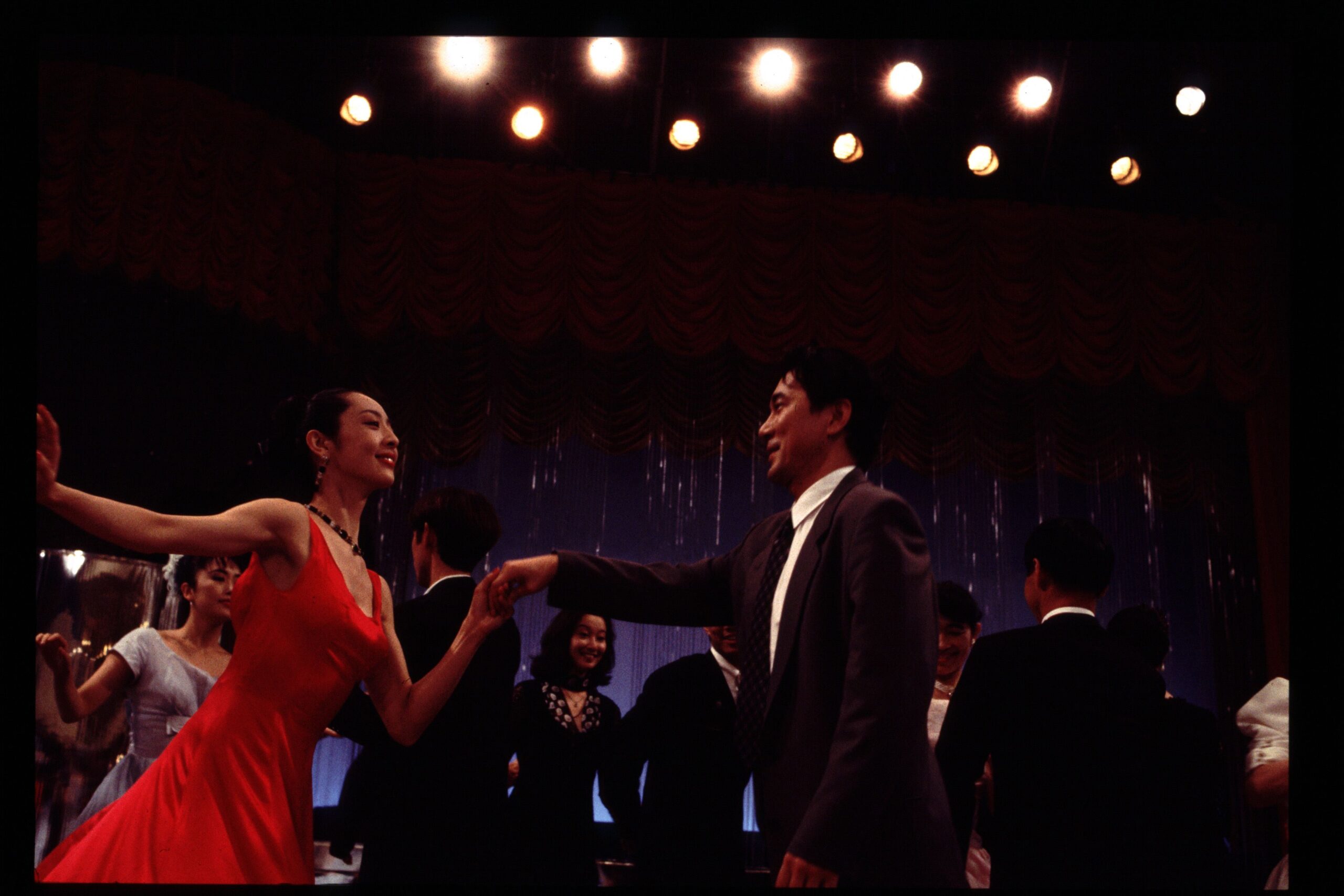
When businessman Sugiyama (Kōji Yakusho) first sights a forlorn Mai (Tamiyo Kusakari) looking out the window of a dance studio, we immediately see a passion blooming. But unbeknownst to Sugiyama at the time – and maybe even to a heart-eyed audience expecting a discovery of love – this kind of passion is not the romance between two people. In Masayuki Suo’s fourth film Shall We Dance?, the thesis of this passion can be defined by a line from Shakespeare’s Venus and Adonis that was engraved at the film’s introductory dance hall: “Bid me discourse, I will enchant thine ear.”
However, if there was a person who was not in the mood for discourse, it would certainly be Mai, a ballroom dancer who dropped out from a high-stakes competition following a fiasco with her partner. Her standoffish aura is not so enchanting when Sugiyama gathers the courage to walk into the studio. As ballroom dancing has yet to be accepted in Japanese culture, Sugiyama is flummoxed by the environment and is politely disappointed when he is assigned to a group beginner’s class led by the older, friendly teacher Tamako (Reiko Kusamura). Based on his stilted stumbles,, we’ll soon find that Sugiyama’s crush may not help guide his feet to the right steps.

His infatuation with Mai can be seen as a bit of an ick, as he has a wife and daughter at home. But prior to his dance lessons, Sugiyama may have been the working man’s embodiment of docility and conformity, to a fault. His financial stresses over his house mortgage seem to instill a corrosive mundanity on his livelihood, which has a rippling effect on his marriage and job. Attempting to find a satisfying solace in Mai is a fool’s errand, which comes to realization when she outwardly rejects his attention one night. However, instead of quitting from the initial thing that brought him there, Sugiyama is shaken awake. He comes back again to the studio. He practices his 1-2 step in the rain. That passion that he had been surrounded by is now within him.
It’s not only Sugiyama that we root for. Mai’s hesitation to rejoin the ballroom scene then anchors her in the dull safety of working at her father’s studio, giving private lessons without a wink of excitement. Sugiyama’s classmates, which include his co-worker Aoki (Naoto Takenaka) and a weight-loss-oriented Tokichi (Yu Tokui), become each other’s hypemen and shoulders to lean on when they misstep. Romantic love may have been the film’s Trojan horse, trotting into the scene where warfare is not the fight between two people meant to be entangled into physical intimacy, but finding a troupe of misfits and loners against the grind of the go-getters can forge a deeper connection. The world may rush and expand, but the waltz will always dance in its own time signature.
From strong-character performances as a samurai or detective, Yakusho’s portrayal of the fatigued businessman can be a difficult task to show when it’s a slow-burn self-discovery. The film integrates Western beliefs and culture of one’s identity to Japanese’s collectiveness with kindness; the pursuit of individual happiness can work. Sugiyama does not tell his family about his dance lessons, which raises his wife’s suspicions of after-hours infidelity. If open communication was an easy thing to do, perhaps Sugiyama would have not needed the dance studio. But sometimes people have the innate ability to ask for what they need, while others might need a beautiful woman to get through the door and encouraging words from strangers to take the first steps.
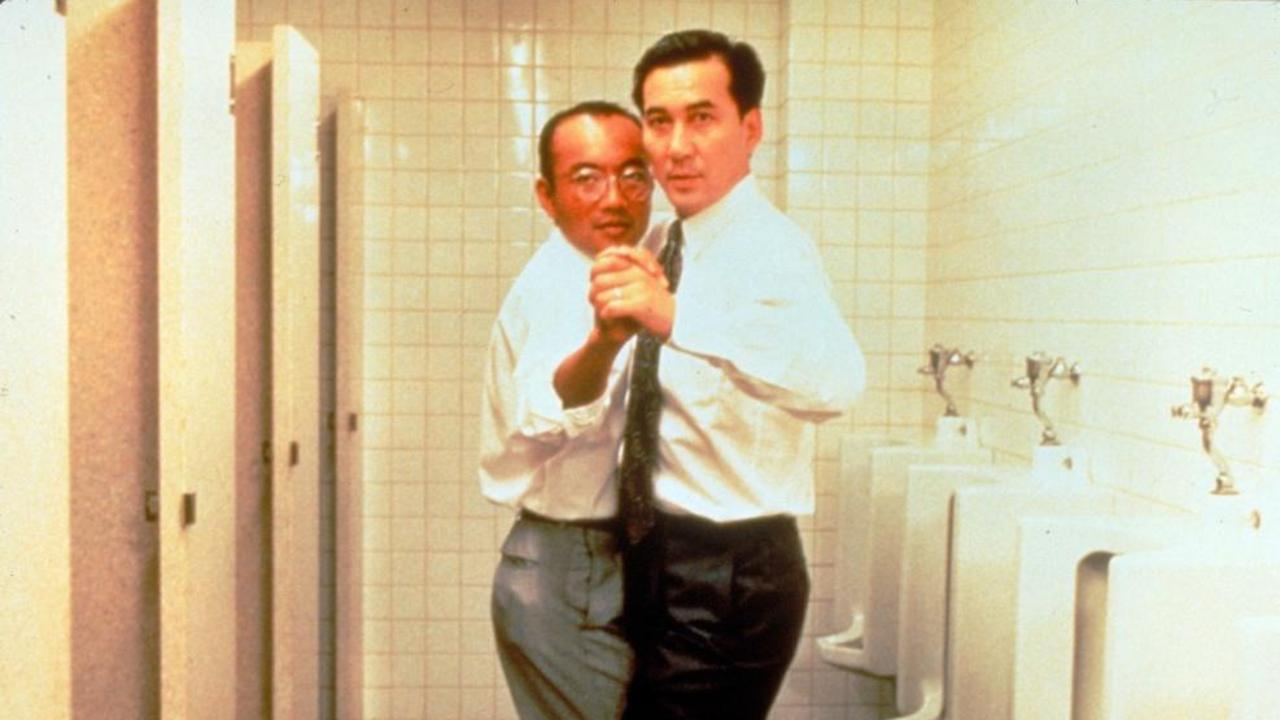
Shall We Dance? eternalizes the feelings of hope and disappointment that threads through generational malaise. The question of the title, recalled from a song in the musical The King and I and within the flirtatious rhythm between Astaire and Rogers, is a familiar beckoning for connection between two people. Dance films will come and go, the last song of the night will end, and the floor will clear, but the moment shared between two people can be as marginless as an echo.
I bring to attention a scene not of the last climactic dance, but of a scene where Sugiyama, Tamako, and Mai are walking up a desolate staircase at night, returning from a dance hall with mixed experiences. They pass another dance studio, in which participants are concentrated on their partners, instructions, and numbers. As they discuss about the uncertainties of their future in dance, the studio’s fluorescent interior glows upon their expressions with a telling enlightenment: Tamako in a self-assured dreamy smile, Mai furrowed in half-shadows, Sugiyama looking up into a life that could be his. At this moment, it’s possible that we can feel like one, or all three, at the same time. Whatever you might be feeling, I know that these characters will extend an inviting hand to join them.
Shall We Dance?
1996
dir. Masayuki Suo
136 min.
New uncut 4k restoration!
Screens Friday, 7/18 through Monday, 7/21 @ Brattle Theatre – click here for showtimes and ticket info
Part of the repertory miniseries: Kōji Yakusho x4