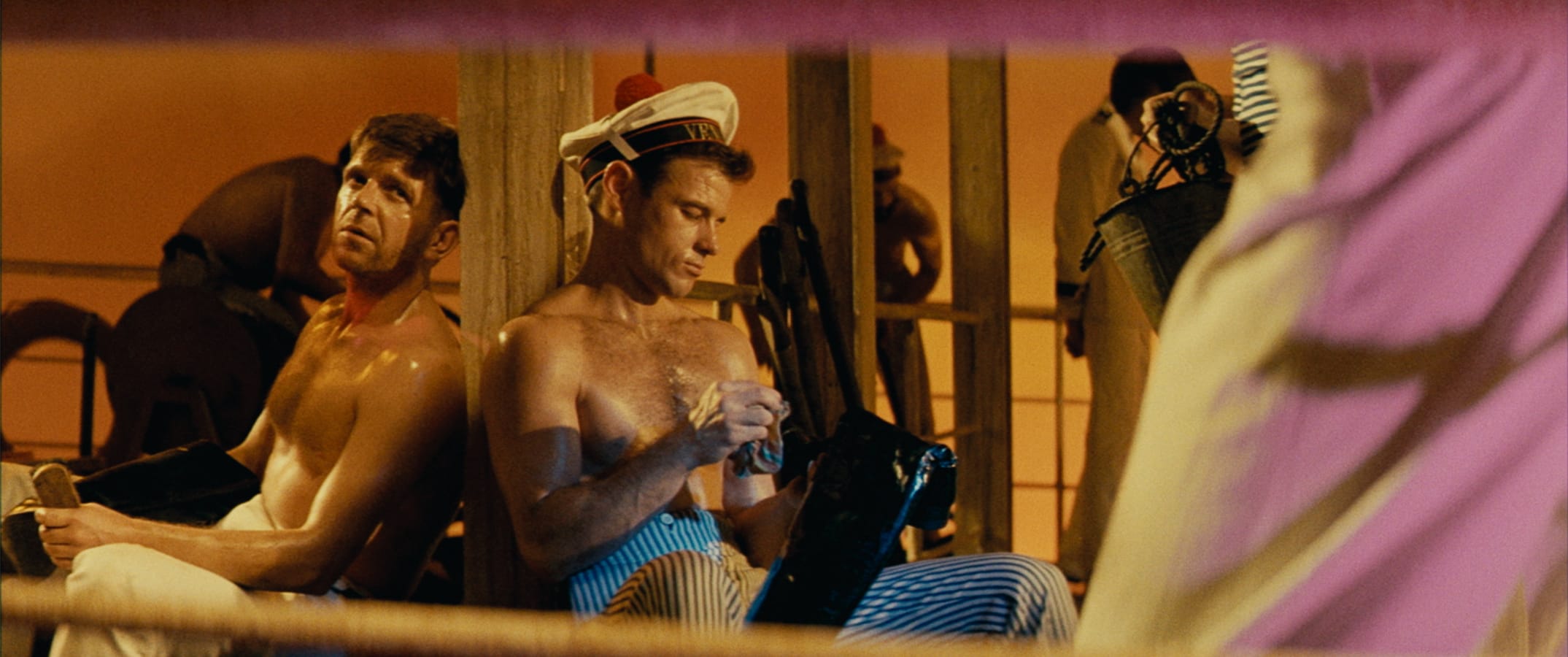
Querelle is a weird, upfront, proudly absurdist, and boldly ’80s over-the-top gay sailor flick. While it’s significantly overstuffed and more cartoonish than its near-squeamishly sensual tone and imagery necessitates, Querelle is also a mildly thought provoking biblicization of the titular sailor Georges Querelle (Brad Davis) coming to terms with his own homosexuality. Following him as his crew anchors in Brest, he goes to a brothel-bar called Feria, owned by lustful Lysiane (Jeanne Moreau), run by her drug dealing husband Nono (Günther Kaufmann), and also managed by another lover who is also Querelle’s brother, Robert (Hanno Poschl). As Querelle explores Feria and its oddball inhabitants and workers, he finds his sexuality begin to unravel past conventional means as he simultaneously becomes more mischievous from murdering a fellow sailor. As Querelle discovers himself further, the beautiful and ugly of human nature rear their heads in varying forms as he determines how to escape the law without losing himself again.
Querelle is equal parts intentionally ludicrous and overly silly—homoerotic, surely, but overly self-indulgent with how much this film leans into ‘80s camp. The imagery is, fortunately, powerful enough, and the narrative is loose enough for the metaphors to shine through in the end. Querelle himself is established early on as “a figure comparable to the Angel of the Apocalypse,” for example. He is an embodiment of sin as this apocalyptic angel; the more he discovers of himself, accepting sodomy from Nono and others at a whim, the more he’s freed of morally inclined burden (or, at least, free from Christian-imbued morality). Such a powerful presence afflicts everyone around him: “Little by little, we realized that Querelle, already inside our flesh, was growing, developing in our soul, feeding off the best within us.” Nono, corrupt cop Mario (Burkhard Driest), and even Querelle’s own ship’s commanding officer, Lieutenant Seblon (Franco Nero), find his budding queerness and obvious charm irresistible, and allow themselves similarly mind-opening sexual and mental ventures. In the end, after numerous other metaphorical reflections and literal quotes flashed on white screens, Querelle’s ultimate message becomes clear: sinfulness mislabels components of human nature that need embracing for people to truly live. God or no, Querelle becomes the symbol of absolutely personal freedom, a “hero of those who are contemptuous” and fearful of who they really are. This is but one of the many far-reaching ideas director Rainer Werner Fassbinder instills in his final flick—sexuality, gender roles, age, and legitimate morality are all other focuses—leaving Querelle as contradictorily dense as it is mindless.
While such metaphorical interplay, frank narration and dialogue, and symbolic imagery—such as many architecturally sound penis columns—certainly makes Fassbinder’s last feature feel deeply personal and almost soul-permeating at times, an overreliance on ‘80s melodrama significantly hinders Querelle’s majestic attempts. For example, while an entire sub plot focuses on Querelle and Robert’s relationship—“Since they themselves wished to deny it, the strange resemblance of the brothers seemed attractive only to the others”—it’s campy. The first time they reembrace, they dramatically hug whilst swinging fists at each other’s ribs; later, they spout random bits of poetic insults towards each other, flamboyantly swinging all limbs as they circle each other in a knife stand-off. All this overblown camaraderie hinders what could’ve been an equally abstract look at their borderline incestuous relationship, especially as it gets reinforced by Querelle’s attraction to later character Gil (also Poschl), because up until then its difficult to take them seriously; the staged-ness of it all shines miserably through when they’re together. Nevertheless, thanks to Brad Davis’ varying performance, a touch of self-awareness in the film’s zaniest and most obtusely abstract moments, and pure psycho-sexual exploration backdropped by a murder thriller on sea legs makes Querelle a zesty queer art house film. For Fassbinder fans, Davis fans, art house cinema fans and—in a very different vein—fans of ‘80s film cheese, Querelle has a range of ideas for viewers to get intimate with.
1982
dir. Rainer Werner Fassbinder
108 min.
Screens Monday, 6/30, 7:00 p.m. @ Coolidge Corner Theatre
Part of the ongoing repertory series: Queer Cinema