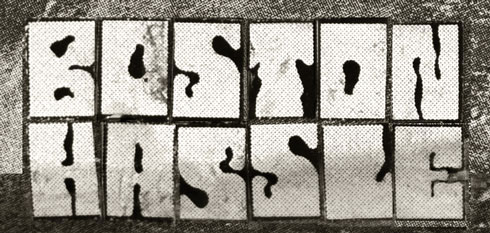
Putney Swope is an indicative, occasionally tacit, and frequently funny counter-culture flick about a Black man’s attempt to reinvent an advertising firm. Directed by the father of Iron Man‘s Robert Downey Jr., Downey Sr.’s critical take on American racism and social standards is almost as poignant and critical as it is lighthearted and politically incorrect Even if Swope‘s jokes oft flatten the graver punchline—whether by surfacing subtext to simple told-not-shown levels or fundamental continuation confusion—Putney usually satiates with cutthroat humor representing business’s lethality and greedy familiarity.
The only Black executive in an ad firm, Putney Swope (Arnold Johnson, dubbed over by Downey himself), gets mistakenly voted into power. Once there, Swope fires all but one white executive, hires all Black replacements and workers, renames the firm “Truth and Soul, Inc.,” and axes the firm’s affiliation with war toys, alcohol, and cigarettes. Focusing instead on anything else profitable—from mousetraps to skin creams and morning cereal—Swope utilizes nudity, sexist extremities, and surreally hilarious mockery of whiteness to sell ideas he steals from employees he promptly fires. As Swope’s firm catches the attention of the U.S. government, the obnoxious, short, and unnamed U.S. President (Pepi Hermine), and Mr. Borman Six (Lawrence Wolf), whose automobile company is profitable enough for Mr. Six to manipulate the president, Swope must make hasty decisions about the company’s future without revealing his scam ideas or eroding the company’s core values. With tongue-and-cheek sketches that make light of company corruption, U.S. institutional flaws, and racist/sexist social division—even if stereotypes still emerge and a lack of focus dampens the concept’s overall effectiveness—Putney Swope sees the titular character learn about business evils, people’s inherent search for their own kind, his faults, and how no one really wins in the end under capitalistically driven socioeconomic systems.
Swope shows how oppression against anybody in any form is merely a symptom of the human condition. In a time where it seems the U.S.’s current administration encourages the racist, sexist, and homophobic veins of hatred historically familiar to all minorital groups, Swope is a necessary reminder of discrimination’s heavy tolls—a criticism of our capability for greed, our fear of difference and foreignness, and our business savvy society’s inability to stop hate. Aside from the overt racial swap, many instances deliver the divisive me-and-us-vs.-you-and-them mentality everyone carries, like the treatment of a delivery boy: “I told you to take the freight elevator,” Swope himself and other employees remind the balding, glasses-wearing middle-aged man. When the man takes matters into his own hands, firing several rounds in their building before being scooted out, nobody’s terribly shocked; “Violence is a cleansing force,” a resistance-experienced business representative says elsewhere in the film, “…. Non-violence has proven to be nonfunctional.” Even if entitlement and a fixed white-over-Black hierarchy are still the main enemies, most of Swope‘s Black characters can understand the aging shooter’s upset.
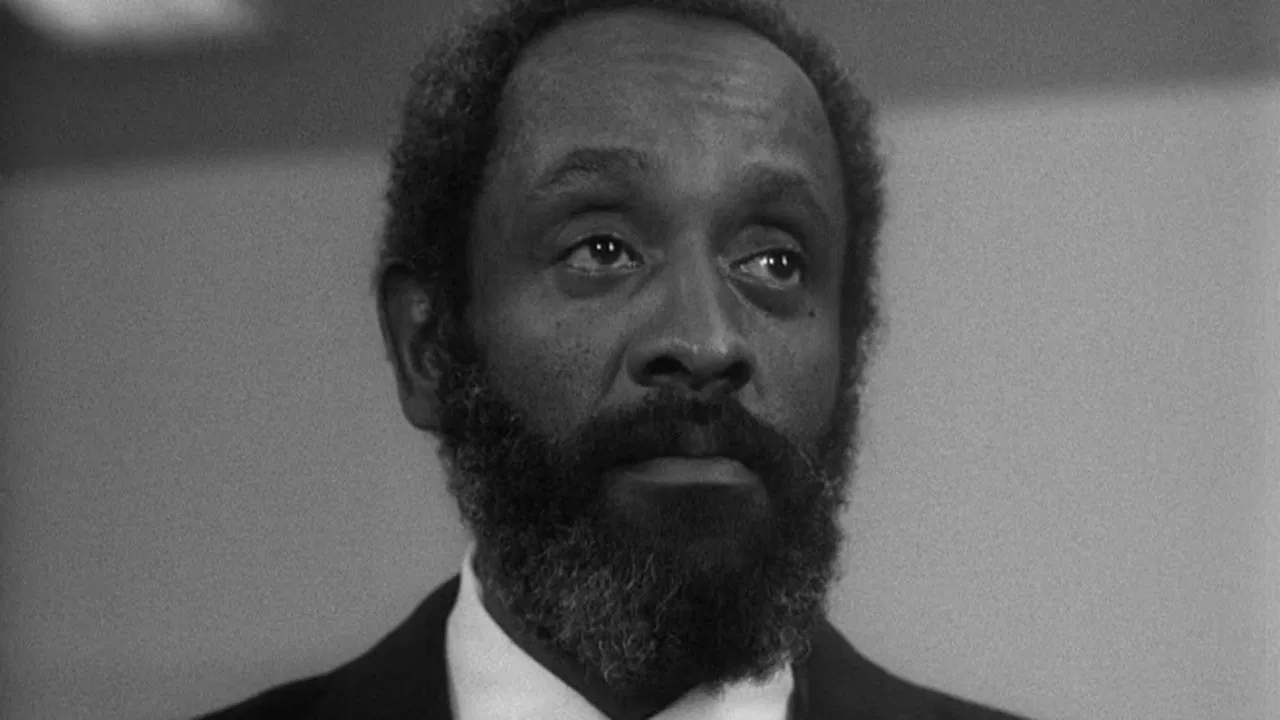
Elsewhere, another lone white employee gets paid less; a white maid gets corrosively reminded of her place in a Black couple’s house—”You little bitch. What are you doing out here? Get your ass in that house immediately…. Why do you think I have you for, anyway?”—Swope even constantly turns down whites looking to do business, such as photographer Mark Focus (Eric Krupnik): “You’re the best photographer in town. Take a walk,” he mutters. Whether unfair but polite or cruel and dehumanizing, white people get a taste of their unjust taters. White people can finally be shoved out, and Swope does just that. Such a feat gets reinforced by the in-color advertisements sprinkled throughout to socio-politically stinging comedic effect.
Each ad represents a distorted, colorfully laughable version of typical TV ads; a breakfast cereal is talked about as the camera zooms in on a Black man’s face before he says, “Oh, shit!” in response to the information overload; a woman, even though she says “It’s stupid! I don’t wanna say it,” is forced to wear a smile as she tells viewers of the “peach fuzz and feminine whisker” eliminating skin cream’s magic ability to get her a boyfriend; one sees a half-limbed old man advertise for Worth It Health Insurance muttering, “They charge an arm and a leg in there, but it’s worth it.” All familiar cornerstones of Americanized issues like expensive healthcare and overly costly, sexualized, and racialized beauty products get kinetically charged by Swope’s aggressively vulgar advertisement approach. While that stilts too much of the film’s focus away from other important filmic components—the characters are static, people can talk inorganically to beat home messages and themes, and the underlying story is a bit messy, reducing the film to an oft muddled but funny and thematic flick—it hammers home the delicately woven, allowed interpersonal destruction capitalism encourages to keep the rich rich and everyone else, not. Even inner division between powers like Swope and his consistently critical employee known simply as the Arab (Antonio Fargas) is expected, if not hoped for, even if it backfires as it does with the Arab’s film-closing Molotov cocktail.
Thus, while the aforementioned narrative and character issues weigh Putney Swope‘s stride and several sexist-racist stereotypes still appear, the film is sharply aware of the (in)humanity of social norms, business models, finances, infrastructure, and legalities. For commentative comedy fans, old cinema fans, and those striving for realistic global improvement, Putney Swope is a must-see. Just don’t expect grander ideas to match up with an organic or grounded narrative and set of characters.
1969
dir. Robert Downey Sr.
85 min.
Screens Wednesday, 8/27, 6:30 p.m. @ The Brattle Theatre
Part of the ongoing repertory series: Summer of Satire