Prom Night is a killer ‘80s campy thriller about a loose maniac on teenagers’ most memorable night of their lives. Prom Night offers nothing unique; it isn’t exactly well-executed, and it delivers too much buildup with not enough payoff. However, its star power, a few themes, and unintentional laughability more than make up for its shortcomings. One day in 1974, a group of kids—Nick McBride (Brock Simpson as a kid, Casey Stevens as a teenager), Wendy Richards (Leslie Scott young, Anne-Marie Martin later), Kelly Lynch (Joyce Kite, then Mary Beth Rubens), and Jude Cunningham (Karen Forbes, then Joy Thompson)—play a pretend murderous game in an abandoned brick building somewhere near Toronto, Canada. While there, a trio of siblings—oldest sister Kim Hammond (Debbie Greenfield, then Jamie Lee Curtis), middle brother Alex (Dean Bosacki, then Michael Tough), and their youngest sister Robin (Tammy Bourne)—walk by, prompting the youngest to join in out of playful curiosity. However, when inside, the four game players all become the killer, screaming “The killer’s gonna get you!” and “The killer’s here! Kill! Kill! Kill!” as they surround and tease Robin, who, feeling overwhelmed, backs up and out of a high-up window before plummeting to her death. As the kids freak out, Wendy makes them all swear never to tell, so they all leave before an unknown figure overshadows Robin’s corpse.
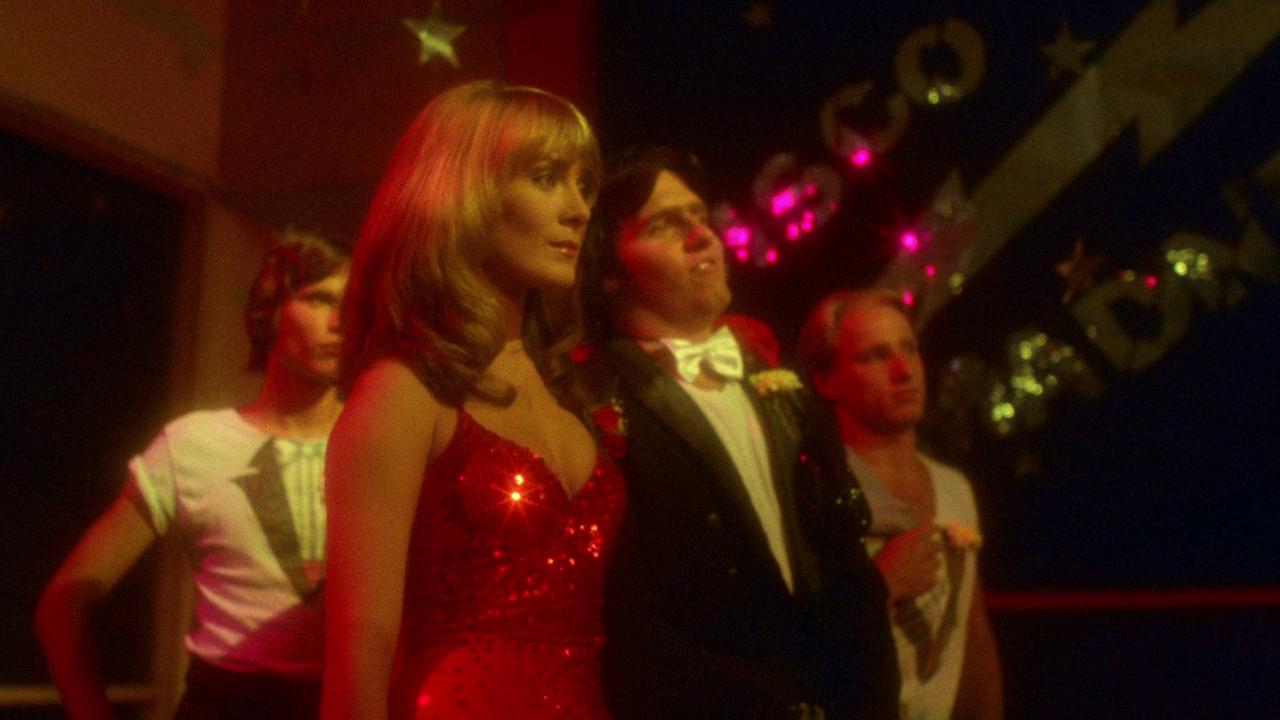
Six years later, in 1980, with all aforementioned characters now in high school, everybody’s getting psyched for their big high school dance. Typical teenage melodrama splatters across Prom Night’s runtime; girls fight over dudes, dudes get slimy when their sexual offers get turned down, and all around, people are deeply insecure about making themselves “look perfect,” as Wendy herself remarks in reaction to Kim’s dating Nick, who at one point dated Wendy. However, hot on their tails is the exact unrevealed figure from the manslaughter scene, who torments them with suspicious calls from a scratchy voice and cut-outs of their yearbook photos next to glass shards before he shows up to pick them off one by one at their most cherished teenage event. With Kim being strangely the only one left alone, she must help her friends and discover a terrible truth about their intertwined past.
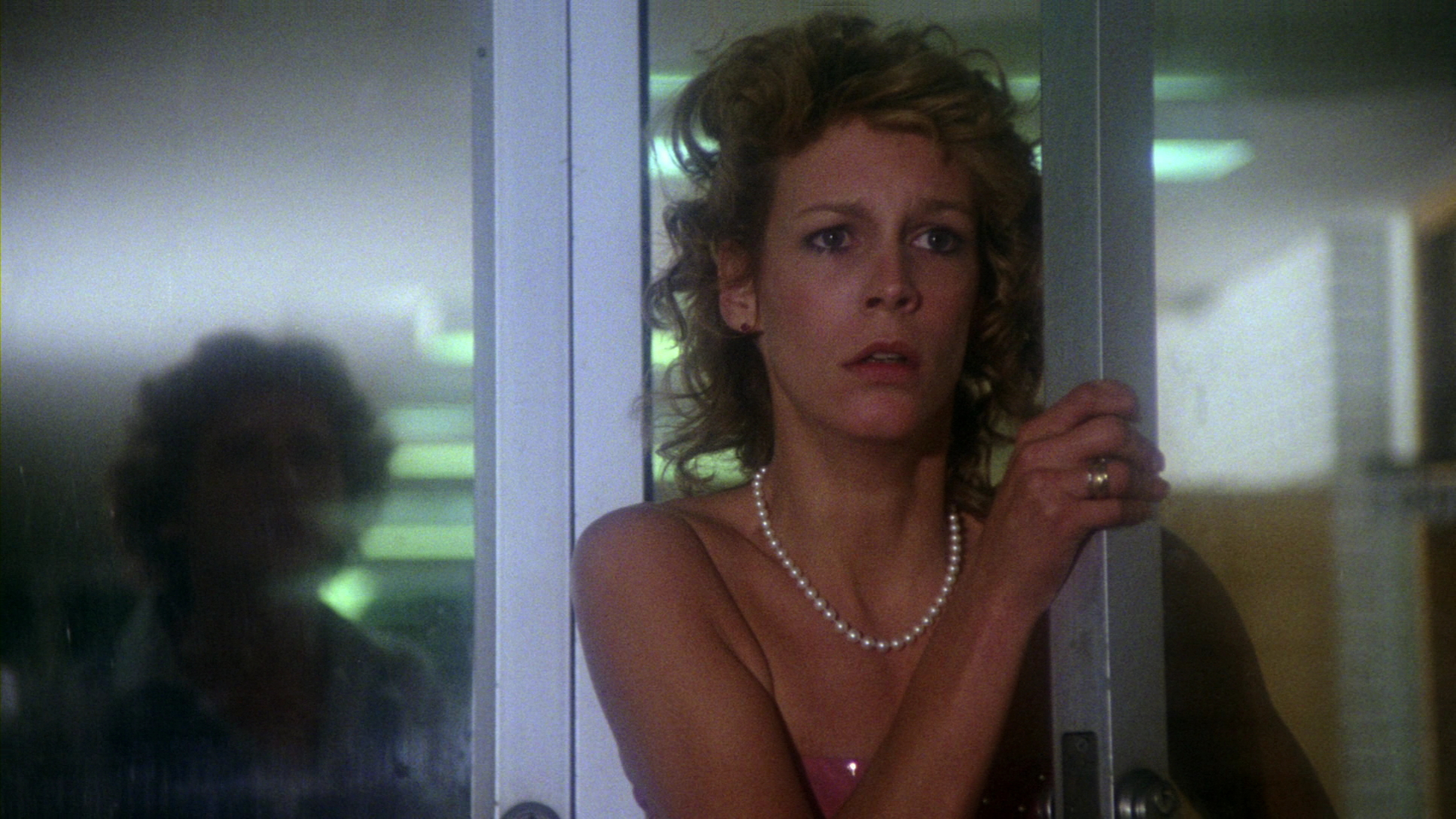
High school, at least for many, sucked. As I write this, the blotchy colors of my Weston-based high school, its oddball teachers I either heard ghost stories about or whose rigidity I faced myself, and the student body’s overprivileged cliques seep back into mind. There are always the good and bad moments, of course, but it’s doubtful most look back on it with much else than relief. For Curtis and co.’s characters, high school seems much the same. The only American actor or actress present in this Canadian-dominated production, Curtis, of course, steals the show as Kim, delivering a next-level charm and wit that the rest of the characters scarcely possess (which is understandable given the vast majority of the cast’s recent graduations from Canadian film schools). Thanks to her, Kim is a rootable character even in the petty melodramas she faces, such as the one-sided love triangle that the same Wendy who covered up Kim’s sister’s death forces upon them and Nick in refusing to give Nick up. Throughout, Wendy does nothing but sneer at Nick’s newfound love for Kim, whether indirectly or spat out at Kim’s face, like when she finds Kim practicing her disco moves for the dance: “Practice makes perfect. Kim’s always so perfect…. You are keeping in mind that after tonight, it’s all over. Everything‘s going to be back to normal. I mean, Nick is king of the prom, and you just have to be queen of prom. But that’s as far as it goes, Hammond.” Unfortunately for Wendy, and very much due to her constant sneering, that “normal” is in fact a delusion as Nick and Kim’s prom royalty bears little on their actual relationship.
That strong bond is most affectionately displayed when Robin’s death anniversary arrives. Kim can’t help but lean on Nick (unbeknownst to his shared responsibility in the fatal accident) as her sister’s death haunts her, forcing tears and a soft-spoken tremor in her verbal accounts of her feelings and the loss: “It’s Robin‘s day. My mom is all upset. My dad is too. He’s just too strong to show it. You know she would’ve been a junior this year? It would’ve been her first prom. But—I mean, the prom must maintain. Whatever.” Curtis emphasizes the nuanced emotions that come with such loss, from the faint smile thinking about how Robin might’ve looked older to the sudden furrow of her brow and the drop of her cheek as she talks about her parents in Nick’s arms. Nick, in turn, lovingly reminds her, “I love you, you know that?” before struggling to find the words to confess his terrible, “killer” truth to her. As they both struggle, they cling to each other just as any would with romantic loved ones in vulnerable times. Even as Wendy teams up with the school’s pigheaded outcast, Lou Farmer (David Mucci)—who gets expelled for getting physically violent towards Alex Hammond and sexually relentless towards women, including Kim early on—to make prom a humiliating experience, she can’t get what she wants, unlike almost everyone else: a boyfriend and to be the center of attention. Unfortunately for them all, the killer has other plans, putting everyone minus Kim in grave danger of an unforgettably fatal follow-up to Robin’s death. Other points, such as the contrast between Jude’s sex-filled night with a respectable van driver named Slick (Sheldon Rybowski) and Kelly’s fear to go all the way with her boyfriend who mule-ishly tells her, “If you don’t, I know plenty who will,” further demonstrate the insensitive, hurtful, and inexperienced decisions and actions these kids believe to be acceptable, and the chaos already present without the killer’s existence.
Aside from the Kim-Wendy drama, Wendy’s vain and weak attempt at revenge, and the general themes of unmitigated young lust and meanness, everything else is just hilariously bad. Again, aside from Curtis, most of the cast and particularly Nick’s older actor Casey Stevens are as stiff as the killer’s ax handle, making them, their reactions, and/or deaths funny ’80s typical romps; the writing, for the most part, is uninspired if not unrealistic—it’s hard not to laugh when the police ask a Dr. Fairchild (David Gardner) about a potential off-screen suspect and he says “I’m sorry, but Leonard is an unknown quantity”; in fact, the faux suspect Leonard Murch doesn’t even come on screen, weakening that entire throw-off entirely; the kills are left for the last 15-20 minutes and, aside from one studio requested beheading, are surprisingly muted and occasionally choppily edited; the final twist is somewhat clever, elevating the rest beyond mundane nothingness to a hilarious spectacle of early ’80s slasher sludge and paving the way for other non-Halloween slashers to cut through the mainstream. It does have a great soundtrack of absorbing ’80s disco knockoffs (that led to a copyright lawsuit back in the day—oops!) combined with chiller suspense tunes, and some additionally beneficial presences in Kim’s parents, Mrs. Hammond (Antoinette Bower) and school principal Mr. Hammond (Leslie Nielsen), helping to disguise the film’s otherwise bland-scape. Prom Night is not something you watch expecting elevated horror or even decently crafted thrills; it’s a laughable, well-lead, schmaltzy, and genre-defining gem of petty teenage lust and drama in the face of a real threat. For ’80s campy horror fans, Jamie Lee Curtis fans, and those unfortunate enough to have only seen the mindless 2008 remake of Prom Night, this film is a fun, nostalgic midnight flick of kills and youthful stupidity.
1980
dir. Paul Lynch
92 min.
Screens Friday, 10/10, 11:59 p.m. @ Coolidge Corner Theatre
Part of the ongoing repertory series: Coolidge After Midnite and Flick ‘r Treats