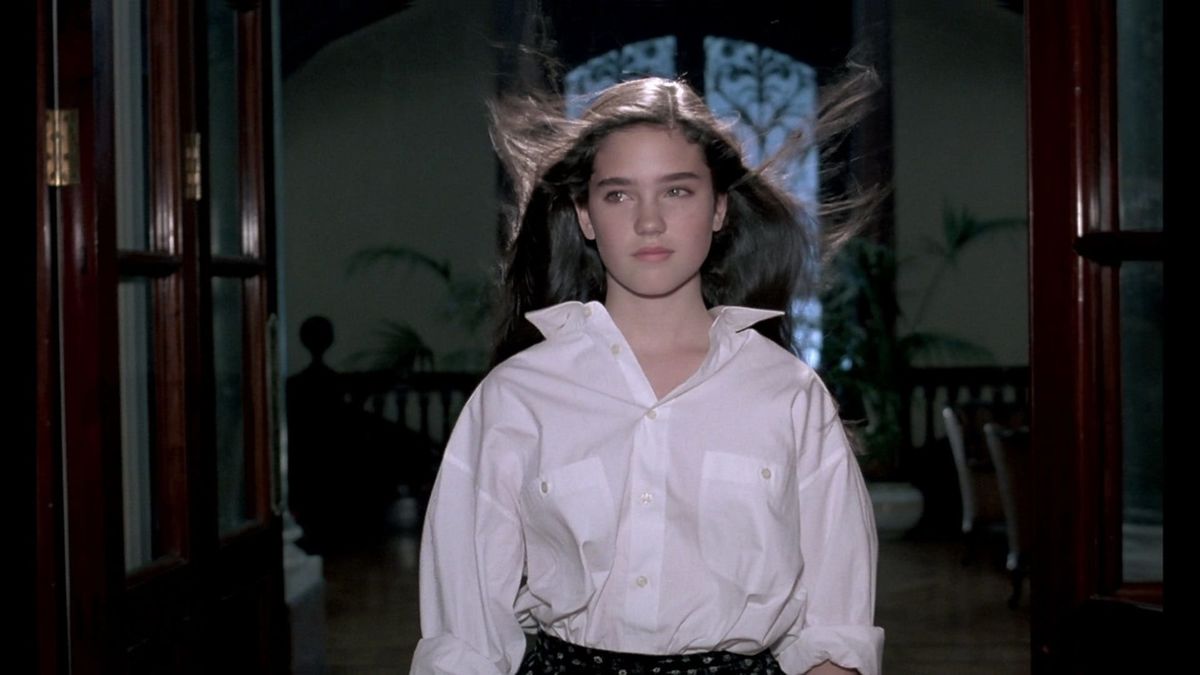
Phenomena is stylistically artful ‘80s horror cheese that does a lot more aesthetically than it does anything else. Jennifer Corvino (Jennifer Connelly), the 15-year-old daughter of famed filmmaker and actor Paul Corvino, transfers to a pristine boarding school in a small Swiss town eerily referred to as the Swiss Transylvania. She loves bugs and is excited for a new life. Meanwhile, forensic entomologist John McGregor (Donald Pleasence) and Inspector Rudolf Geiger (Patrick Bauchau) chase a serial killer nearby known for decapitating or mainly dismembering female victims. As Corvino herself gets involved, extraordinary circumstances arise: her love of bugs goes beyond that of any human, as she can telepathically communicate with them. As flies rely on rotting corpses for and as larvae (or so Phenomena explains), they lead Jennifer to scenes of the killer’s crime, even as they occur. With nowhere else to turn in her strict boarding school, she turns to John McGregor for assistance, as he specializes in bugs himself. Together with an army of flies, Jennifer and John uncover the mysterious source of the Swiss Transylvania’s killer.
Phenomena certainly has plenty of subtext. While disguised as a comically ’80s horror splatter, Suspiria director Dario Argento leans heavily into the untold in this eight-year-later slasher. Though it is not discernible upon viewing, Argento himself has discussed the importance of Phenomena‘s being in an alternate post-World War II world because “I imagined that between 1940 and 1945 there had been a very serious incident, the war, and that the Nazis had won [in Phenomena]… and life therefore has a totally different vibe, it’s a world where the Nazi order won.” Swiss living, in reality, was and still is very much as displayed in Phenomena, but Jennifer’s strict boarding school—from its vague propaganda concerns, such as when a poster of Jennifer’s (American) father gets torn down, to the building once being Hitler’s favorite composer Richard Wagner’s home—demonstrates the Nazi world’s brutish, matter-of-factly cruel structure. “After thirty-forty years, the people had wiped this dramatic event from their memories and didn’t talk about it anymore,” Argento says of the Nazified ‘80s—a point reflected in Phenomena’s entire ensemble’s refusal to discuss anything pressing beyond the damnable wind that “causes madness.” Trauma and problems are not discussed, but Phenomenally explosive in all the wrong ways. Along with compellingly naive and cryptic performances from Connelly and Pleasence, respectively, Argento makes an abstract case for why we live in the superior timeline where Nazis are no more and should never rise again.
Unfortunately, none of that conceptual gravitas comes through that well—making Phenomena through and through a hilarious endeavor. From disruptively jolty editing and cinematography, indescribably disconnected dialogue, cardboard-thin performances from many (minus Connelly or Pleasence), a severely ableist serial killer that villainizes physical disabilities, and an overused synthesizer score that hams things up, Phenomena is simply too narratively surface-level for its deeper ideas to flourish beyond laughter. It certainly has compelling moments, particularly after all the vital introductions are done, but it’s simply too campy, discombobulated, and insanely ignorant to be anything more than an ‘80s laughingstock. For ‘80s fans, Connelly or Pleasence fans, and those looking for something to laugh over or a flick that is surprisingly more meaningful than it seems, you may find yourself saying “We worship you!” like Phenomena is the queen bee of ‘80s schlock.
1985
dir. Dario Argento
116 min.
Screens in new 4k restoration Wednesday, 4/30, 6:00 p.m. @ The Brattle Theatre
Part of the one-day celebration: Halfway to Halloween