
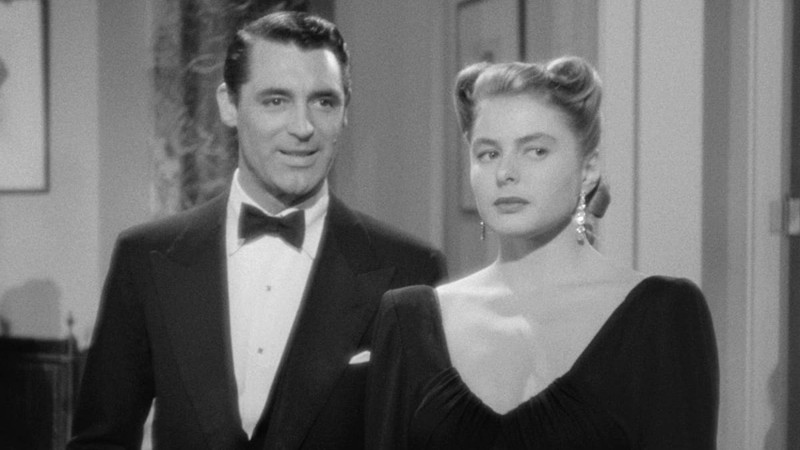
Notorious is an exceptionally suave spy-romance thriller and one of director Alfred Hitchcock’s more attentive and recognizably Hitchcockian films. Set shortly after World War II, U.S. government agent T. R. Devlin (Cary Grant) infiltrates the house of Alicia Huberman (Ingrid Bergman), the wealthy daughter of an infamous Nazi spy. Once they meet, he recruits her for a special assignment in Rio, Brazil, where they together must infiltrate a runaway Nazi organization. She reluctantly signs on thanks to Devlin having recordings of her and her dad’s revealing conversations, and whilst Huberman and Devlin wait for instructions in Paris, the pair fall in love—though Devlin’s not convinced of Huberman’s American loyalty—making the assignment more personal for both of them. Upon arrival in Rio, the pair get to work, only for their fling to flip upside down upon learning their primary target’s identity: Alexander Sebastian (Claude Rains), a German Farben pharmaceuticals executive and old personal friend of Huberman’s father who once held deep affections for her. Huberman and Devlin’s boss then instructs Huberman to seduce Alex so the detectives can easily access the lockup-enabling evidence they need, leading to more arguments and separation between her and Devlin. Together and apart, Devlin and Alicia must bring justice to those damned Nazis without sacrificing themselves—or love—in the process.
For Hitchcock fans, Notorious is a trip down familiar avenues. From the Oedipus complex displayed through Sebastian and his mother’s relationship to the MacGuffin being a uranium-filled wine bottle, Hitchcock’s distinct techniques and tricks bleed through in what’s otherwise an expertly dashing spy-love flick. Though predictable, Hitchcock and co. keep viewers on their toes by throwing in enough goings-on that fill what could otherwise be dry, ordinary plotting. For example, instead of Huberman simply stumbling upon the mischievously filled wine bottles, she discovers so after a guest at a dinner party makes a scene about them being out instead of locked away. “I’m so sorry for making a scene; please forgive me,” the guest pleads to Alex and his Nazi compatriots before they agree to take the guest for a drive through the country (wink wink). Hitchcock understands how to keep things moving naturally and thickly enough for such predictability to get ignored easily. Grant and Bergman are also brilliant together; leisurely when most vulnerable, kinetic when most argumentative, and visibly disquieted when desire and duty struggle to outshine one another, they’re each electric on their own and irresistibly charming together. Watching them fall in, fall out, and repeat is intensely euphoric, so throwing in spies and World War II only ups the ante.
Loads of themes keep themselves just beneath the surface as well. Devlin, aside from representing Hitchcock’s facing his fear of the police, represents the second-guessing generalization that naturally arises in authority figures in wartime. Even allies cannot be fully trusted, as every person is inflicted by the same traits as Nazis that make them maim and kill by the millions. He doesn’t trust Huberman, not because of her personality or her current actions, but because of her connections and past; once an alcoholic, always an alcoholic, so once connected with Nazis, one is always associated with them. “What a little pal you are. Never believing in Me/ Not a word of faith. Just down the drain with Alicia,” Huberman exclaims after Devlin refuses to confess his love for her over his moral qualms. It’s both a natural and dangerous human trait because the same second-guessing necessary to uphold ethical values in conflict can turn into distrust of those same values later on. As he finally gives in—”I was a fatheaded guy, full of pain. It tore me up, not having you,” Devlin professes to a weakened Huberman—his questioning nature also dissolves as Huberman convinces him of what the U.S. government wants to convince American audiences: to take their word for things at face value. While it may have been safe to stop questioning his love, he should’ve only increased the questions thrown at his own country. Elon Musk and Steve Bannon’s insanely Hitler-mirrored salutes to their crowds suggest dark history repeats, which both Devlin and Huberman would be deeply ashamed of.
Thus, while Notorious is notoriously jumpy and almost priggishly upper-class in vision and context, it’s slick, layered, and tense. For Hitchcock fans, spy-noir-romance fans, Bergman or Grant fans, old cinema fans, or those looking for something pristine even in its most predictable moments, Notorious is a grandly sharp time. It’s also a good reminder of what the U.S. is supposed to stand for: freedom and goodness against oppression and evil.
1946
dir. Alfred Hitchcock
102 min.
Screens Tuesday, 2/25, 7:00 pm @ Coolidge Corner Theatre
Part of the ongoing repertory series: Cary Grant: The Man from Dream City