
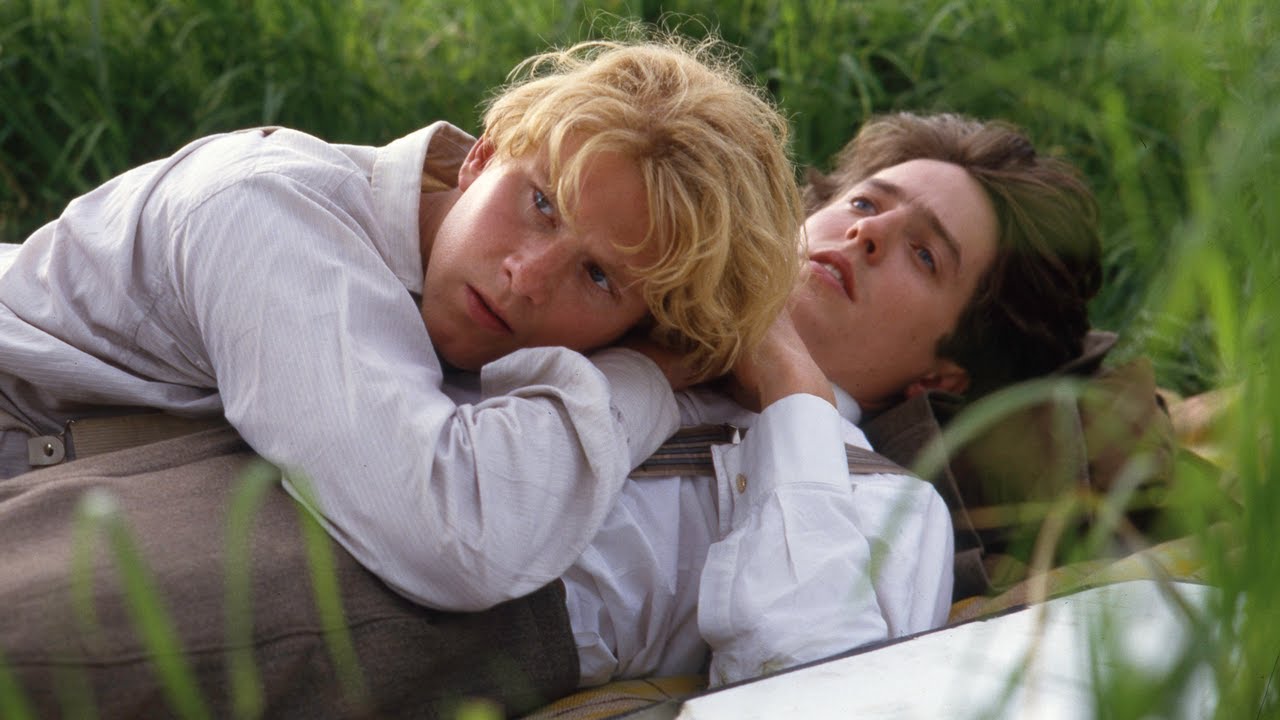
Maurice is a slow-burning, poetically inclined drama-romance about being gay in England’s early 20th-century Edwardian era. In the 1910s, fatherless British upper-middle-class Maurice Hall (James Wilby) attends school at the University of Cambridge. Brought up in a wealthy, WASP-y setting—the film opens with an uncomfortable sex talk between an 11-year-old Maurice and a teacher years earlier—Maurice frightfully grows feelings for one of his two new, intellectually inclined school friends, Clive Durham (Hugh Grant). The pair fall in love as they deal with other coming-of-age issues, which unfortunately make Clive consistently hesitant to go all the way with Maurice despite their strong feelings. As chaotically as they get together, they eventually break things off, as Clive is tired of secrecy and desires a higher social and financial position in life, even if that means getting involved with a woman instead. Left alone for another number of years, Maurice is left to deal with his homosexuality and more; empathy, the beginnings of class consciousness, and the societally spilling flaws of his and Clive’s wealth- and status-driven background are only some of Maurice’s grandiose (and severely overstuffed) growth.
Maurice, though packaged and primarily appealing in its fine-tuned romanticism and unexpected turn of events, is as much an appeal to empathetic development as it is one of found love. Brought to life as if it’s easy to rollercoaster one’s emotions from Grant, Wilby, and everyone else, Maurice’s change starts when Lord Risley ridicules their religious college’s heavily Christian Dean: “Your dean here dwells in superstitious clouds of Christian self-righteousness. Your dean pretends that only insensate faith is of any significance,” a middle-parted, dagger-eyed, tie-adorned Risley spits. Maurice, absorbing more of Risley’s press for respect than the surface-level insinuations of his insults, is naturally drawn. While Maurice publicly does nothing, RIsley finds him and Maurice eventually meets his first true love, Clive. Slick-haired with a sharp jawline, charismatic slur in his high-class British accent, and devilishly clever, Clive would be desirable to anybody attracted to the male figure. His mind is as attractive as his material, and the pair bond over their shared rare fascination for more profound meaning and connection.
It’s Clive’s very pontifications in school, as melting tree-greens and the sturdy brick symmetry of old Cambridge architecture are captured mesmerizingly by cinematographer Pierre Lhomme, that open Maurice’s mind. Their canoe trips over pristine, unspoiled by man waterways and similar adventures see Clive indulge in his most vulnerable ideas: “a masculine love, of physical beauty and of moral beauty, and of the beauty of the thirst for human knowledge, you omit that and you’ve omitted the mainstay of Athenian society. It’s as if our benighted dean hadn’t even read the Symposium,” he pleads to Lord Risley and Maurice’s prying ears. Such awareness of what a man can be, one concerned not with just “physical beauty” but that of “moral beauty” and beyond, is a rare find. As the pair first embrace one another, hands gently caressing, bodies shuffling, and chairs slowly creaking in sonic match to the air of sexually charged hesitation, such consideration from Clive shows as boldly as ever—making the pair’s fallout, especially considering Maurice’s otherwise unkind nature, all the more painful.
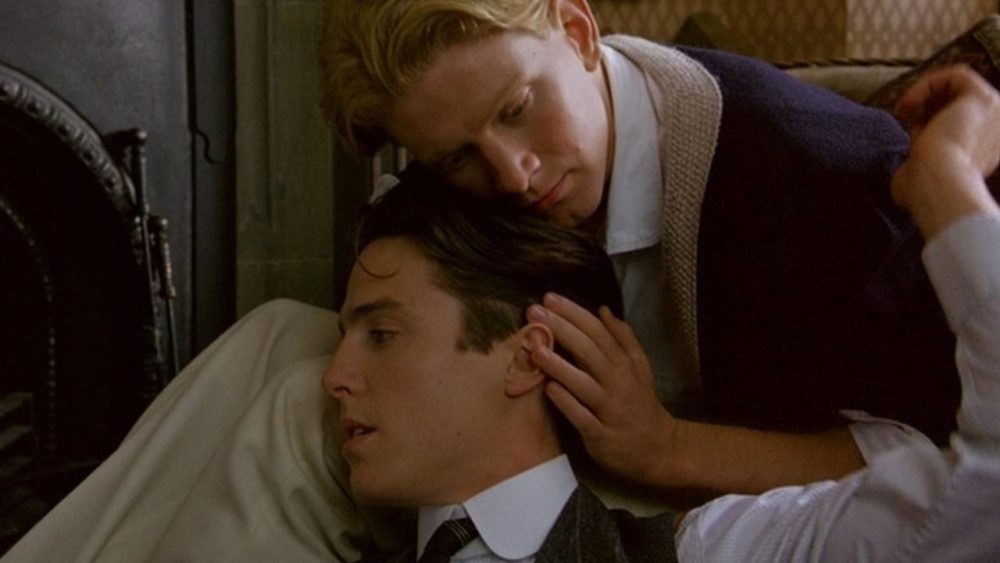
Beyond Clive, Maurice himself is not likable for most of his story. He treats women as if they know and can do nothing, treats servants and workers like trash, and strictly obeys what is sinful without any regard to what’s immoral. “You’ve always been unkind to us,” one of Maurice’s sisters tells him, after he, with a drink in hand and hair slapped to the side from physically fighting Clive in their breakup, lies and accuses her of sleeping with Clive. While Clive is indeed selfish in choosing money and status over love and happiness, which Maurice himself reminds Clive of for years to come, he treats women with a great deal more kindness and workers with at least a minimum amount of human respect. After their breakup, Maurice initially accepts the personality hole he’s dug himself: “I get used to being horrible. The poor get used to their slums. After you’ve banged about a bit, you get used to your particular hole.” Though he lives in his “particular hole” with confidence, he slowly realizes the cost, especially once he meets his true love, houseworker Alec Scudder (Rupert Graves).
Alec is nothing but kind to Maurice. Even as his employee, he goes above and beyond to ensure he’s kind to Maurice: “Good day, sir, glad to see you again,” Alec usually says behind a pair of longing eyes before being scolded away. Once he discovers their shared homosexuality, the pair embark on a much shorter and sweeter life debacle that enlightens Maurice more than he expected was necessary. Upon their second time meeting up, for example, Alec describes how he doesn’t exactly respect Maurice and his kind because of their lack of respect: “The old lady [I worked for], she says, ‘Oh, would you most kindly of your goodness post this for me. What’s your name?’ Every bloody day for 18 months I went to that front porch for orders and the old bitch doesn’t even know my name…. My people wouldn’t take to you [or that lady] one bit. And I don’t blame them,” he exclaims confrontationally. Up to this point, workers were nothing more than that: manual laborers who get directed around. But through such eye-openingly direct conversational confrontation, Alec demonstrates to Maurice why his “particular hole” is particularly nasty and needs to be dug out of—for love transcends financial, physical, or social attributes, even if it took Maurice a long time to see that.
It should be clear by now that everything picked apart above is only one complex thread of themes and character beats. Religious traumas, interpersonal revelations, and other typical and atypical social challenges also arise, further enhancing Maurice’s complex overtures towards humanity, prioritizing love over wealth and status. Unfortunately, this inclusion of so many components also significantly weighs Maurice down from the masterpiece its crew tried to create. Many jokes or intent-filled scenes could easily be omitted, shortened, or restructured to bring this film to a more proper hour-and-forty-minute runtime where its emotional beats are more isolated and thus more impactful. As of now, Maurice feels closer to the character study that E. M. Forster created in the original novel, and feels already way too long by not even 15 minutes in because of it. Thus, for romance-drama epic fans, fans of the cast, E. M. Forster, or those looking for an intellectually romantic time, Maurice is a slow gait through 20th-century British woods, queerness, and classism.
1987
dir. James Ivory
140 min.
Screens Thursday, 6/5, 7:00 p.m. @ Coolidge Corner Theatre
Part of the ongoing repertory series: Big Screen Classics