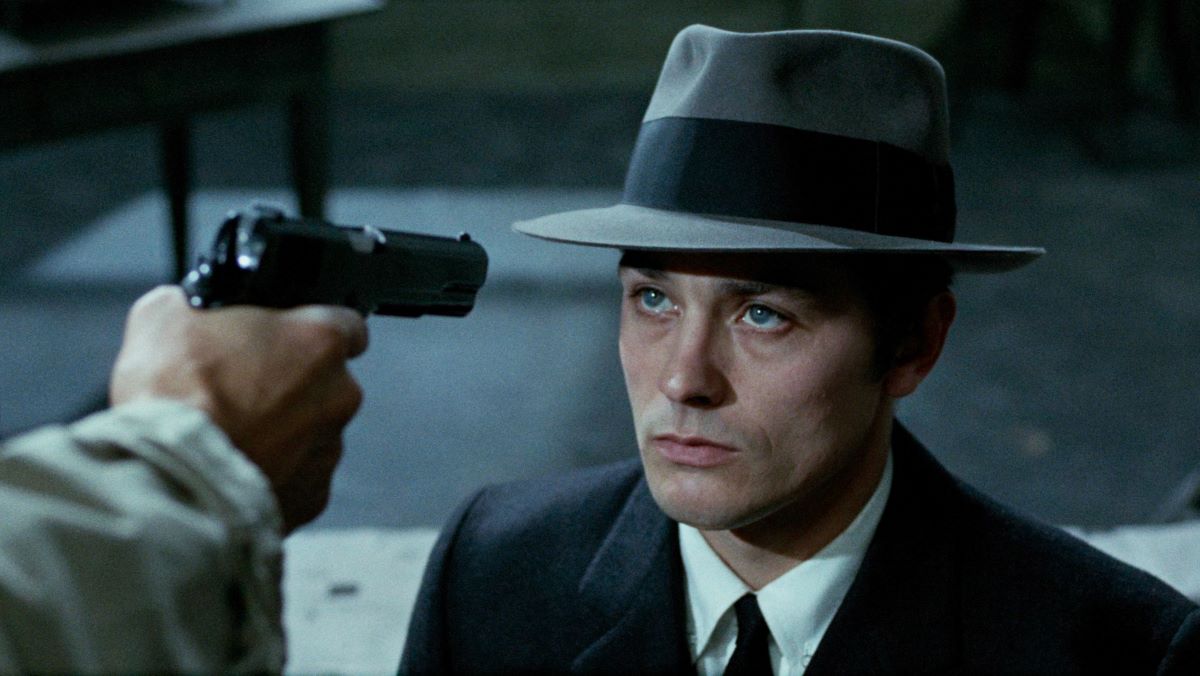
Le Samouraï is a meticulously crafted and presented crime-thriller, packing more symbolic punch and metaphorical swings than unpredictability. Following professional hitman Jef Costello (Alain Delon) as he follows through on a spotlessly alibi’d hit against a politician, the film sees Costello get nonetheless arrested, leaving both the cops and his authority-hating employers in hot pursuit upon escaping. With nothing but his smarts, gray-blue eyes, and detective-like trench coat and hat, Costello must get away before he—or his lover—loses.
Despite its typical plot, Le Samouraï is one of the few films that soars beyond set expectations. The film’s director, Jean-Pierre Melville, understands how to craft form-fitting characters and match a film’s style with his main character’s persona. Costello—played with breath-stilling precision by Delon—is an intelligent, sociopathic player of the killer’s game. He can predict where people will be, who his foes are, and what they’ll do, and he knows it: “I never lose. Not really.” He outsmarts everyone in the film, never panicking; as he calmly strides through alleys and dimly lit parks, his mind festers over what’s next—pleading with us to read his mind. It allows him to go home to his blank, one-bedroom apartment with nothing but a caged bird for company and a lover (pretend plaything) elsewhere. That’s precisely how the film plays: entirely focused on his self-imposed solitary life, as he calmly plans the next steps even as the trouble leaps closer. Any form of panic that does bleed through does so indirectly or symbolically. The caged bird, for example, gets increasingly rattled with each appearance, which usually coincides with a step up in danger. The closest audiences come to seeing panic is never known otherwise.
Samouraï also hints at different social components, like the male gaze. In a sequence where Costello’s lover Jane Lagrange (Nathalie Delon) gets interrogated by the commissioner (François Périer), the commissioner insults Jane about her having financially backed sexual relations with rich men: “It’s a shame. Girls like you are essentially prostitutes. Ever given that any thought?” Aside from the depravity of such an insult, the remark reveals how sex workers were—and still are—thought of. When comparing Jane and her “profession” to that of the bar pianist/witness (Cathy Rosier), she’s simultaneously separated from and bound to other women. She’s separated because most others are in more acceptable positions, like mothers or pianists like the witness. But she’s bound because she and the pianist share a similar purpose: to perform. In both professions, these women have to perform to mostly men around them. The men decide their worth, as the commissioner did, or if they deserve life—as Costello eventually does for the witness. It’s still a man’s world that women are forced to contend with.
Thus, though predictable and sometimes too slow, Le Samouraï is a dense interweaving of gritty implications disguised as a crime thriller. With fantastic performances, a fine-tuned attachment between man and narrative, and nuanced themes of inequality and solitude, Le Samouraï is a robust crime flick.
1967
dir. Jean-Pierre Melville
104 min.
The 4k Ultra-HD Restoration Screens Friday, 10/11, 9:00 pm @ Harvard Film Archive
Part of the ongoing repertory series: Melville et Cie.