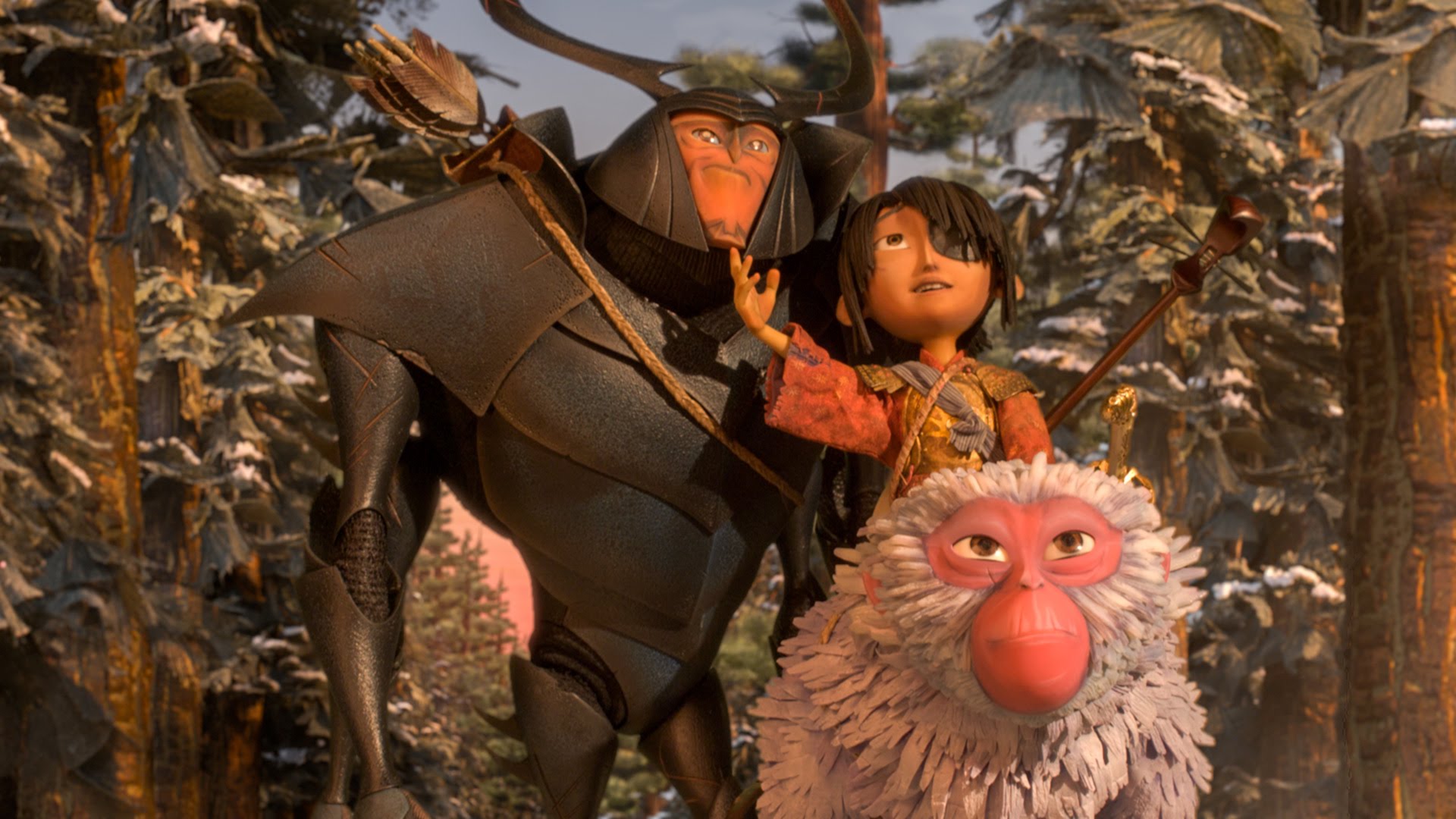
Kubo and the Two Strings is an imaginative, positively sentimental, and breathtakingly animated hero’s journey about finding strength in yourself and your family even if they’re gone. With nothing more than a traditional Japanese shamisen to magic her way through perilous waters, periled witch Sariatu (voiced by Charlize Theron) battles unseen forces through the night to get to her son, Kubo (Art Parkinson), whose left eye got taken by her father Raiden (George Takei), the evil Moon King, and Sariatu’s shadowy twin sisters Karasu and Washi (Rooney Mara). Twelve years later, Kubo takes care of a now dementia-afflicted Sariatu (at least during the daytime), biding the time in the pair’s isolated cave home by telling epic stories with loose or no endings in their closest village. One night, troubled by stories Sariatu told of Kubo’s father Hanzo, who tried to stop Raiden and his daughters the night Kubo’s eye got taken before being presumably killed, he stays out too long and the Moon trio spots him. They track him down and kill Sariatu, who uses the last of her magic to enliven a wooden monkey carving Kubo always kept on him. With nothing but his mother’s shamisen, Monkey (also performed by Theron), and Beetle (Matthew McConaughey), an old comrade of Hanzo’s cursed to become the namesake bug, Kubo must get his family’s unbreakable armor and stop his evil family members before he loses his other eye—and everything worth seeing.
Love is powerful, no matter its form. Across different storytelling genres, methods and themes, love is a potent force of goodness and a shining example of humanity’s greatest strength: emboldened empathy. With love, dictators have been fought and conquered, unfair laws and norms get struck down and reshaped, and people find solutions to the most convoluted problems. Kubo demonstrates love-power through the titular hero’s relationships, the memories created from their bonds, and how these bonds impact Kubo‘s self-confidence and abilities. While the film is incredibly predictable, it’s still organic enough for the love to push through. Before Monkey and Beetle even get revealed as Kubo’s resurrected and cursed parents, respectively, the dynamic forms quickly: as Kubo rests after the trio’s last Moon sisters battle, Beetle and Monkey bicker: “Ugh, you’re ridiculous, you’re just absolutely ridiculous. RIDICULOUS. Crossing the lake is a ridiculous idea. It’s not your fault. There’s no sense left in your head,” Monkey says, caressing Beetle’s face as the pair continues arguing over strategy and Kubo. They care for Kubo like he’s their own, and he eventually grows into being their “adopted” kid: “I’ve never had a meal between anyone before,” he says as the trio laughs face-full of food. The beauty in these small moments arises throughout the film between action and devastation, forming the memories that reinforce the magic Kubo needs to face Raiden even as he faces loss on all sides yet again—because at least he got to meet his parents and feel their warmth once more. Kubo thus demonstrates how love outshines everything when appropriately utilized. The stories that fuel love allow those lost to live on in their living loved ones’ thoughtful actions and caring nature, as Kubo does even in the face of a tyrant grandfather.
Unfortunately, while Kubo certainly plucks at the heart from beginning to end, there’s also a massive downfall: it is a primarily white crewed production centering everything around traditional Japanese everything. With that known, the film’s more superficial elements—the setting, the formatting, the themes’ presentation, the characters and their beliefs, the lore—come off as just that: whites making an admittedly well-produced kids story from Japanese stereotypes. While Kubo faced backlash in 2016 over the cast being white minus Takei as Raiden, the crew’s being predominantly white is much more pressing; voice actors’ faces are irrelevant, but every crew-made decision is pertinent. Thus, while Kubo and the Two Strings is a beautifully crafted movie at its core, an unintentionally racist execution based on the crew’s whiteness limits Kubo from being as progressive as it may think it is. For animation fans and family fun fans, Kubo will pluck at your heart and the Two Strings it promises, but it should also get recognition for such insensitivities no matter how incidental.
2016
dir. Travis Knight
101 min.
Screens Friday, 3/14, 7:00 pm @ MFA Boston
Part of the ongoing repertory series: Cult Classics