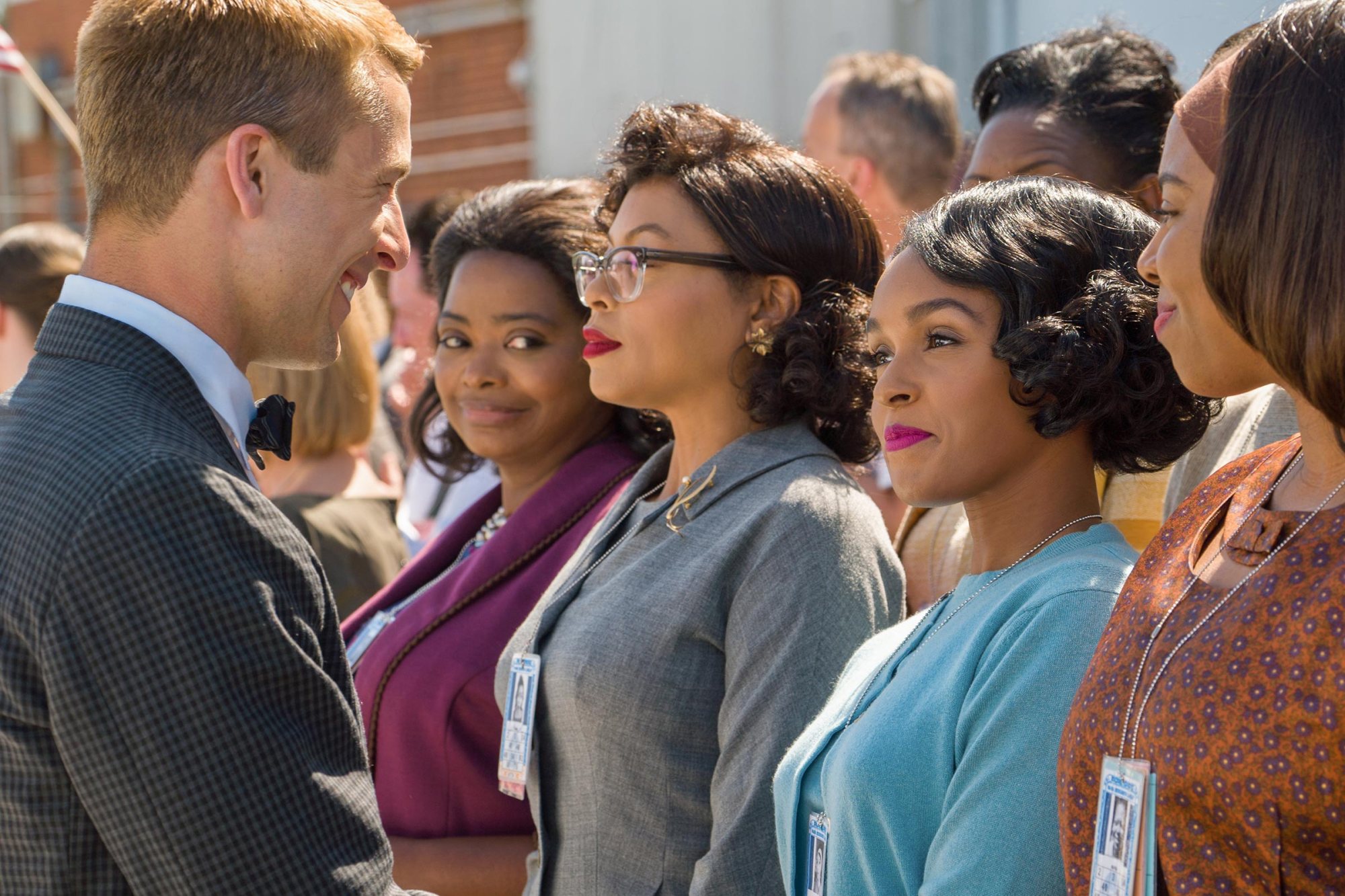
Hidden Figures is a feel-good, character-driven drama flick loosely based on the undiscussed activities of three hard-working Black women during the great ’60s Space Race and the orbital launch of astronaut John Glenn (Glen Powell). Adapted from the same-named non-fiction novel by Margot Lee Shetterly, three leading Black mathematicians—Space Race and eventual Apollo 11 mission trajectory calculator Katherine Goble Johnson (Taraji P. Henson), NACA and NASA employee and eventual West Area Computers supervisor Dorothy Vaughan (Octavia Spencer), and engineer Mary Jackson (Janelle Monáe)—fight to their dreamed-of spots in NASA, where they eventually play key roles in major space missions despite their gender and race. On the way, they experience various hardships because of their doubly minoritizing identities as Black women, from harsh stares from the white and/or male majorities around them to having to run half a mile to the nearest Black-used bathroom in NASA’s sprawling facilities. While the history is significantly altered and dramatized, notions of white saviordom skid in from time to time, and the script thins down to a flattening formula for a solid chunk before another satiating last 15 minutes, strong performances, embellishing relationship and dynamic developments in the first half, and striking visual separations between the Black leads and their white compatriots makes Hidden Figures a sufficiently emblematic reflection on racism and sexism in higher echelons of American institutions.
For most good, ordinary, well-thinking individuals, Hidden Figures‘ innate message is already clear: racism, sexism, and general bigotry of any sort are destructive to oppressed groups and restrictive to everyone else. Racism and sexism are symptoms of ignorance, malice, and, perhaps, evil. In a rapidly (de)evolving United States of America that currently sees near-unprecedented cultural, institutional, and legal changes across the board under the current presidential administration, it may be difficult to remember what real progress looks like (or at least once did). It may be even more difficult not to see these shifts as a regression, where such evils, amongst others, are at least allowed to exist once again if somebody can make a lot of money. Healthcare, infrastructural inequities, unequal opportunities and rights, the nation’s poorly rendered education system, climate change, grocery prices, and general affordability for the American public are non-starters if money has to be spent. “It’s strictly business,” I can hear Al Pacino’s Michael Corleone say in The Godfather films. Hidden Figures, despite some writerly flaws that contradict the film’s purpose, pertains to such a vision of change, acceptance, and proper all-encompassing progress that those reasonable on all sides of the political spectrum can appreciate.
In Figures‘ first half, especially, director Theodore Melfi and co. eloquently grasp onto the hardships of such -isms through its central characters’ lives. While, historically, virtually none of Figures’ narrative matches to the real events—from timestamps and locations to ages and specific events, Goble Johnson, Jackson, and Vaughan’s histories remain cinematically Hidden—the filmmakers firmly establish the harsh realities faced by Black professionals. For example, while Vaughan in reality got promoted to a supervisor position in NASA as early as 1949, her main filmic focal point is supervisor Vivian Mitchell’s (Kirsten Dunst) refusal to give her the role: “I just stand by the rules, which apply the same to everyone,” Mitchell says after turning Vaughan’s proposal down a third time based on educational lacking, to which Vaughan’s more emboldened friend Jackson says: “Every time we have a chance to get ahead, they just move the finish line.” Throughout Figures’ run, Hidden goal posts to reach each genius’s “finish line” continue to be added, whether invisibly or overtly.
Vaughan spends years trying for the supervisor position. Jackson, to even fathom an engineering position, must get a court order to go to an all-white school for needed credentials. Goble Johnson, for most of the film’s run, obtains nothing but harshly blank stares from her balding white male co-workers in NASA’s headquarters; papers of numbers get thrown at her like she’s an animal in a cage; she receives threats every time she requests assistance or specificity in the numbers she crunches: “just do your calculations with what you got, or we’ll find somebody else who can,” sneers the jealous, condescending head engineer of the Space Task Group Paul Stafford (Jim Parsons) upon piling another load of presumed-correct-but-actually-false numbers on Goble. Goble even has to sprint half a mile away to the only colored bathroom in her old and underground working grounds, triggering the film’s most famous speech, which won’t be spoiled here. The history may be incorrect, but not the feelings: getting pushed down at every turn, without the perpetrators even realizing their wrongdoings much of the time, is indescribably humiliating and degrading. Combine that with equally well-established personal sides of these women’s lives—with Vaughan teaching her kids how to navigate the world, Jackson doing the same but with a pessimistic, almost abusive husband nagging on her resolve, and Goble falling in love with and eventually marrying military officer Jim Johnson (Mahershala Ali) after a rough adjustment to being “the Mommy and the Daddy” to her three kids because of her first husband’s death—and Hidden Figures interweaves living, breathing characters into a comprehensive analysis of living unwelcome.
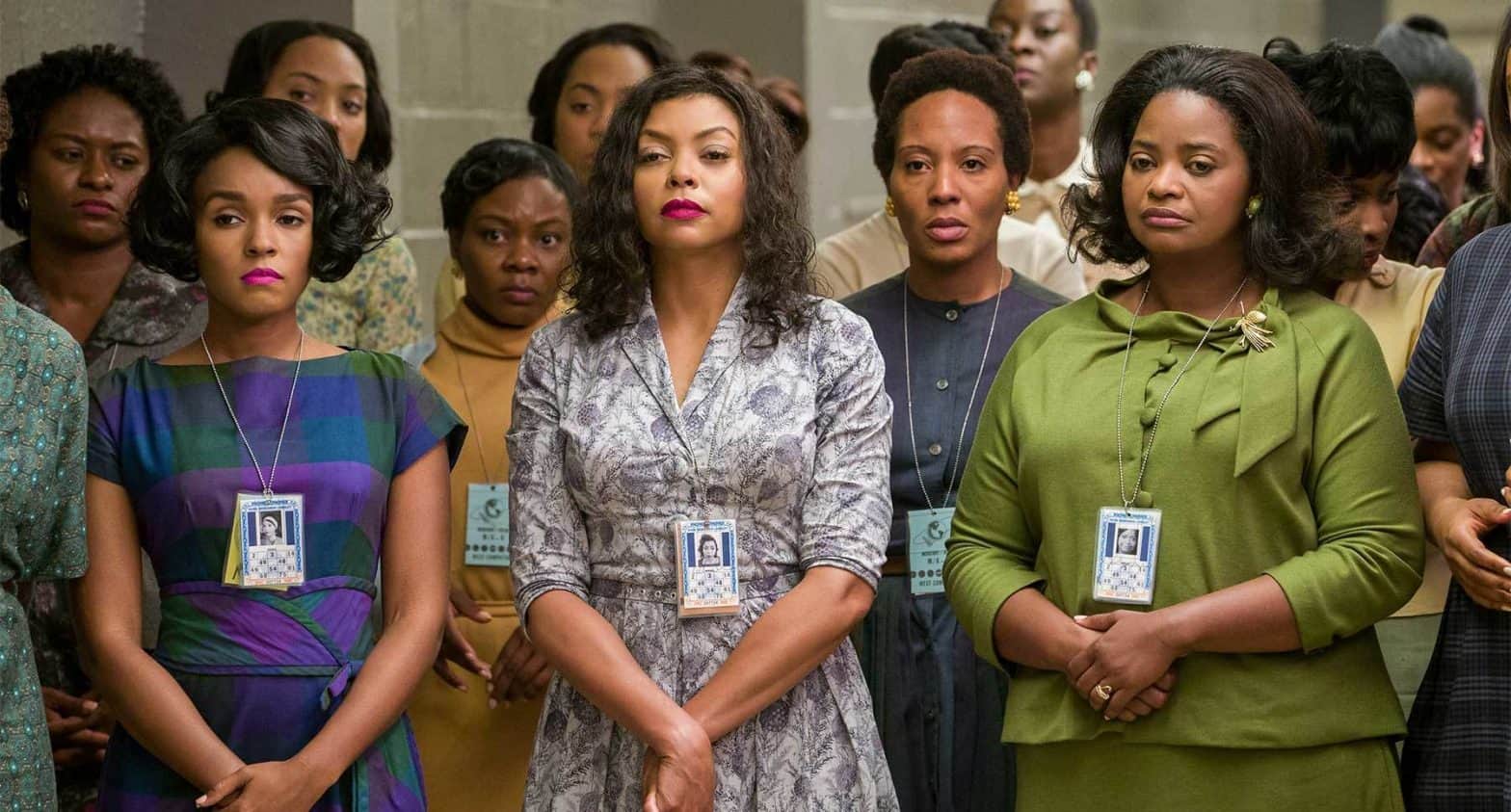
Monáe, Spencer, and Henson, of course, all fill their characters with unique traits and senses of resilience. Whether or not their real counterparts act the way they do here, Melfi and co. ensure the trio’s respective skillsets are fully utilizable. Jackson is introduced as an emboldened, unstoppable force from the get-go, and Monáe fills such a presence with unbreakable tenacity. When the trio gets pulled over by a white cop, Jackson instantly goes on the offensive: “No crime in being [Black] neither,” she says after a less on-edge Goble tries to calm the group’s nerves. After everything gets cleared, the policeman gives them a police escort, to which a now-driving Jackson tailgates him recklessly, saying: “Three [Black] women are chasing a white police officer down the highway in Hampton, Virginia, 1961. Ladies, that there is a God-ordained miracle.” Spencer represents Vaughan as a sturdy, self-assured presence who mothers Jackson’s recklessness and, more importantly, Goble Johnson’s lack of confidence. She’s always the first to reassure anybody upon another hard day: “Separate and equal are two different things. Just ‘cause it’s the way, doesn’t make it right. Understand…? You act right, you are right. That’s for certain,” she says with soft, widened eyes, a trying smile, and comforting arm rubs to her kids upon their being thrown out of a whites-only public library. Her moral compass allows Goble, thanks to Taraji P. Henson’s timid but open-minded portrayal of the NASA-vital mathematician, to grow increasingly confident throughout the film. Being the most brilliant of the three, she grows more sure of her ability to outsmart her cohorts from the opening scene until the end. Together, the three dominate the screen with different shades of personality and charisma that (hopefully) even the most racist viewers cannot resist.
Unfortunately, Hidden Figures suddenly comes apart for a good chunk in its latter half. After the unrevealed, most-remembered speech, things quickly flatline as fictional Space Task Group director Al Harrison (Kevin Costner) goes around literally hammering off the segregating bathroom signs. Surrounded by staff and a security guard, he beats away to a triumphant score before cheekishly declaring, “At NASA, we all pee the same color.” Such a moronic and entirely made-up scene that immediately follows what is arguably the film’s and Henson’s shining moment deflates all tension, ruining the following sequence of what should be a celebratory victory in the group’s first successful manned space launch. After that, until more racially motivated interplay reappears within the last 20 minutes, things move formulaically and as if white people suddenly were okay with their existences. The three women face other obstacles, give a ‘smart’ or ‘noble’ monologues to white judges or co-staffers, whose responses are usually little more than a chuckle and an easy pass. Firstly, again, most of those scenes didn’t happen, such as Jackson needing an entire court order to get through school. Secondly, with such a formulaic rise-and-fall in these newer obstacles to get to the film’s end, stakes and intriguing forward motion cease until the final crisis (which also didn’t happen in John Glenn’s real orbital launch, but returns to the aggrandizing intensity the film earlier flaunted). Thirdly, and perhaps more importantly, it’s an inadvertent white saviordom call. An excuse for whites to pat themselves on the back for all the progress we ‘allowed’ to happen, when in reality we fought such progress at every turn.
The director, Melfi, gives very unversed responses in addressing these claims: “There needs to be white people who do the right thing, there needs to be Black people who do the right thing, and someone does the right thing. And so who cares who does the right thing, as long as the right thing is achieved?” he exclaims in one interview. “I am at a place where I’ve lived my life colorless and I grew up in Brooklyn. I walked to school with people of all shapes, sizes, and colors, and that’s how I’ve lived my life. So it’s very upsetting that we still have to have this conversation. I get upset when I hear ‘Black film’…. Basically it’s modern-day segregation. We’re all humans. Any human can tell any human’s story,” he exclaims in another. With this known, it’s clear there is still a lack of understanding between the film’s white director, white co-writer Allison Schroeder, and any story of Black people’s struggles. Even for the white guy who watched Hidden Figures and types this now, that racially insensitive distance based around Melfi’s insistence of a “colorless” world is glaring, and it weighs Hidden Figures down significantly as the script simultaneously bloats.
Thus, while Hidden Figures is too historically inaccurate and self-indulgent to either consistently wow or properly criticize (mainly as it focuses racism primarily within a single state rather than as an intrinsically nationwide institutional flaw), its characters are relatable, the cast is enveloping, and the themes, for more than two-thirds of the time, are dramatically realizable. For history buffs and more socio-historically well-read viewers, don’t expect Hidden Figures to accurately retell its stars’ stories or the true takeaways of their experiences. But for drama fans, fans of the cast, historical fiction fans, and those in need of hope in the current times of crypto-and-fossil-fueled darkness, Hidden Figures is a most refined gem.
2016
dir. Theodore Melfi
127 min.
Screens FOR FREE Tuesday, 8/7, 8:00 p.m. @ Statue Park-Davis Square
Part of Somerville’s annual free screening series: SomerMovieFest 2025