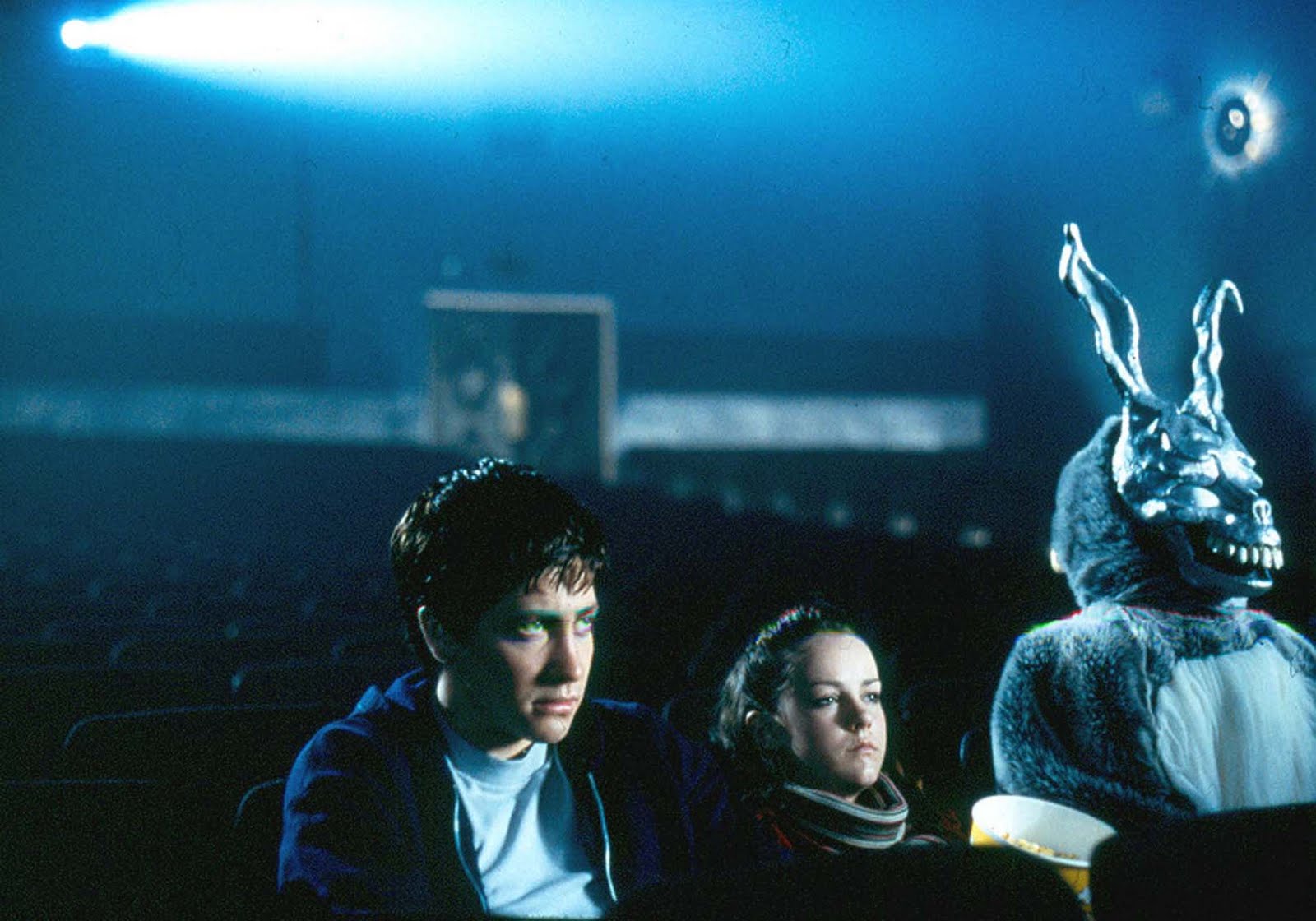
Donnie Darko is a surreal, psychotic, and gritty sci-fi drama about a troubled kid finding his purpose through morosely construed time travel. Director-writer Richard Kelly’s premiere feature continues jolting watchers with its ethereally unanswerable questions about fate, morality, and growing up in a harshly framed world. In a typical small American town, where politics spark tense dinner discussions and religion divides in its rigidity and occasional delusion, troubled teenager Donnie (Jake Gyllenhaal) stirs up trouble everywhere he goes. Whether through sexually explicit jokes about his eight-year-old sister Samantha Darko (Daveigh Chase), cracking racist jokes with his foul-mouthed and mannered friends, or staying out for god knows how long into the night, Donnie is standoffish and lost. Despite his parents and therapist’s best efforts, Donnie spirals into schizophrenic delusion that affects his schooling, social life, and sleep (he sleepwalks too!). Things get worse when, on October 2, 1988, Donnie has a vision from a rabbit-costumed stranger named Frank (James Duval). Frank the rabbit eerily warns of the world’s end 28 days from then, subsequently revealing how he came to Donnie through time and how time travel works. As Donnie strings together what’s to happen whilst simultaneously finding stability in a new girl named Gretchen (Jena Malone), he discovers more about himself, human emotion, empathy, the world, and sacrifice. He must see why time is warning him of time’s end before it does.
Donnie Darko takes teen angst and mental illness, charges them with a sci-fi apocalyptic tinge, and twists them with a boatload of socio-political subtexts, a scintillating character study, and thoughtful imagery. No one looks back at teenagedom fondly. A scarce lucky few may have aged unscathed, but for the rest of us, it was a time of awkward dynamics, unknowing miserliness, and bad decisions. For Donnie, it’s not much different. Portrayed as a pompous, emo, and insecure loner by Jake Gyllenhaal, Donnie stumbles with no real goal other than to disrupt and have fun, and he does. At the same time, he has some heart. As his friends mock a Chinese kid, spitting “Go back to China, bitch,” Donnie eventually tells them to “Just leave her alone” despite initially joining in on the fun. Even as he drags a cigarette and talks poorly about his parents, he has a clearer understanding of what’s right and wrong than the primitive nitwits he calls friends. Even so, his mental problems often get in his own way. With or without meds, he brawls hardest with his mother constantly: “What happened to my son? I don’t recognize this person today,” his mother asks a defensive Donnie who astutely retorts, “Then why don’t you start taking the goddamn pills…? Bitch.” He does his best in school under a more emotionally aware English teacher, but he can’t help but be at least verbally cruel and undermining at home.

When the rabbit thus first hops into Donnie’s consciousness—”Wake up, Donnie,” he raspily commands the titular character—Donnie thinks it’s a hallucination, as he sleepwalks to a nearby golf course and sarcastically smiles and Kubrik-stares at Frank, muttering “28 days, 6 hours, 42 minutes, 12 seconds.” Like with much else in Donnie’s increasingly reality-detached life, he presumes Frank is merely another imagination figment. As his therapist digs into him and his opinions about the people around him, she reinforces such a reality as well, referring to his real visions as daylight hallucinations, which are common for real schizophrenics. Unfortunately for all of them, Frank is very real. As Frank points Donnie to equally real points of time travel relevance—to the author of a book titled The Philosophy of Time Travel in which Donnie learns everything, for example, who is now referred to as Grandma Death by Donnie’s friends as she wanders back and forth to her house mailbox for hours at a time like a dementia-ridden senior—Donnie discovers a significant truth: time travel is partially pre-ordained and isn’t entirely controllable as in Back to the Future, meaning his involvement in saving the universe isn’t random. He has a purpose, and he must clear his conscience fast. That’s where Gretchen comes in.
Gretchen’s arrival sparks immediate romantic interest, driven in part by her past tragedies. In a weird scene, Donnie’s teacher asks Gretchen, the new kid in the class, to sit by the cutest boy; Gretchen sits by Donnie. Later, they walk home together, learning what they can. Gretchen’s violent family history spills; as her stepfather violently stabbed her mother multiple times, Gretchen has moved to town with a new identity to hide. This past makes Gretchen immediately attractive to Donnie, as Gretchen can understand his current tragedies alongside hers: “I guess some people are just born with tragedy in their blood,” she says at one point. Through her, Donnie not only learns about love and care but also begins to understand why he has the heart he has: to be good for Gretchen and the world. As they bond, kiss, and have many other romantic firsts together, Donnie’s integrity gets strengthened—and his purpose clearer as he begins going against legitimate villains, like the religious public speaker Jim Cunningham (Patrick Swayze), who eventually gets revealed as a pedophile. Gretchen teaches Donnie—just by existing, being kind to him, and relishing with Donnie in life’s many great wonders—that the world can be picturesque: “When it reminds you of how beautiful the world can be?” Donnie asks, correctly presuming Gretchen’s motive for not wanting her first kiss to be on a random street near a random onlooker. Despite the rest of the world always having such “beautiful” moments, it took Gretchen for Donnie to finally see them—and to see the true purpose for his need to time travel. Sacrifice is a given when time travel is tied directly to one’s fate and that of the world, and Donnie will do whatever it costs to keep Gretchen and her purity alive.
Along with a killer ’80s soundtrack, twisted cinematography and visual flair of futuristic misgivings, tragic or terse performances, and loads of timely references placing viewers inside the ’80s American sociopolitical climate, Donnie Darko presents itself as this millennium’s defining (and first!) independent sci-fi thriller that forces thoughts about fate, purpose, morality, and perspective on viewers. Not every vaguely open-ended answer is as satisfyingly question-inducing as they hope, but they don’t splash much in otherwise mesmerizingly murky waters of time travel and Donnie’s timeline. For sci-fi mystery fans, Gyllenhaal fans (as Maggie Gyllenhaal plays her brother’s on-screen sister, Elizabeth), psychological drama fans, and those looking for something poignant in its fantasies, Donnie Darko is an exquisitely dark time.
2001
dir. Richard Kelly
113 min.
Screens in 35mm Thursday, 11/6, 9:45 p.m. @ Coolidge Corner Theatre
Part of the ongoing repertory series: Cult Classics