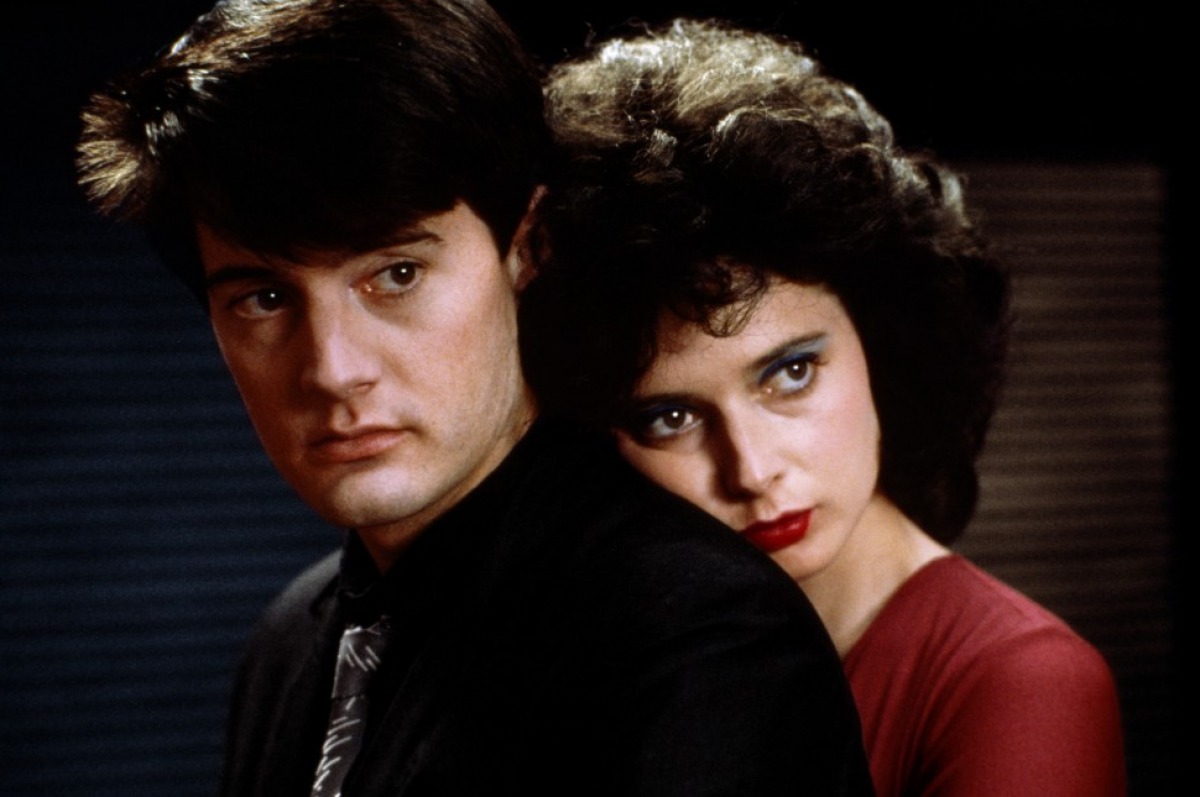
Blue Velvet is a convulsive, fluidly plotted, and sexually charged crime-thriller where trauma bonds and voyeurism are one’s least troublesome problems. Jeffrey Beaumont (Kyle MacLachlan), a curious, slightly perverse, detail-oriented high school graduate, finds a decomposed ear whilst throwing rocks at a shed it was near. He brings it to local Detective John Williams (George Dickerson), who advises Beaumont to leave the case to him—advice Beaumont is smart enough to follow until the detective’s own daughter, Sandy (Laura Dern), meets Beaumont and expresses a shared interest in the ear’s story. While initially an exciting venture into a new, thickly enveloping mystery, the pair break into the main suspect’s home, singer Dorothy Vallens’ (Isabella Rossellini) apartment, where they learn of the larger—and more violent—mystery. But before Beaumont or the younger Williams get the chance to report the crimes committed in Blue Velvet‘s electrically buzzy buildings, cornered spaces, and almost hazy color/lighting scheme, Vallens finds Beaumont and launches him into a traumatic spiral of sexual assault, violence of varying degrees, perversion, introversion, and general instability. With nothing but the now innocent appearance of his home life and Sandy’s ordinary teenage persona, Beaumont must fully solve this case without getting maimed, murdered, or, worse, scarred.
As good as people can be, there is plenty of room for the awful. Whether by choice or in reaction to experiences and environments, drug-fueled murderers, rapists, blackmailers, and kidnappers exist. We all have that capability; it’s mostly a result of how we get raised, the people around us, and, eventually, our reactions to life. Unfortunately for Beaumont, he stumbles upon a man of all four aforementioned talents, clearly riddled with dysfunction from an equally destructive past that never gets revealed. As Frank Booth (Dennis Hopper) gets nitrous high, screaming “Mommy! Mommy I need them!” at Vallens before beating her yelling “Don’t you fucking look at me!”, viewers see a man who’s lost control of his destiny. With every muscular twitch, eye widen and deadly serious reminder of Booth’s madness capacity that Hopper eloquently emphasizes, both viewers and Beaumont get a traumatic taste of the real world: people, especially white men, are allowed to roam free sick as dogs.
Blue Velvet then uses Booth to demonstrate in both Vallen and Beaumont how trauma bonding works. Before Booth even appears, Vallen terrorizes and nearly sexually assaults a broken-in Beaumont slightly less torturously than—but still in reflection of—Booth’s minutes-later episode. Beaumont, traumatized but understanding of Vallen’s position, tries to comfort her, which only leads to a majorly concussed Vallen begging him to “Hit me! Hit me! Do you like me? Then hit me!” For anyone who has taken psychology courses or has lived through such pattern-creating trauma, it’s easy to see how natural Vallens’ request is; it may be a fucked up situation, but it’s what she knows. This trauma-induced habitual behavior then leeches onto Beaumont, who dreams nightmarish rehashes of Vallens’ awful requests and of a violently high Booth—nightmares that inevitably hook him onto the case for the rest of the film, even as his better connections like Sandy beg him to do otherwise. It becomes clear that Blue Velvet’s sexual aggression is not at all the point of the film; it astutely begs even the most insensitive, un-traumatized viewers to understand the complexities to being a sexual victim, let alone a victim of any kind of abuse. Even as love reigns supreme, those memories will never get forgotten.
Thus, though remaining separate from the actual dreamscape unlike much of Lynch’s work, Blue Velvet is an eye-peeling—if insanely disjointed and loosely plotted—gaze at some of the worst human actions imaginable, imploring viewers to understand the psychology behind these people and why victims keep going back. As Booth himself says, “In dreams, I walk with you, in dreams, I talk with you… in dreams, you’re mine forever,” a nightmare neither Beaumont nor Vallens can escape easily from. Along with engrossing in-shock performances all around clever metaphors not even aforementioned, and a slight neo-noir feel that alleviates some of the film’s more jarring (to say the least) components, Blue Velvet is a mind-boggling classic for David Lynch fans, crime-thriller fans, or fans of Dern, McLachlan or any of the rest. It’s half-suave, half-sadistic, and engaging all around.
1986
dir. David Lynch
120 min.
New 4k Remaster screens Tuesday, 4/15, 7:00 p.m. @ Landmark Kendall Square Cinema
Part of the ongoing repertory series: Filmmaker Focus: David Lynch
Also screens Friday, 4/18 @ Somerville Theatre in a double feature w/ Wild at Heart