
Bitter Victory is a cathartic, terror-charged, and character-driven psychological war drama about two soldiers fighting each other as much as they fight the Nazis. While a tumultuous churn of formulaic beats muddies Bitter Victory‘s otherwise darkly entertaining psyche exploration—and its racist Arab depictions feel outdated even for the ’50s—the film’s sturdy ensemble, themes of duty vs. love, and surprising openness regarding gender make it a morosely enlightening war flick. During World War II’s Western Desert Campaign that saw Allied forces infiltrate Egypt, Libya, bits of North Africa and other Middle East regions, British Forces General Patterson (Anthony Bushell) interviews two very different officers: Major David Brand (Curd Jürgens), a South African army officer with no combat/command experience, regional knowledge Arabic linguistic abilities, and Captain Jimmy Leith (Richard Burton), a Welshman volunteer with extensive Libyan knowledge and linguistic prowess. After they’re both interviewed, they come to know each other over drinks, where Brand’s Women’s Auxiliary Air Force Flight Officer wife Jane (Ruth Roman) gets introduced and, unbeknownst to Major Brand, gets revealed as Leith’s former lover. Jealousy heightens in both men’s minds, and, unfortunately, they get assigned to the same Libyan mission under Major Brand’s command. As war drives them and their men towards survivalistic limits in the harshly dry sands of the Middle Eastern desert, Brand and Leith discover each other’s true natures—and why maybe only one of them should return to base.
Bitter Victory lives up to its name in its Brand-Leith focus. While this predominantly French production maintains a fierce grip on the war-ravaged wastelands Brand and co. sludge through—sand-sunken vehicles and sun-baked dead and injured almost force the smell of gunpowder and blood through the screen—Brand and Leith’s opposing reactions are what make that eventual Victory feel Bitter. As Leith remarks to a fearful Brand himself, they’re “mirror” images of each other’s strength and “weakness”; Leith, unafraid of danger and personal cost, is among the first in Brand’s regimen to jump to action. Whether attempting to carry a fatally wounded man back to base—”Damn you! Let me down, damn it! You’re hurting me! You coward! Leave me alone!” the gravely injured soldier screams on Leith’s back—strategizing with the troops, or killing the most Nazis, he never hesitates. Brand appears cowardly in comparison. Never one to jump into battle or go out of his way to help his men, Leith becomes suspicious upon the pair’s first stealth op as he sees Brand’s knife-armed hand trembling. Brand’s lack of killing experience bleeds through, only worrying Leith and viewers as the mission intensifies. Unfortunately for Leith, Brand’s inexperience and lack of dedication also allowed him the time and energy to wed Jane, an achievement Leith will seemingly never attain, given his fighting spirit.
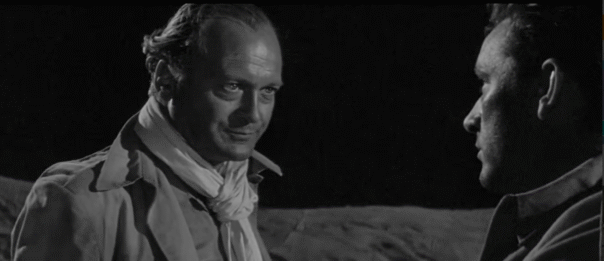
So, ultimately, who comes out alive, and who takes Jane’s hand? Boiling down to the pair’s differing traits and reactions, only experience, jealousy, and zeal will determine that. But once Brand makes his first kill, a scorpion-stung Leith relents, “We’re all murderers now, aren’t we? Welcome to the club.” They’ve become closer to each other through the field’s necessity for grit and remorseless murder, with both understanding—or, for Brand, coming to understand—there to be little difference between that violence and war’s larger casualty figures, and that they themselves deserve chances at prosperity once it’s all over. They finally understand it’s not a competition, but a learning experience: for Brand to be a better soldier, he must stand up and fight, and Leith must allow himself more than the frontline to live a plentiful life. But alas, only one learns his lesson as Leith pleads to Brand in case he should perish, “Tell Jane that she was right and I was wrong”—Leith could never be more than a good soldier. Whoever comes out alive must bear the burden of their fallen comrade and the lessons they taught, whether or not they can adhere to such new understandings.
Thus, along with engulfing performances by Burton, Jürgens, and their varying supporting castmates, an impressive amount of isolating war imagery yielded from the film’s CinemaScope techniques, and heartbreaking instances of tragedy across both sides of the war, Bitter Victory is indeed a Bitter insight into war’s personal tolls. While flattened side gags meant to flesh out the battalion’s dynamics are too cheeky to make them feel like a group of real people fighting a real war—and the aforementioned formulaic execution doesn’t help—there are more than enough revelations of the heavy sins and traumas war brings. For war flick fans, old cinema fans, Burton or Jürgen fans, and those looking for a poignant reminder of violence’s heavy (and unnecessary) costs, Bitter Victory is a hefty viewing. “No more war,” a dying Nazi soldier begs Leith before getting put out of his misery—if only he knew the price peace costs even now, as the Israeli-Palestinian and Ukraine-Russia conflicts continue to shake the world to its core.
1957
dir. Nicholas Ray
102 min.
Screens Friday, 11/21, 7:00 p.m. @ Harvard Film Archive
Part of the ongoing repertory series: Columbia 101: The Rarities