The Boston Baltic Film Festival screens the Latvian classic as a fundraising event later this week.
Depending on who you ask, A Limousine the Colour of Midsummer’s Eve might be the all-time Latvian classic. The National Film Centre of Latvia calls it “arguably the most beloved Latvian movie of all time,” and Latvians on Letterboxd regularly log the film while saying things like, “In Latvia, it’s permitted to shoot people who don’t like this kino.” That’s a joke, of course, but it also highlights the emic importance of the film.
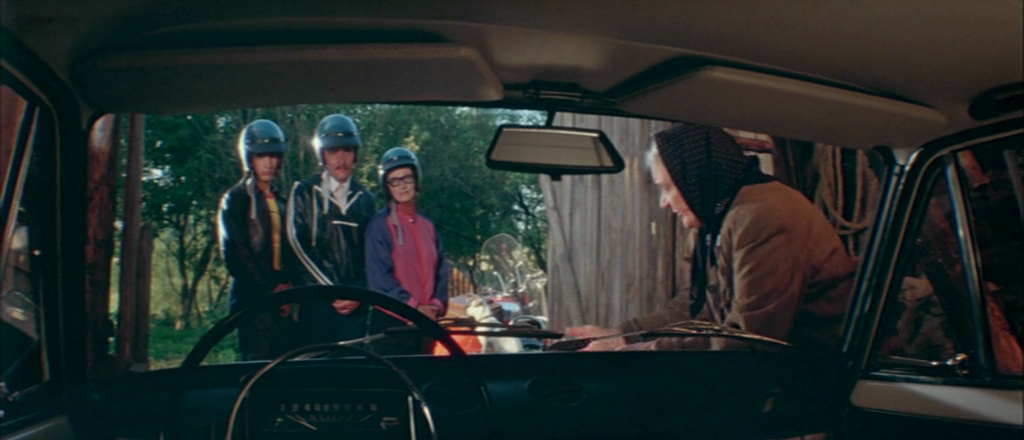
Aunt Mirta (Lilita Bērziņa) is old and probably dying when she wins a state lottery for the new Zhiguli model, a rare and highly sought-after automobile commodity in the Soviet Union. Long lost and distant relatives come out of nowhere upon hearing the news to cozy up to the old woman as she prepares her final will and testament. Her nephew Ēriks (Uldis Dumpis), his wife Dagnija (Olga Dreģe), and their son Uģis (Gundars Āboliņš) cancel a fancy vacation in the Carpathian Mountains to spend time with Mirta in the agrarian countryside. Later, a woman shows up whom Mirta doesn’t quite recognize. It’s her former daughter-in-law Olita (Baiba Indriksone) and her family: husband Viktors (Boļeslavs Ružs) and daughter Lāsma (Diāna Zande). The families are (un)healthy mixes of deadbeat losers, lousy lovers, and just plain mean people. None of them deserves the kind final gesture of Mirta and this becomes even clearer as we spend more time with them.
The classic by director Janis Streics takes place around the Latvian summer solstice festival of Jāņi, a holiday that comes with loaded memories for Mirta of her departed husband. Flowers are everywhere, the colors are warm (particularly so in the beautiful 2008 restoration), and the light-hearted swaying music gifts the picture its whimsical tone. The setting, combined with the themes of leisure, young love, and preparing for the future, makes it a wonderful summer movie. It’s to Latvian summers what Charlie Brown is to American Thanksgiving: a television staple.
Comedy is the most ephemeral of film genres. What is funny in one culture may differ from what is funny in another. Time also kills comedy, as the context and relevance shift with the months, let alone the years. Limousine’s humor—dependent on awkward family situations and the context of a dying empire—translates well into both English and the present. Bērziņa, a stalwart of the local theater scene who came out of retirement for the role and would die shortly after, had impeccable timing and line delivery. No scene illustrates her talents better than when she asks someone else to read her will aloud, but instead accidentally hands them a paper about the artificial insemination of her cows. She gives an impeccable, multi-note old-lady performance. You won’t need to be Latvian to laugh along to this Baltic classic.
It’s also a patriotic film. Filmed in 1981, Russian was the lingua franca of Soviet film at the time, and the choice to film (mostly) in Latvian instantly limits the reach while increasing its importance for the language speakers. Limousine feels more like a Latvian film than a Soviet one. Raimonds Pauls composed the music for the film and several of the songs clearly carry patriotic undertones. The most nationalistic of these might be “Teic, kur zeme tā” (Say, Where The Land Is) with lyrics that wouldn’t be out of place on a Woody Guthrie record with its subtly subversive land claims: “Say, where the most beautiful land is … / Here is my homeland.” Paul’s patriotic Latvian score anticipates his lengthy political career in the late-Soviet period and post-independence; he even won the 1999 presidential election but refused office after failing to reach the necessary majority of votes. The holiday context also connects the then-contemporary Soviet Latvia to pre-occupation (and even pre-Christian) Latvian traditions. For what it is worth, Jāņi and the day before it are now national holidays, authorized days to celebrate nationalistic sentiments.
It may be the middle of winter, and Jāņi may be far away, but seeing A Limousine the Colour of Midsummer’s Eve with a packed crowd of Latvians and other Balts at BBFF’s fundraising screening is a rarity any Boston cinephile should rue missing.
A Limousine the Colour of Midsummer’s Eve
1981
dir. Janis Streics
83 min.
The Boston Baltic Film Festival is screening A Limousine the Colour of Midsummer’s Eve on January 17th at 4:00 PM at 58 Irving St., Brookline, MA, as a fundraising event. Suggested donation of $35. The event also features live music; Baltic food; and a raffle including BBFF tickets, Brattle Theatre and Harvard Film Archive memberships, & more!