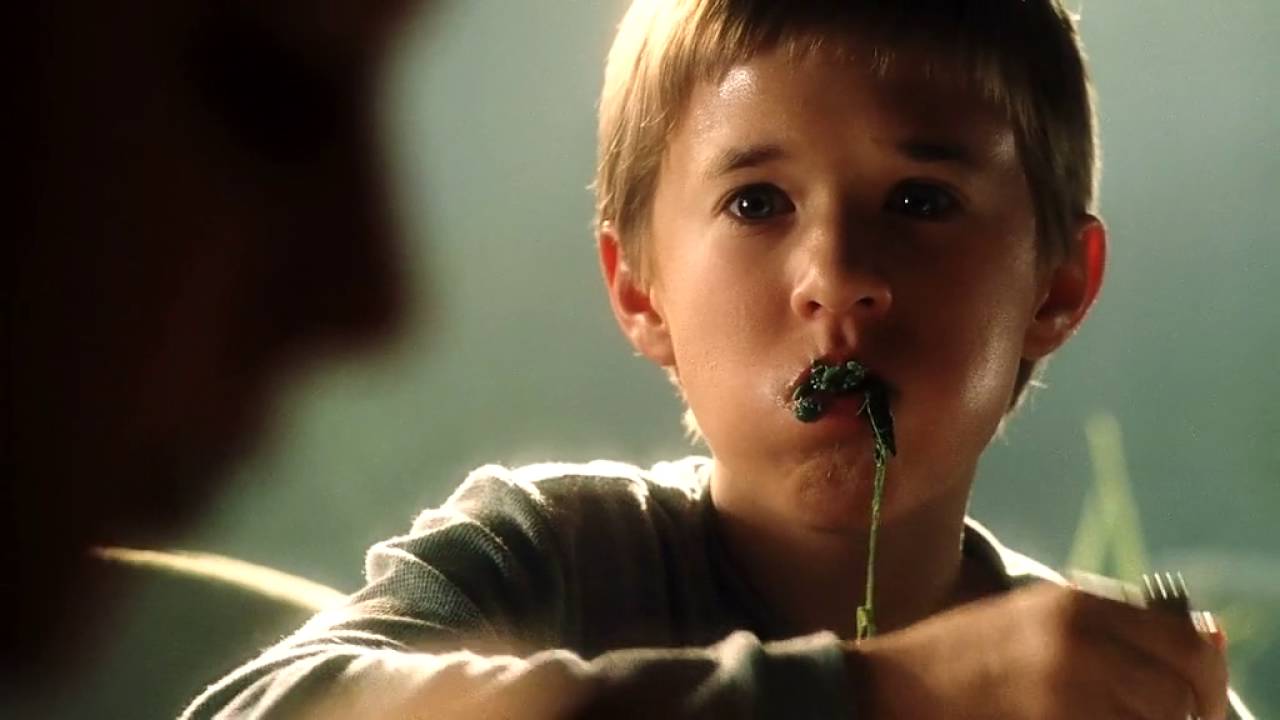
A.I. Artificial Intelligence is an emotionally profound sci-fi adaptation of Brian Aldiss’s short story, “Supertoys Last All Summer Long,” that touches on the morality of kids’ fairy tales and how those same wishes define humanity’s core. Though somewhat uneven due to its competing directorial visions–Kubrick’s clinical, analytical approach versus Spielberg’s emotionally driven storytelling– this one-time collaboration explores humanity’s strengths and flaws through the eyes of a “kid” named David (Haley Joel Osment).
In the 22nd century, climate change has won, and humanity struggles with population decline, forcing global government to produce mechas, humanoid robots meant to fill needed roles in society. David’s one of them; designed to experience love and affection, David is a kid-looking robot meant for those who can’t bear children, or who’ve lost theirs, or who want another. Created by Professor Allen Hobby (William Hurt) and secretly designed to look like his own dead son, Hobby convinces an international board to send a trial David to a couple, Monica (Frances O’Connor) and Henry Swinton (Sam Robards), who already work for the company and whose own kid, Martin (Jake Thomas), is held in suspended animation to stop an incurably fatal disease from progressing. Though he’s initially accepted—with Monica going so far as to activate David’s imprinting program, attaching him to her as her child, and giving him Martin’s beat-up old supertoy, Teddy (Jack Angel)—things quickly fall apart when Martin returns home, cured. Within days, David faces the worst fear any kid holds: his mommy leaves him on the side of a road, simply saying, “I’m sorry I didn’t tell you about the world” before shutting him out permanently. Now in a rougher world than imaginable, where mechas are hunted and tortured for fun, David resorts to the promise of an old fairytale—that the Blue Fairy from Pinocchio can turn him “into a real boy”—to get what he wants: his mom’s love and acceptance, as every youngin’ wants. He tests his mecha and human limits against impossible odds, demonstrating the power (and, to some extent, the toxicity) of the will we all share to get what we need or most desire.
If the above sounds like a mouthful, A.I. Artificial Intelligence is. There’s so much exploration of this humanity-dying world, the main characters, their morality, and the real differences (or lack thereof) between mechas and humans that sometimes it’s hard to remember the film’s core messages. None of it’s in poor taste—quite the opposite, as Spielberg’s darker elements deepen Artificial Intelligence’s somber lows that Kubrick’s cozier, more analytical components didn’t muster—but the competing visions make Artificial Intelligence janky and much slower than it seems intended to be. Going from the predominantly observant family drama of the film’s first 40 minutes (Kubrick) to a much splicier, disproportionately explosive rest of the world as told through the Flesh Fair’s savage, Roman gladiator-esque display of mecha annihilation (Spielberg), for example, is overly jarring. Though it’s slightly mystifying to watch A.I. almost converse with itself as the film unfolds—perhaps reflecting how real AI chatbots and slop-art programs operate—the difference is noticeable enough that David’s dream-driven adventure can feel sloppy. Fortunately, for the most part, Osment’s mechanically precise performance, grand-sweeping ideas and demonstrations of humanity’s deepest traits, gorgeous visuals, and an intriguingly restrained score from John Williams maintain A.I. Artificial Intelligence’s soul-searching strengths even in its long-winded workarounds.

There really are only a few things that make life worth living. Details may vary from person to person, but it usually boils down to one component: our loved ones. Regardless of dynamics, love knows no bounds; family, friendship, romance, etc., love, mutual respect, and genuine care. While yes, David was programmed to experience and give these same treasures of life to someone he imprints on, he learns firsthand what it looks like to love and be loved through Monica, how it feels to be rejected once her “real son” re-enters the picture, and how bloodlessly cold a world without much love functions. Going from the pristinely clean white-washed walls and spotless surfaces of a well-loved family home to a literal trash heap of one’s metal-borne brethren’s body parts would drive many insane or to suicide. David, though, in all his naivety about the world and human hope for some way forward, does the opposite: he follows his dream of becoming a real boy, no matter where it takes him. Though a bit obsessive—at no fault of his own, like many human children might be when parents cut them off—and not without a little help from Teddy and a lover mecha named Gigolo Joe (Jude Law), instead of giving up or surrendering, he continues adapting, insisting, and denying alternate options in search of what makes him happiest. The bigger the Artificial Intelligence world grows, the more devoted David grows to reunite with his mom, and the more other traits of humanity—our contradictory capacities for brutalism, kindness, othering, acceptance, self-destruction, and recovery through bonds—seep through in David’s creation, creator, assigned mother, friends, and enemies. Even if David’s dream is instead “part of the great human flaw to wish for things that don’t exist” and he is, in fact, “a real boy, or as real as I [Professor Hobby] ever made you,” his capacity to desire, love/hate, self-motivate, and learn in reaching for the stars proves humanity’s most sacred characteristics prevail. Love and our need for it are too fundamental to human existence, as A.I. repeatedly underscores.
That love—only a chunk of what this Kubrick-Spielberg sci-fi feast serves—makes bravery, and that bravery drives soldiers to go to war, medics to save lives, parents to raise kids, and people to do the right thing where they should. David reminds us and some advanced mechas who eventually find him why we should all love and dream more. If we keep yearning and hoping, perhaps we can get at least one more perfect day and continue helping each other achieve the same. For Kubrick fans, Spielberg fans, sci-fi lovers, and those looking for a hopeful gaze at humanity’s soulful continuation, A.I. Artificial Intelligence is an organically smart, heart-piercing tragedy.
2001
dir. Steven Spielberg
146 min.
Screens Monday, 4/27, 7:00 p.m. @ Harvard Film Archive
Ending of the ongoing repertory series: The Complete Stanley Kubrick