Diractors is an ongoing series in which Hassle writer Jack Draper examines films, new and old, whose directors are better known for their work in front of the camera.
“You’ve been tryin’ to get yourself hung for the last fifteen years kid. This time I think you might have made it.”
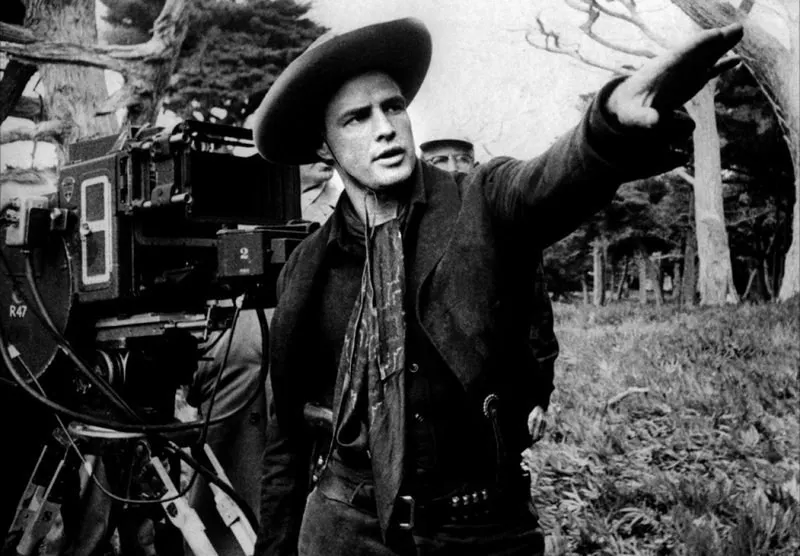
In the long tradition of westerns directed by actors, Marlon Brando’s One-Eyed Jacks fits in just fine with the careers of Clint Eastwood or Kevin Costner. Brando’s dedication to his craft makes it seem like he would have directed more than one movie. It would be an okay assumption to make; in Jacks, Brando proves once more that an interesting actor frequently makes an interesting director. This, combined with Brando’s pioneering way of inhabiting a character, can give one a sense of how Brando felt that Charles Neider’s novel, about the life and myth of Billy the Kid, would make a good fit for his talent. Simply put, Brando and his collaborators artfully take the groundwork created by masters like Anthony Mann or John Ford and riff on the complicated heroes and depraved villains. There’s a bridge to be found here between the productions of old Hollywood and the emotional intensity of new Hollywood.
Running from the law after a bank robbery in Mexico, Dad Longworth (Karl Malden, in a role earmarked for Spencer Tracy by original director Stanley Kubrick– both great options) finds an opportunity to take the stolen gold and leave his partner Rio (Marlon Brando) to be captured. Years later, Rio escapes from the prison where he has been since, and hunts down Dad for revenge. Dad is now a respectable sheriff in Monterey, California (beautifully shot on location), and has been living in fear of Rio’s return. Meanwhile, Rio has been manipulating and taking advantage of Dad’s step daughter, Louisa (Pina Pellicer, in her very tender debut role), without a care for his old friend. The nastiness of the movie leans into how much Rio wants to make the disturbing relationship even more real– more than just something to get back at Dad for becoming something Rio hates. After Rio takes advantage of Louisa the day of a town festival, Dad publicly humiliates him, but this only makes Rio want to go after Louisa more rather than go directly after Dad. After a bank robbery goes wrong without Rio’s knowledge, he is blamed and imprisoned by Dad as a way to make Rio feel for the pain he caused the town and himself. Yet the movie is so compelling to not waver from letting the moral superiority of Dad not automatically make him the hero.
I felt this film in its entirety. These mates see that the line is very much drawn in the sand by the opposite sides of the law they represent. It’s especially clear to Dad, who’s all about honor and integrity. Rio, meanwhile, can’t change who he is, unlike his ex partner. Malden’s bluster is a perfect complement to Brando’s typically soft-spoken manner. Dad’s intensity is well measured by his slow downfall once his power is usurped and his ability as a family man is put to the test. When confronted, he accuses Lousia, “You’ve never appreciated anything I’ve done,” when he looks like a worse role model than Rio. Battling for her trust is one tragedy; the other is that his inability to see who the other man has become, making it more difficult to leave this partnership for dead. Cinematographer Charles Lang beautifully captures the California ocean, as if these men will be washed up by their violent actions.
I enjoy Howard Hampton’s Criterion essay for the movie, particularly his astute observation, “If One-Eyed Jacks proved anything about Brando, it was that it’s all true—everything dubious, childish, and questionable about him, as enumerated by snark-tanking gatekeepers from Truman Capote on down to the lowliest tabloids.” It’s difficult to not enjoy One Eyed Jacks in two halves that make up the experience. The first half is devoted to the ideas and how successful Brando is at being a filmmaker. The second, meanwhile, is about the troubled production that nearly put Pennebaker Productions in debt. When producer Frank Rosenberg bought the book, he hired Sam Peckinpah to write, Stanley Kubrick to direct, and Brando to star. Then Brando fired Peckinpah, hiring Guy Trosper in his stead. Brando then stepped into the director’s chair once Kubrick departed to get Lolita off the ground (and because he couldn’t take Brando’s perfectionism). Brando ended up shooting over a million feet of film (when a normal production for this time is 10 feet of film used for every one foot used for the final cut), the budget ballooning to 6 million dollars (65 mil in 2026 money). In a 1975 Rolling Stone interview, Brando said of directing, “You work yourself to death. You’re the first one up in the morning… I mean, we shot that thing on the run, you know, you make up the dialogue, the scene before, improvising, and your brain is going crazy” Clearly, One-Eyed Jacks was a stressful movie to live through, especially with as many hats as Brando wore. Like Warren Beatty after him, Brando did reach a status within the industry allowed him the ability to smooth over an ambitious production. It probably wasn’t the right movie to direct first if Brando wanted to direct again, but I’m happy this was fine tuned enough to be as great as it is. I feel like adapting Tennessee Williams was right there if he were up for it!
One-Eyed Jacks
1961
dir. Marlon Brando
141 min.
Currently streaming on Tubi, Hoopla, Amazon Prime, and countless other platforms