
Diractors is an ongoing series in which Hassle writer Jack Draper examines films, new and old, whose directors are better known for their work in front of the camera.
“The land of opportunity? Where? Where is it? Show me? Somebody show me where the land of opportunity is.”
The funeral for America was 40 years ago, and Lee Grant read the eulogy. Not as a reflection as a way things were, but how the system works fine and shows itself to be immovable. People are unable to do anything but accept a fate undesirable and unexpected. We are educated on systemic hardship, and become aware that this country doesn’t love us the way we love it. In Down and Out in America, Grant was able to document people waking up to how little we are cared for without money or power. The poor no longer look like a disheveled man with fingerless gloves huddled around a fire in a garbage can. Down and Out reminds me a bit of Diane Keaton’s Heaven, both films that can challenge an idea of how someone can get to the place of ultimate struggle. Or, for that matter, Lost in America, in which Albert Brooks shames the idea of Reaganomics and its failed experiment for prosperity. It’s a difficult tightrope to walk making something this timely, and Grant passes beautifully.
Down and Out is a story about America prior to the Reagan era just as much as it is about the failure of the economy. The recession of the 1980s split the country into the haves and have-nots, from family farmers to factory workers and homeless people forced to live in decrepit welfare hotels. This split happens very suddenly and to educate people with goals but nobody to help those goals. On the verge of losing everything, courageous Americans discover the power of community organizing to fight injustice. Still, it’s a very quiet fight that has a far too powerful opposition. Starting in middle America, there’s a sense of grief on the looks on everyone’s face. “It’s a war,” a farmer muses, “No blood yet, but I’m afraid there will be.” Across the country, we are told, farmers are $215 billion in debt; in Minnesota, the banks foreclose on 250 farms a week.
The documentary visits a farm auction near Sauk Centre– once the home, though no one mentions it, of Sinclair Lewis. Grant speaks to an employee of the bank holding the auction. The bank officials don’t look much different from the farmers, except they have suits on and stand on the other side of the desk. They’re just a group of people upholding the structures in place and another feeling the weight of capitalism’s taking a bite of someone’s livelihood. While this isn’t the most dramatically gripping thesis, it is very easy to join the doc’s side about this injustice. As the issue stands, the bank wants the farmers to put up unmortgaged property as collateral for their loans. It might seem reasonable, yet Grant can’t look past how corrupt this is in the face of false hope.
Grant then moves the narrative from middle America to Brooklyn. We’re now interviewing a young couple, Bruce and Kathy, with their kids on the street, scraping by on the welfare system, with nobody to pour their hearts out to but Grant’s camera. This is a family who is loving and capable, but it amounts to nothing without money. They are trapped in bureaucratic hell when making the slightest attempt to make a life together. It’s in this section of the film, more than our time in middle America, that feels most familiar today, a plea for help in the streets of New York. Seeing them visit their apartment that caused them to be unhoused due to a fire is like visiting a cemetery. Grant takes them down to a boardwalk, where they both start to break down that their marriage has gotten “hostile” and that there is an 18-year waitlist to get housing because of the size of their family. Being unhoused makes them “easy targets” for having their kids separated from them without a home or money. They’re both so young– 27 and 30 years old. Grant asks few questions and plays no music to underscore the pain of knowing how far behind in life they are.
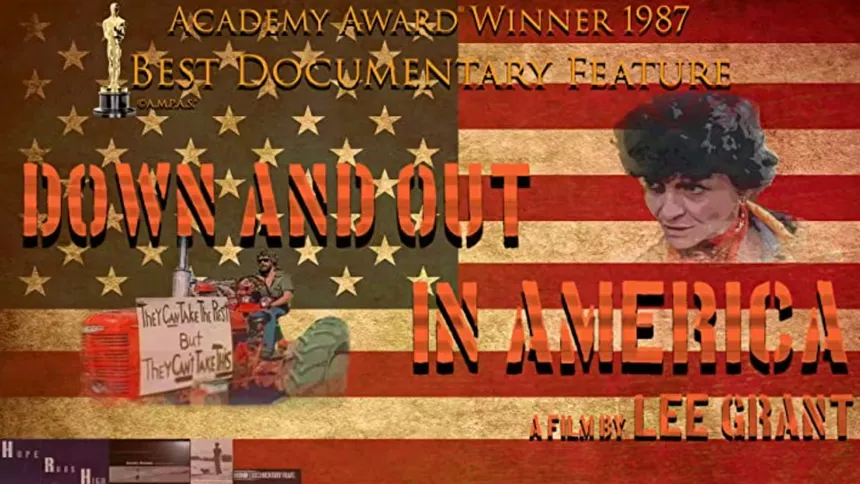
Lee Grant has done everything you can do in Hollywood through her 70-year career on stage and screen. She became an instant sensation, turning in a memorable performance in The Detective Story on Broadway, then reprising her role in the film adaptation. She got nominated for Best Supporting Actress for the role in 1952, then was swiftly blacklisted due to her involvement with screenwriter Arnold Manoff. Stuck in purgatory and unable to work consistently for about 12 years, her career took a hit until the mid ’60s. Her comeback came when she was cast in In The Heat of the Night, ands she slowly integrated herself back into the acting community. Warren Beatty cast her in Shampoo, for which she won an Oscar for Best Supporting Actress. This was bittersweet for Grant; it was a deserved and joyful win, representing her full acceptance back into Hollywood, but she was approaching 50 and knew that interesting roles tend to dry up for women approaching that age. Thus began her curiosity for filmmaking. The American Film Institute had a program for women filmmakers, giving her career a resurrection and allowing her to some of the finest docs of all time. Down and Out and America would go on to win the Oscar in 1987 and remains one of the great statements on America’s sins.
Down and Out in America
1986
dir. Lee Grant
57 min.
Currently streaming on Kanopy