The Boston Palestine Film Festival runs online from October 13 through October 22. The live component has been postponed due to the tragic current events in Palestine and Israel. Click here for the schedule and ticket info, and watch the site for Joshua Polanski’s continuing coverage.
ALAM (2022) dir. Firas Khoury
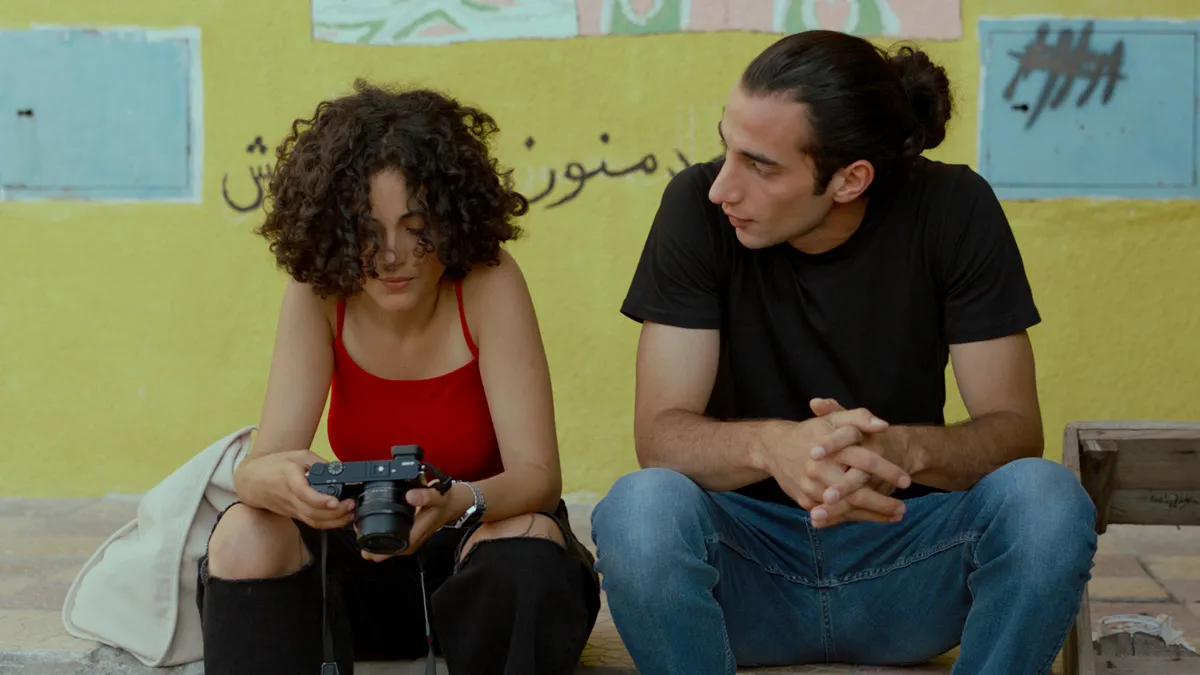
Earlier in 2023 the State of Israel banned public displays of the Palestinian flag. The flag is an “identification with terrorism,” according to far-right national security minister Ben Gvir. This is the context that Firas Khoury’s Alam (The Flag in translation) precedes by mere months. Khoury’s feature debut about an “operation” of Palestinian high schoolers to replace their school’s Israeli flag with a Palestinian one preemptively fights these alt-right policies with a creative combination of revolutionary images and sounds that only become more potent in the face of the prohibition.
School troublemaker and social flâneur Tamer (Mahmoud Bakri, a lesser-known member of the Bakri acting “dynasty”) has run out of strikes at his Palestinian school in Israel. One more mistake and he’s expelled. He doesn’t seem to care about much and wastes his time goofing off with friends and watching MILF pornos until a pretty girl (in real life) catches his attention (Maysaa’, played by Sereen Khass). The lesson he must learn is a simple one (though it’s certainly not part of the preparation for the Israeli Bagrut certificate): he has much more to lose than an education.
Safwat (Mohammed Abd El Rahman) is the most politically aware of the group, the “mastermind” of the flag plot, and intentionally sees the operations as more than a symbol of resistance. For him, it’s the start of a revolution. Shekel (Mohammad Karaki) and Rida (Ahmed Zaghmouri) connect and fill in the gaping hole between Tamer and Safwat while also littering a non-distracting amount of humor.
Tamer lives alone, a convenience both for the flag scheming and also his love life (Maysaa’ lives in eyesight from his front door). A non-imposing grandfather clock with only a secondhand stands tall in his apartment: it is always the right time for action. As the Lenin quote goes, “There are decades where nothing happens; and there are weeks where decades happen.” Khalil’s film shows what the start of the latter could look like…and who might be the most well-equipped to start it: the students.
I strategically picked a Lenin quote here, since he’s on the mind of the filmmakers. The students try to buy weed from a disillusioned man who goes by the nickname “Lenin.” This Lenin lives with his elderly mom and doesn’t seem like much of a revolutionary, though a worn hammer and sickle decorate his wall (right next to a magazine image of a woman in a bikini, purposefully cutting off her head). If he was once an earnest revolutionary, that energy for change has been siphoned and spent elsewhere (perhaps on weed). He’s not a lumpen—but he’s certainly not part of any radical solutions that Palestine might require.
And while he may live on his own, privacy is a right neither Tamer nor his friends share. His dad barges in twice and on both occasions Tamer has company hiding elsewhere in the house (one he knows about, the other he doesn’t). Elsewhere, the students turn their phones off when having conversations they’d prefer to keep away from the snooping and ever-present ears of Mossad. The Palestinians in Israel are never entirely alone.
Alam finishes with a spectacular series of symbols and sounds. In the first, an Israeli soldier shoots a protester in the head on the anniversary of the Nakba. What makes the image powerful is we only see this through the blurred background of a centered image. We are supposed to see that we don’t see. It’s moving precisely because it obscures the identity of the victim. Do we know them? Are they one of the students? Which one?
And in this moving indefiniteness, it can be anyone. That’s a fact of life under the Occupation.
But the final two scenes—involving a burning olive tree and a recording of Leonard Cohen’s version of “The Partisan,” with the olive tree being both the national tree of Israel but also a symbol of Palestinian resistance. “It represents the steadfastness of the Palestinian people, who are able to live under difficult circumstances,” said Sliman Mansour, a Palestinian painter in Jerusalem to Arab News. “In the same way that the trees can survive and have deep roots in their land so, too, do the Palestinian people.” A burning olive tree, and what that might signify, I will leave for you to decide.
Equally vigorous is Cohen’s rendition of “The Partisan,” which plays just before the credits begin. The song was originally recorded as an anti-fascist anthem during the French Resistance, an important alt-right political analogy that Khail makes only slightly. The singer is more important. A global citizen, Cohen might be the most widely known and beloved Jewish artist of the 20th century. Through Cohen’s version of the song, Alam relates in quiet but quite powerful terms a clear message: Nakba and Shoah both mean “catastrophe.”
I’m not sure how many better endings I will see this year.
BIR’EM (2022) dir. Camille Clavel
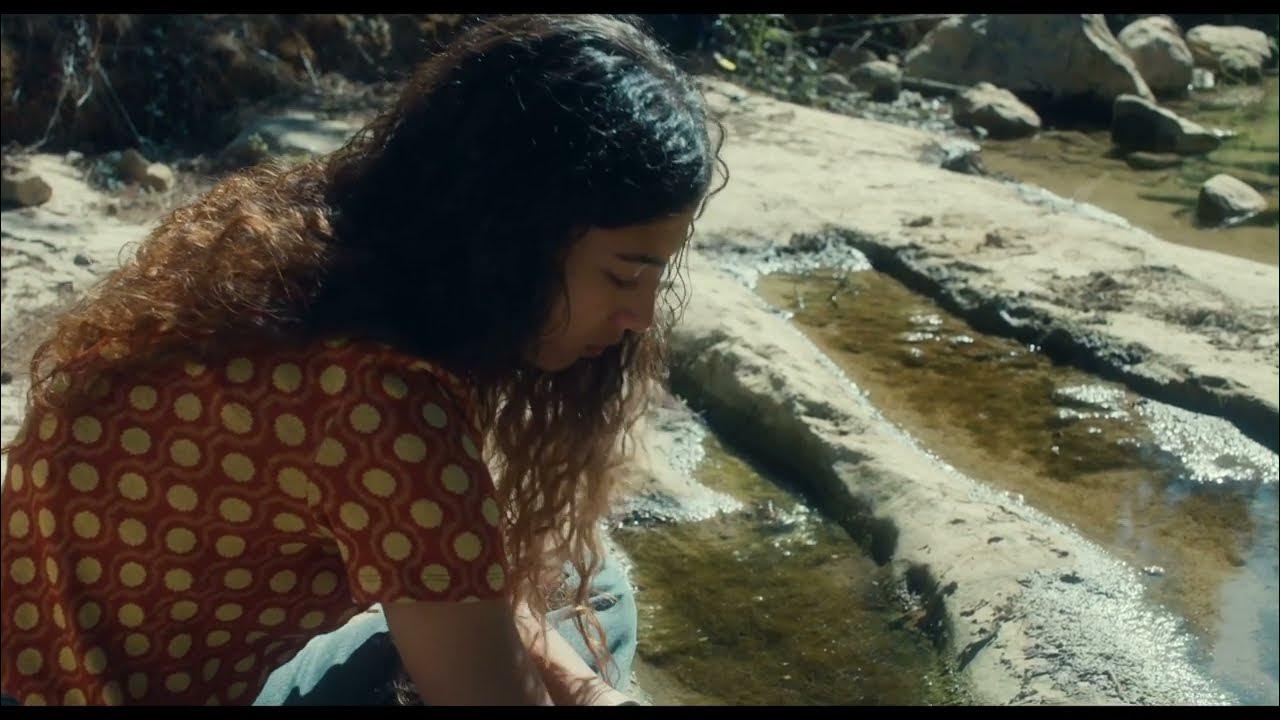
Bir’em is named after a village erased during the Nakba. A young Palestinian woman, Nagham (Sama Abuleil), returns to her family’s village and her grandfather teaches her lessons about life before and after the war in 1948. But it could have been named The Sounds of Palestine and I wouldn’t have batted an eye.
Director Camille Clavel adopts a cinematic realist style: a minimalist soundscape, frequent camera movement, strong colors, beautiful frames of human bodies cutting through gorgeous landscapes, and a series of patient long-shots. It’s not minimalist in the strictest sense of the word, but I’m not sure a single scene in the entire film makes use of more than one camera (or more than one lens, for that matter). This is not the observational mode of Béla Tarr, nor the dispassionate and sad cinema of Jia Zhangke. Bir’em is a minimalist approach where the compositions always appear just a little too beautiful to quite be true.
In several ways, the cinematography reminded me of Zeina Durra’s Luxor (2020)—though Bir’em is more sentimental than it is romantic. The destruction of the city is intrinsically related to its beauty, a beauty that fades only as the memories do. Bir’em doesn’t just emptily testify to the power of memories; it participates in them. These memories are universal, the conversations general—almost too so.
But it’s the sounds of Bir’em that truly captivate. The always diegetic music never seems to stop. Whether it’s Nagham’s grandfather “singing” old tunes, the Adhan, or a dance party with friends, the sound of music is indistinguishable from other tools of resilience and preservation. The characters that populate Bir’em really, really experience a social attraction to music.
The preservation of these sounds is an act of resistance.
Alam
2022
dir. Firas Khoury
109 min.
Bir’em
2022
dir. Camille Clavel
75 min.