From the consummate showmanship of Alfred Hitchcock to the business savvy of Jason Blum, there’s always been something of a carny spirit to the great horror filmmakers, the step-right-up promise of gruesome sights the unsuspecting rube can only dream of outside the tent. Perhaps no one was more aware of this than director Tod Browning, who literally ran away from home to join the circus before settling down as one of cinema’s earliest masters of horror. Browning’s most successful and influential film– 1931’s Dracula– was an outlier in a filmography characterized by lurid tales of sideshow intrigue. This thread reached a crescendo with 1932’s jaw-dropping, career-killing Freaks, the film which, even more than Dracula, is now most closely associated with Browning’s name. But those two films punctuated a fruitful career in silent shocks which, for the past century, have only been intermittently available (when they’ve survived at all).
The Criterion Collection has taken steps to remedy this situation with Tod Browning’s Sideshow Shockers, a slim but indispensable showcase for both Browning’s craftsmanship and his obsessions. Presented as a triple feature across two discs, the films selected provide a handy cross section of Browning’s career, and while one might wish for something a little more expansive, it’s hard to imagine a horror fan who wouldn’t treasure this box.
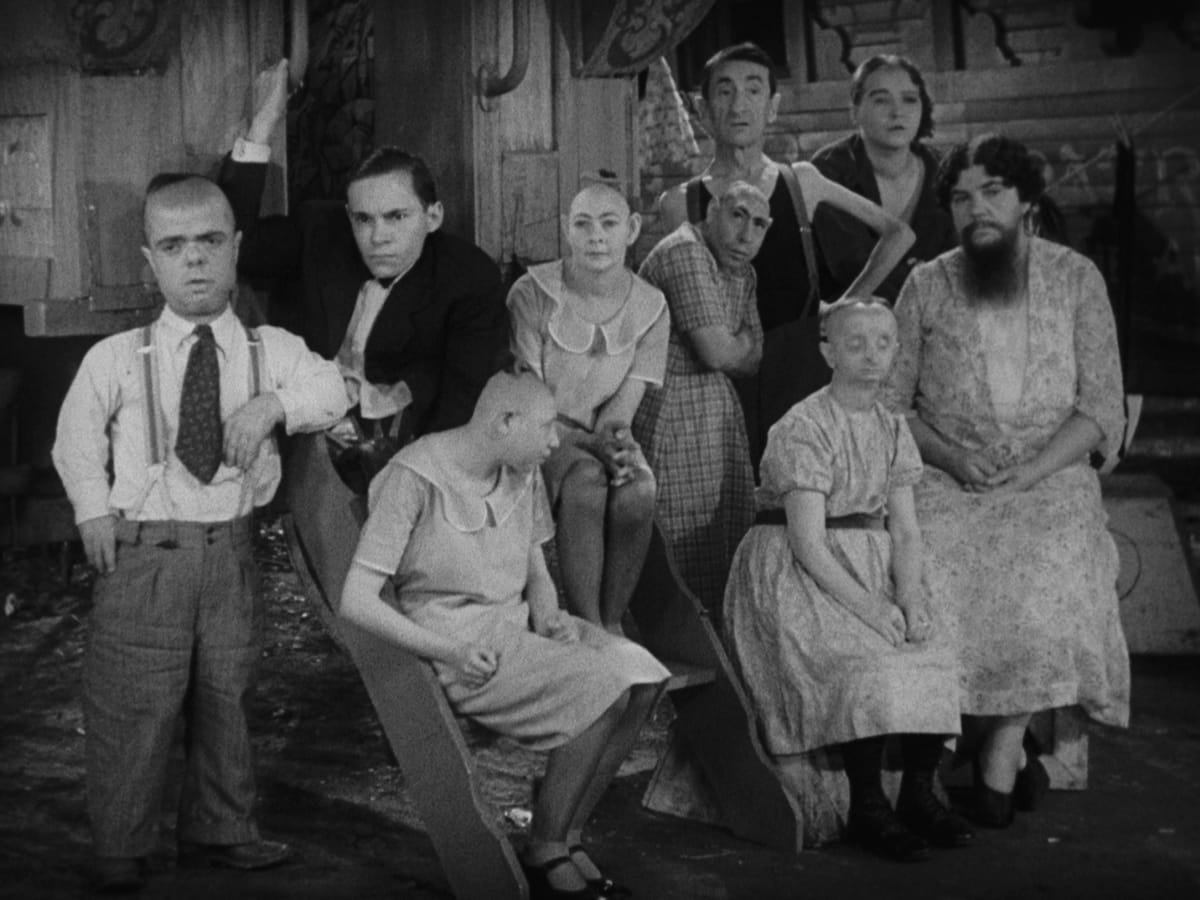
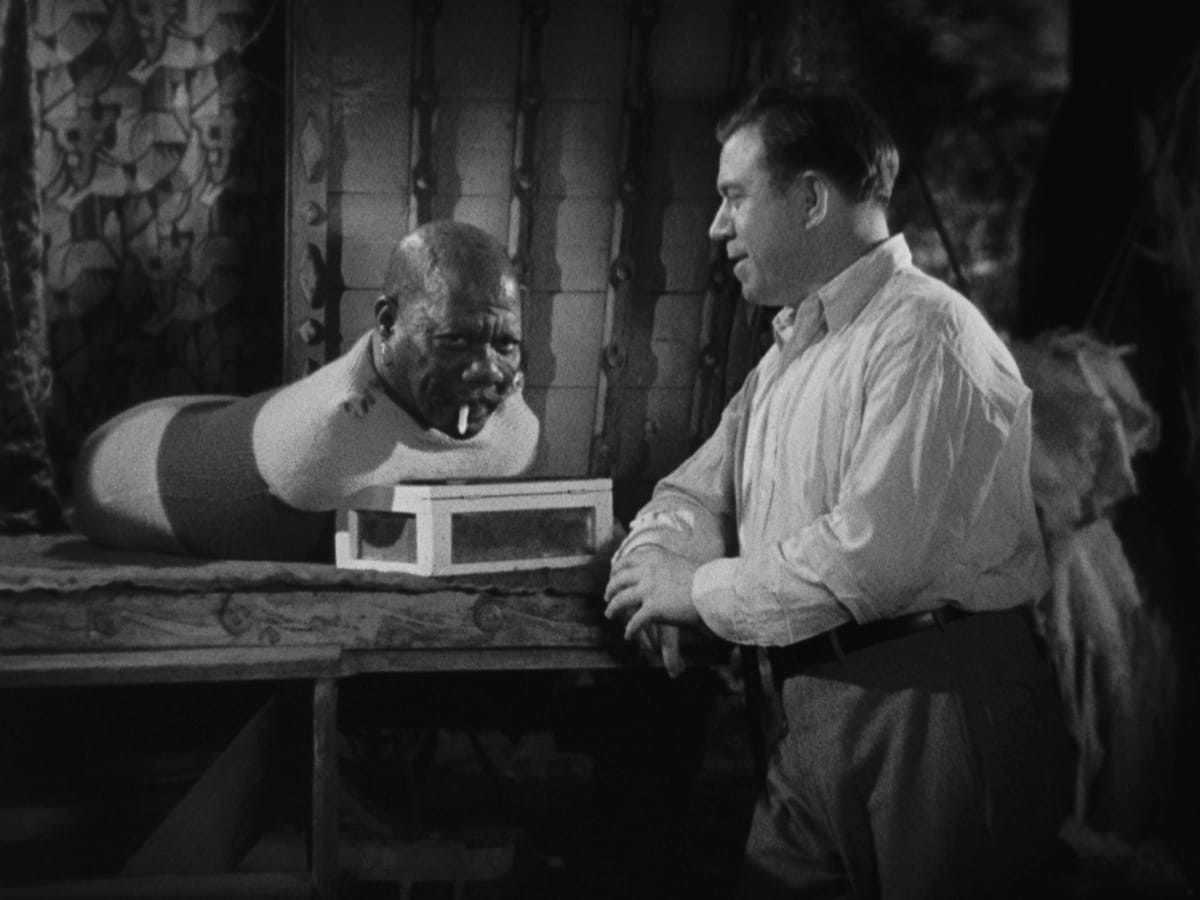
The films are presented in reverse chronological order, beginning with the headliner: the deathless Freaks, which remains a word-of-mouth rite of passage nearly a century after its release. Based on Tod Robbins’ short story Spurs, about a beautiful but evil trapeze artist who plots to manipulate, marry, and murder a successful dwarf performer for his money, the film endures for the very reason it was initially deemed all but unreleasable: its sprawling cast of differently abled sideshow performers, including conjoined twins Daisy and Violet Hilton, several microcephalic “pinheads” (one of whom, the immensely charming Schlitzie, inspired cartoonist Bill Griffith to create his long-running strip Zippy the Pinhead), and the truly astounding “living torso” Prince Randian. Audiences at the time were aghast at the deformities on display, reportedly fleeing from theaters and fainting in the aisles. The producers unceremoniously trimmed over thirty minutes, but to no avail; the film bombed, Browning’s career was destroyed, and if not for bootleg prints toured around the country by “roadshow” exploitation film distributors (only a step or two removed from carnies themselves), it may very well have been lost.
Even in its truncated form, Freaks is strong stuff; its climax, in which the so-called “freaks” crawl through the mud of a torrential thunderstorm to exact their revenge on their tormentors, is as moody and nightmarish as any scene the genre has produced in the ensuing 90 years. But what makes the film so hauntingly watchable after all this time is its profound lack of exploitation. Freaks was a passion project for Browning, and it is clearly colored by the bonds he made during his years with the circus. The “freaks” are all decent, hard-working folks who look out for each other; the villains are the able-bodied people who view them as less than human. Just as memorable as the horrific climax are the scenes of pastoral beauty: the performers gather around the bearded lady as she gives birth (the proud father, “Human Skeleton” Peter Robinson, passes out cigars); Frances O’Connor, “The Living Venus De Milo,” serenely hangs up her laundry with her feet; the microcephalics playfully frolic by the banks of the river. Despite its title, Freaks is lauded by disability advocates for having what is almost certainly the most varied and expansive cast of disabled actors ever assembled*; it’s easy to see why the great film critic Andrew Sarris, in his landmark 1968 tome The American Cinema, labeled it “one of the most compassionate movies ever made.”
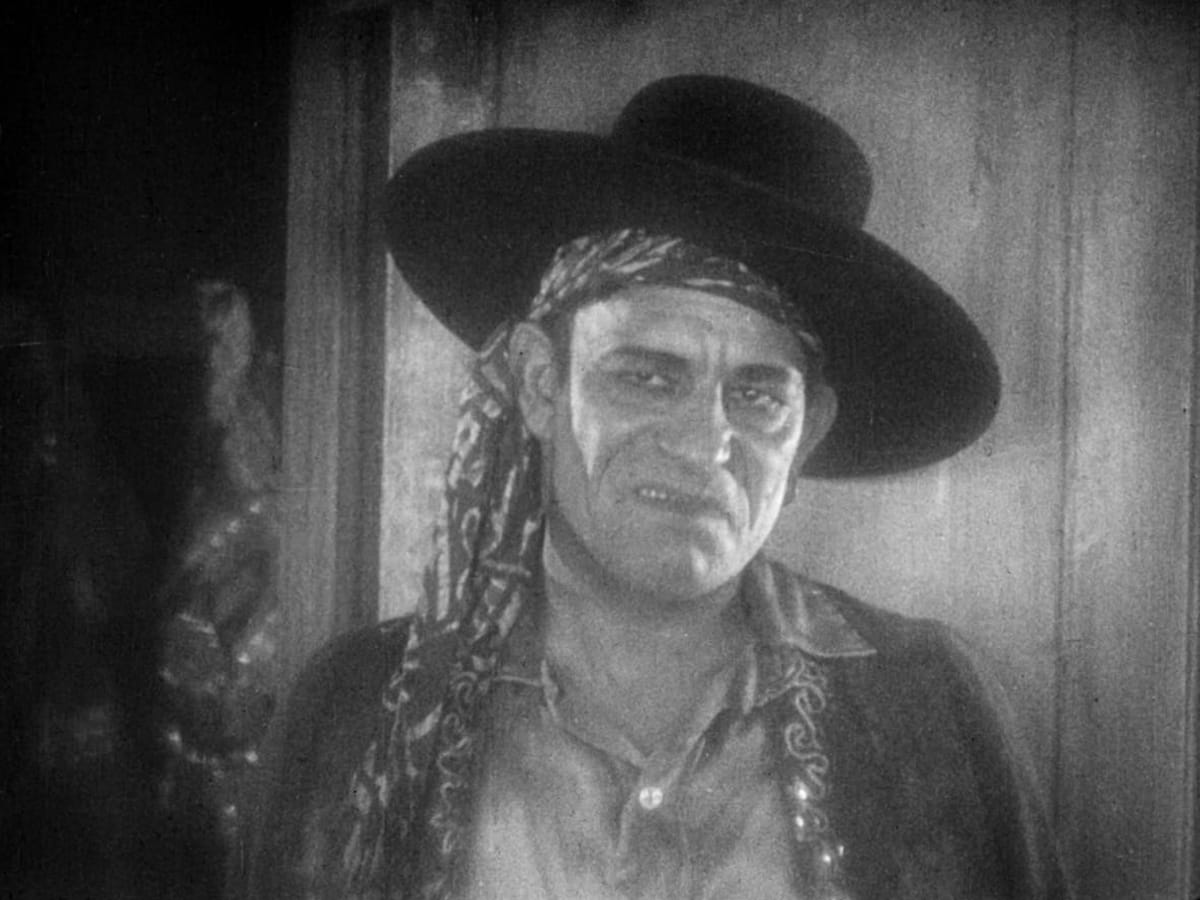
Disc two begins with 1927’s The Unknown, often considered the high water mark of Browning’s long working relationship with legendary horror star Lon Chaney. Chaney plays “Alonzo the Armless,” a knife-thrower for a successful traveling carnival. Alonzo does, in fact, have arms, which he keeps laced inside a tight corset in order to better market himself, as well as to hide his identity from the authorities following an undisclosed crime, and to win the love of Nanon (a shockingly young Joan Crawford), who has an aversion to the male embrace. Here, as in Freaks, Browning displays an intimate knowledge of the internal politics of the carnival. The film also provides a remarkably frank portrait of sexual repression, particularly through the performances of Chaney, who here contorts his expressive face with anguish and self-loathing rather than hooks and wires, and Crawford, whose fear of arms, long glibly labeled by critics as a “phobia,” now clearly reads as an intimation of prior abuse. Though perhaps not as memorable as Freaks (few films are), The Unknown is a fascinating piece of work, and a prime showcase for all involved.

But the real discovery of the set is its most obscure feature. Here making its home video debut– in any format– The Mystic has remained virtually unseen since its release in 1925, and it is truly stunning. The plot, which may very well have inspired William Lindsay Gresham while writing Nightmare Alley, is fairly simple: fraudulent Romani medium Zara (Aileen Pringle) and her accomplices are persuaded by an American con artist (Conway Tearle) to come to New York City to bilk some money out of wealthy but gullible socialites. What makes The Mystic so special, however, are the eerie mood and the striking visuals. Browning once again displays insider knowledge of carny tricks, showing exactly how Zara and her cronies perform their tricks, but the illusions, such as an amorphous, luminescent spirit emerging from the shadows, are nothing short of haunting. The mood is enhanced by the extravagant, art deco costumes of Romain “Erté” de Tirtoff (Erté was apparently quite the character; he is described in the special features as “an Aubrey Beardsley who danced the foxtrot,” which is perhaps the greatest description of any person in history). The Mystic is presented with a newly composed score by frequent David Lynch collaborator Dean Hurley, which, while far from period appropriate, simultaneously emphasizes the film’s out-of-time status and revitalizes it for a new generation.
Like the set itself, the extras are modest but satisfying. Most of the supplements for Freaks are ported over from the 2004 DVD release, including a commentary track by Browning biographer David J. Skal, an hour-long making-of documentary, an opening crawl which was tacked onto later releases, and a short program detailing the film’s various endings (sadly, the original ending, which heavily implies the villainous strongman’s castration, is likely lost to time); added to this release are a recording of Skal reading Tod Robbins’ Spurs, a 2019 episode of the podcast Ticklish Business about the film’s portrayal of disability, and a slideshow of posters and production stills. The Unknown features another commentary by Skal and an engaging interview with film critic Megan Abbott (which should more properly be viewed as an introduction to the set as a whole), while Skal also provides a very informative introduction to The Mystic. The set is housed inside a rough cardboard sleeve which makes it look and feel like a relic of the carnival days itself, and includes an in-depth essay from critic and historian Farran Smith Nehme.
If there is a downside to Tod Browning’s Sideshow Shockers, it’s that it only spans two discs. Obviously, due to lack of extant prints, it’s impossible to compile a “complete” collection of any director of the silent era (Browning’s London After Midnight is arguably the poster child for lost films), and not all of Browning’s films would match the theme of the set. But the absence of 1925’s The Unholy Three is genuinely puzzling. The Unholy Three was one of Browning’s most successful films, and arguably his most famous prior to Dracula; it finds Browning once again working from a story by Tod Robbins, and showcases both Chaney and Freaks star Harry Earles; and the plot, about a trio of sideshow grifters, would make it a perfect fit for the set (the optimist in me wants to believe Criterion is holding onto it for a standalone release, perhaps paired with Jack Conway’s 1930 talkie remake). Browning’s sideshow is so seductive that one wants to get lost in it for days; instead, we find ourselves back out on the midway after only a few hours.
But I can’t complain too much about what is easily my favorite Criterion release in ages. Freaks and Dracula aside, Browning has long been a filmmaker more frequently namechecked than watched, and this is an ideal way to bring his legacy into the present tense. Having Freaks in high definition is worth the price of admission alone; having nearly worn out my VHS copy in high school after bringing it to various friends’ houses, I can confirm that this is almost certainly the best it’s looked since the original nitrate. The Unknown is an ideal gateway into Lon Chaney outside the “designated classics” of Phantom of the Opera and The Hunchback of Notre Dame, and The Mystic– surely one of the most seldom-seen films in the entire Criterion Collection– is a revelation. Together, the films create a mood much like wandering into a musty old tent and looking at things you sense you were never meant to see. I suspect I’ll be busting it out around Halloween for years to come.
* – For all its verisimilitude, it should be noted that the film does include one or two performers who were likely “gaffes,” the industry term for self-made freaks. Though not much is known about the life of Josephine-Joseph, few sideshow “half man-half woman” acts were true intersex people, instead creating an illusion via creative makeup, costuming, and one-sided exercise. Meanwhile, “Stork Woman” Elizabeth Green was, by all accounts, simply an unusual-looking woman with a gift for self-promotion.
Tod Browning’s Sideshow Shockers is available on blu-ray and DVD Tuesday, 10/17