
The Boston Baltic Film Festival runs from Friday, 2/28 through Sunday, 3/2 at the Emerson Paramount Center, and through 3/17 virtually. Click here for the schedule and ticket info, and watch the site for Joshua Polanski’s continuing coverage!
The following dispatch features reviews of Flow & Hell’s Stoker.
Flow is an anomaly. In most worlds a no-dialogue, animated Latvian production made with a free open-access 3D computer graphics software never becomes an international hit, let alone a favorite to take home an Academy Award. But apparently we live in the exact spot in the multiverse, should such a thing exist, where such impossibilities do happen— and, on Sunday night, Flow did indeed end up being the first Baltic film ever to win an Academy Award.
Gints Zilbalodis’s film follows an unnamed dark grey cat searching for belonging and safety after a flood destroys his home. The cat encounters a pack of dogs, a capybara, a lemur, and even a whale in its journey. The world seems to be the apocalyptic leftover of our own or a very similar one. What’s left of massive statues and other remnants of civilization add color and questions to the post-Anthropocene world. What happened to the humans? Is the flood the aftermath of an extinction-level climate change threat? Is the geography imagined or is there now a place in the world that holds a previously geographically impossible quality of biodiversity (lemurs live in Madagascar, capybaras in South and Central America)?
The success of Flow would be impossible without its stunning and unique animation style. The cel-shaded animation was rendered in real-time and accentuates movement and emotion exceptionally well. When the cat moves in and out of the shrubs, the shadows and lighting changes show in remarkable detail. The artificial camera usually frames things from a low perspective, emphasizing how big and scary this world really is, not that the cat really needs any reminders anyways, though. The water, a task animator and VFX artist (and BBFF guest) Mārtiņš Upītis largely accomplished, is the best that animated water has ever looked as far as I’m concerned. The naturalness of the outdoors, with rough edges and neverending depth, looks great in the simplified style. The cat perceives danger at every corner, whether in earnest or imagined.
The whole world of the cat is overturned when its home is no longer a place of safety. This theme of home and the importance of one’s lands in bringing a feeling of safety resonates strongly, especially for a Baltic audience, with the recent stakes being raised by the bullying President Trump attempted of Ukrainian President Zelenskyy in the White House. I’m not sure whether Zilbalodis or his co-writer Matīss Kaža had the war on their mind when they wrote the script—I suspect not—but they certainly had the question of belonging on their minds, and belonging is impossible to detangle from the locations in which we find and feel belonging.
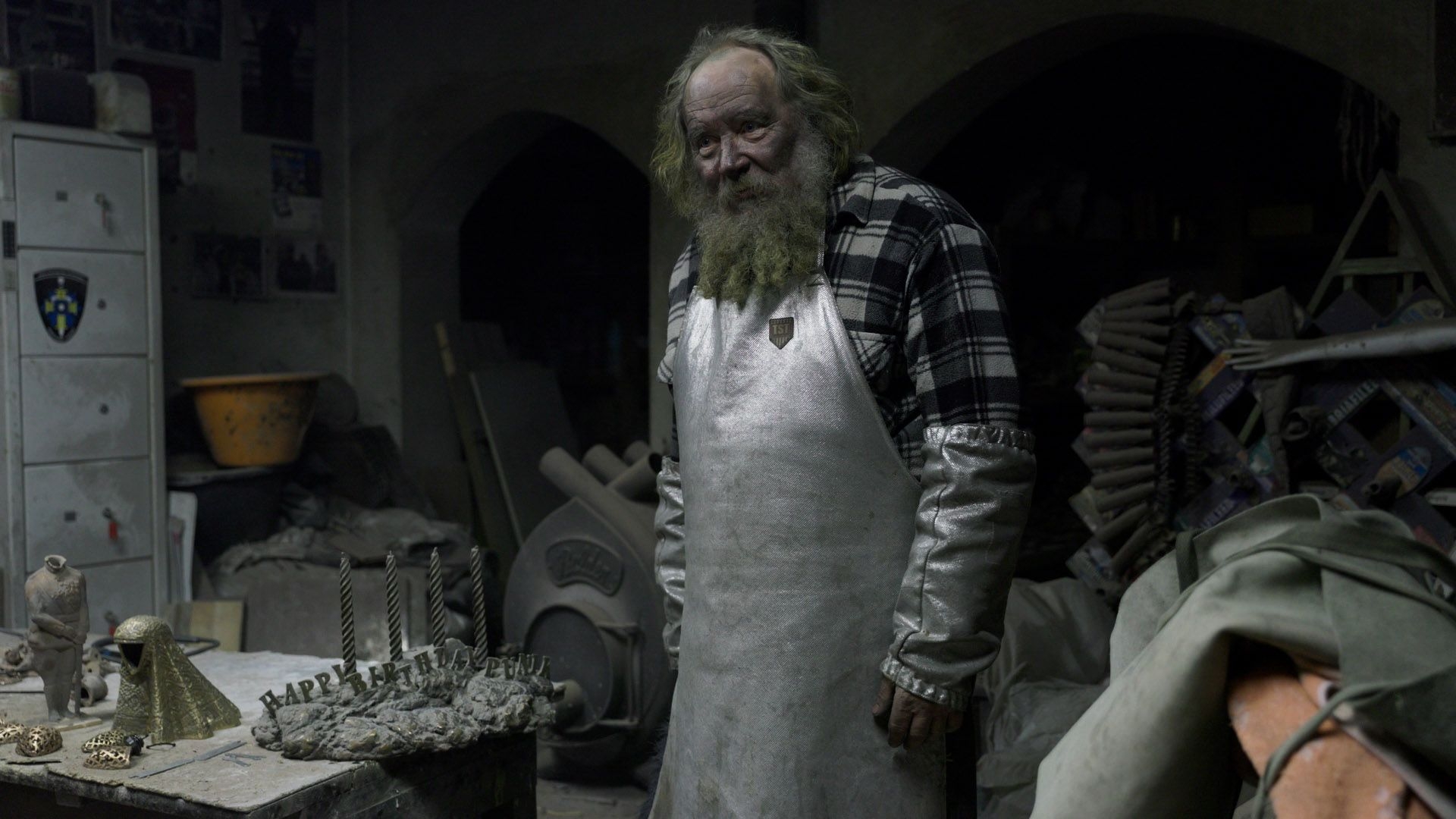
From Georges Méliès’s A Tricky Painter’s Fate (1908) and Carl Theodor Dreyer’s Mikaël (1924) through 2017’s Loving Vincent, films about artists of other mediums are a cinematic subject as old as cinema itself. Something will always be fascinating about the cinematization of an art otherwise not fully experienced on a 2-D screen. The new Estonian documentary Hell’s Stoker is at least the third film by Kullar Viimne about artists, following his work as a cinematographer on The New World, a documentary about activist-artists in Tallinn, and Gori the Caricaturist, an animated documentary portrait of an important turn-of-the-century Estonian caricaturist. This time his subject is modern sculptor Aivar Simson, also known as Seaküla Simson.
Simson sculpts the tormented figures locked in his imagination. Some of the figures and shapes he etches into bronze or cement are the stuff of nightmares lodged deep in his consciousness after his war experiences in Afghanistan. “He was forced to shoot,” one of his friends confides in the camera, as if Simson isn’t in the room or won’t see the film. His other projects reach a level of weirdness and explicitness that Freud would be proud of. The demented penis statues, misshapen as if by demonic influence, might be the most inflammatory (and infamous) of these works. The rest of the work—and probably the bit he makes most of his living from—are private commissions often honoring individuals, normally of the patriotic sort. Among these, he made the famous Tallinn Black Nights Film Festival (PÖFF) iconic “culture wolf.”
Hell’s Stoker is at its best when we see the sculptor at work. He appears to mostly work at night and that makes for fantastic images of metalwork lighting up the dark of night. It also fascinates to see the hard manual labor involved in the process of creating good art. In the film’s most interesting scene, we watch him make the bust for a disabled military general. He struggles to get the hat right and talks about the process of chizzling away a German hat, then a Soviet hat, until he can finally uncover a proper Estonian hat. This way of thinking about his art ties his creations with the meta-history of Estonian sovereignty. It also allows himself, as the artist, as well as those who encounter his works, to interpret a continuity of Simson the Patriotic Soldier with Simson the Patriotic Artist.
It is a shame too little time is spent in the forges and with the molds. The go-betweens with his clients and his visits with his pseudo-psychologist negatively burden the runtime. It’s not that he isn’t interesting as a person, as opposed to his clearly intriguing personality as an artist; the problem, instead, is that this material is relentlessly performative. His conversations with friends are blocked the same way one would stage a TV show conversation of three, neatly and conveniently wrapping a banana shape in front of the camera. When he receives a sleep-inducing hypnotic treatment from his psychologist, the camera pushes so close to his face that the viewer might be able to touch his nose. Even the dialogue reeks of performativity.
Perhaps it is because Simson is only his authentic self when he is standing before bronze and cement blocks. Perhaps it is a failure of documentary filmmaking. I’m not sure it matters, though, because at the end of the day Hell’s Stoker has some more chiseling to do.
Flow
2024
dir. Gints Zilbalodis
85 min.
Read Kyle Amato’s Hassle interview with director Gints Zilbalodis here!
Hell’s Stoker
2023
dir. Kullar Viimne
77 min.