
How’s work these days, assuming you’ve got a job? Exhausting, cumbersome, frustrating? Does time speed up with the work, or slow down with the stress? Are you working in a small business or a massive corporation? How about your boss—especially for those corporate slaves, I mean office employees—do they make your life easier or a living hell? As billionaires get richer and corporations grow more soulless, everyone else is left with hefty expenses, laborious work for outrageously low pay or outright layoffs, and no solutions for those who can’t pay the ever-increasing price of the things we need to survive. So what’s the solution? More automation! Fewer people! Driverless cars and, more recently and terrifyingly, driverless ridesharing!
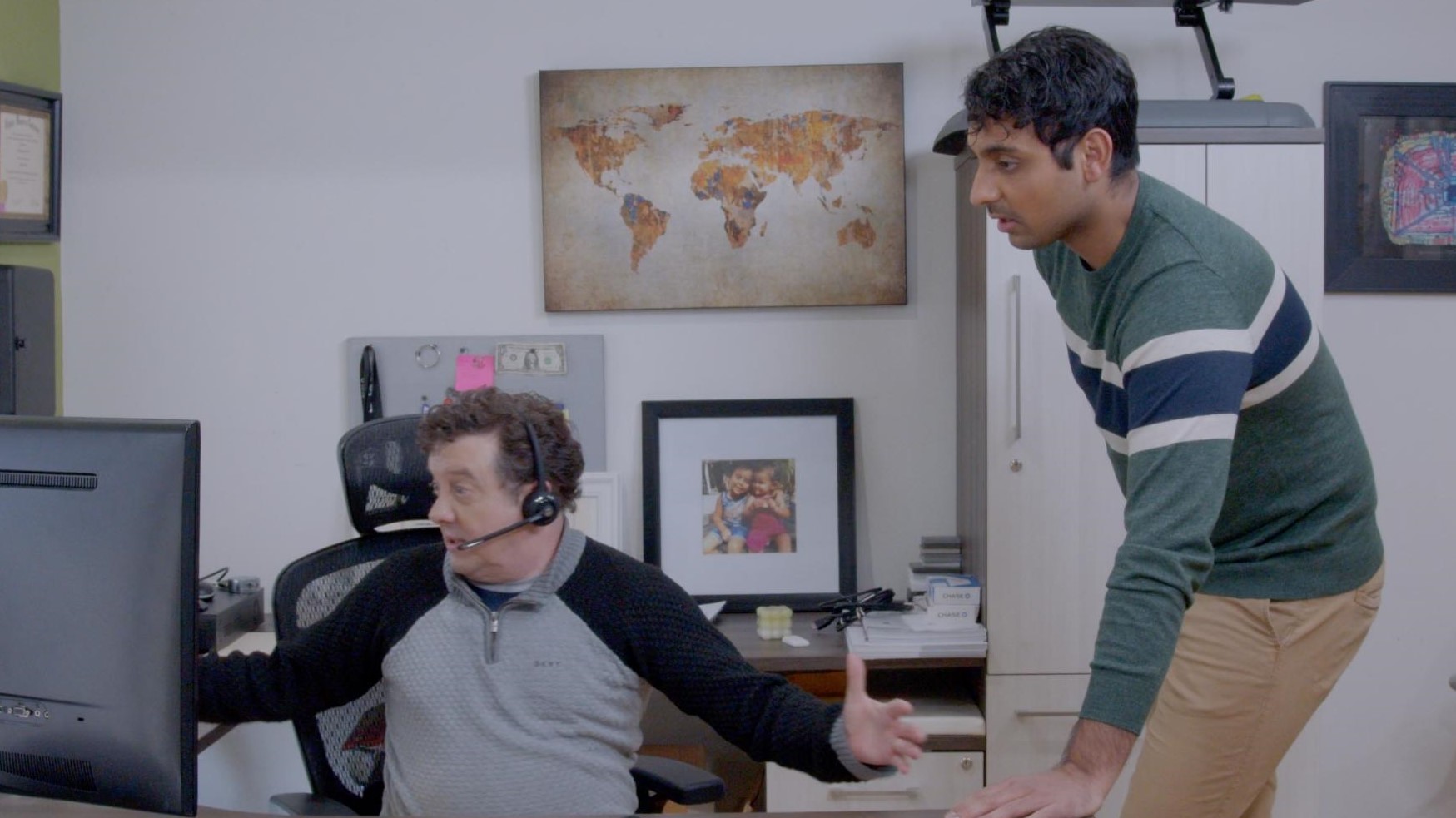
In their hilarious half-hour short aptly titled Driverless, director Charles “Chuck” Pelletier and producer/three-role star Stephen Foster explore the ins and outs of such a human-void, fully automated world through a fictional rideshare company called OLEG Industries. Glen (Foster), a friendly man anxious for employment, is hired at OLEG because his uncle, Miles (Will Roberts), is the boss. With a massive 23-employee layoff that Glen’s here to replace and no one but one cheery co-worker, Raj (Navnoor Kahlon), to assist—as his uncle cares little about the cars or customers’ safety, let alone about Glen—Glen and a variety of OLEG customers soon find just how dangerous cars and corporations are when there’s no one to drive them responsibly. I got a chance to sit down with Chuck and Stephen about all things Driverless, the corporate world’s careless greed, and what the rest of us can do to change these systems and our lives for the better. There’s much to learn from Driverless and its creators’ insightfully amusing corporate insults.
BOSTON HASSLE: What drew you and Chuck to a project like Driverless? Was there a specific instance of corporate-caused frustration, or just years of working directly in it?
STEPHEN FOSTER: I’m a comedy actor and writer, and I love rich, honest, screwball material. I am a lucky guy because I get to hear Chuck’s work almost as soon as it cooks out of his brain. When he said, “I want to write a road movie with driverless cars…” and pitched me the entire concept, I was overjoyed! The entire office comedy meets road-movie appealed to my love of 1970s, Mel Brooks, Woody Allen, Christopher Guest style of films, including offbeat characters, dynamic situations, and HIGH STAKES with some social commentary tossed in. There wasn’t a specific instance or job that triggered the work, but the HUGE gap between the rich and the poor, which we explored in our first comedy short, “That’s Opportunity Knocking,” has been our playing ground for years. It’s the same old story of “the rich getting richer and everyone else working like dogs and being paid peanuts.”
BH: How has the corporate spirit evolved? Has it always been intended to become as driverless as you demonstrate, or has that also rapidly changed with the advent of AI and other technologies?
CHUCK PELLETIER: I’m sad to say it hasn’t evolved at all, at least in the last 150 years. It’s no better and no worse, although they’ve gotten a little better at fooling those of us in the middle class. At the start of the 1900s, corporate leaders had no one looking over their shoulders, so they treated all their workers horribly. Then Theodore Roosevelt became president, and he stood up against the wealth-mongering heads of corporations. He’s my favorite president for that reason, and I don’t think we’ve had a president since then that has had that much courage. Today, the politicians just turn their heads and pretend not to have the power to keep these oligarchs running corporations in line, but the truth is, they have just as much power as Roosevelt did; they are just afraid. Their lack of understanding of AI is just a flimsy excuse. Technology, such as driverless cars and AI, is out of control, but as I try to imply in the film, it’s not just the politicians who don’t understand AI; the heads of those corporations themselves barely understand it. They understand it enough to monetize it. As for long-term consequences, they haven’t the foggiest notion.
BH: Has it really gotten so bad that even the Quakers have to turn to multilevel marketing scams just to fit in?
CP: Whenever I’m writing satire, I ask myself, what would be the most unexpected, outrageous example of what I’m “sending up?” Surely the Quakers, of ALL peoples, are impervious to these corporate narcissists. And in reality, they probably are, but I thought to myself, wouldn’t it be funny if they weren’t? Wouldn’t it be funny if one slipped through the cracks and took over the church, leaving a poor, good Quaker like our character, Woodrow, scrambling between doing what he’s told to do and doing what he knows is right? I would hope a Quaker would see this subplot as sort of a mini-medieval “morality play,” a cautionary tale. Some of those old plays were quite funny, in their exaggeration. I try to do a lot of that when I write comedy. I think exaggeration is critical to socially relevant satire. I love the comedies of Aristophanes, Moliere, Oscar Wilde, Kaufman and Hart, and Quentin Tarantino. Centuries apart, but what did they all have in common? A lot of things, probably, but one thing is that these comedy writers were all attempting to change the world. They all wanted to make it better.
BH: What changes are needed to steer away from this driverless present and even more automated future?
SF: We need to get back to being HUMAN again. Remembering that we are all in this together. The onslaught of technology has increased the remoteness and distance between people, which is a shame. We now have automated phone trees, AI interviews, self-checkout at stores, and Zoom calls instead of face-to-face interactions. This widens the gap and allows people to be shallow, cold-hearted, and covert to each other.
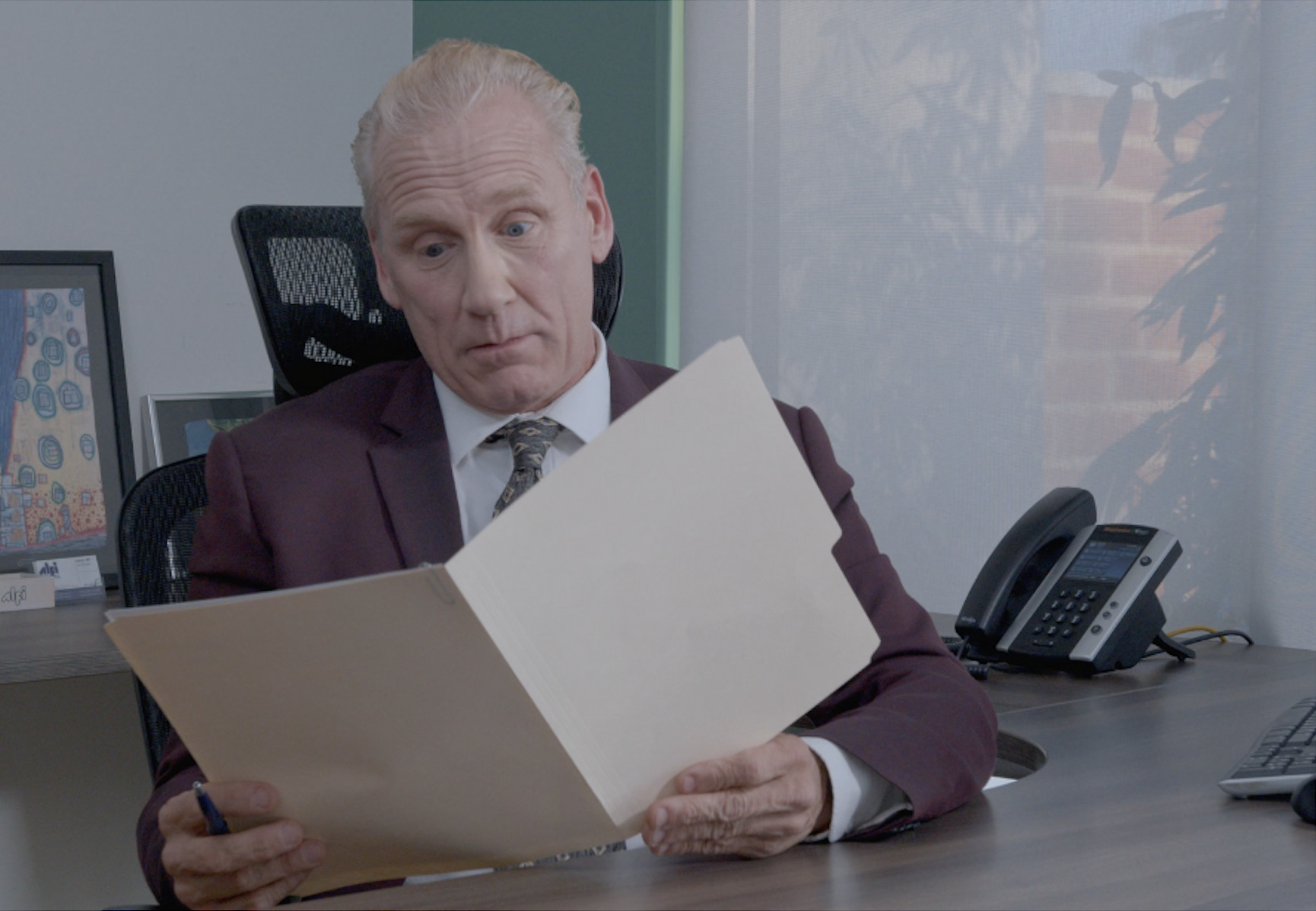
BH: Glen eventually comes to a point where he can’t take it anymore and sends cars after a particularly rude customer. Is the answer partially about customers who keep consuming/being horrible to workers needing to change their ways?
SF: Glen snaps as Lily Tomlin did in 9 to 5, where she thinks she killed Mr. Hart with the rat poison in his coffee. Today, the whole working middle class is about to snap like a rubber band. People can only be pushed so far. Glen shouts in the film, “It’s not the cars that are driverless, it’s the company that’s driverless!” This is the best metaphor in the film. The capitalistic, greedy economy has us all consuming products and buying so much that we are all tapped financially, but still told to “buy, buy, buy.” The more automated life becomes and the more the gap between the rich and the poor widens, the worse people believe they can treat each other. The work environment is in crisis, healthcare is a mess, and corporate greed is to blame. We watched the documentary Groundswell about the farming/food crisis, and they discussed soil regeneration. That’s exactly what needs to happen in the economy. We need to regenerate the economic topsoil before we face another Dust Bowl crisis. Our film pokes fun at a very serious topic.
BH: How have these driverless, damn-near bloodless corporations and their impeded filmmaking both big and small?
CP: Well, that harkens back to my belief that, unfortunately, nothing has changed. Let’s look at the best films of all time. On Citizen Kane, Orson Welles insisted on absolute creative control, and made the best film of all time. Then, talk about impeded – he took on Hearst in the film, and the Hearst organization did everything in their power to kill the film. For his second film, Welles chooses the novel The Magnificent Ambersons, and this time the studio refuses to let him have the same control; they nitpick, take over the editing, and the film comes out horribly—same director, two very different results. Casablanca was not expected to change the celluloid world; they hadn’t even finished the script when they were about to shoot the last scene. It slipped under the corporate radar; they didn’t think enough of it to mess with it, and look what happened. They left George Lucas alone on Star Wars because they didn’t think it was likely to do very well, and it turned out brilliant. But now, all the king’s horses and all the king’s men can’t put a decent Star Wars film together to save a Wookiee’s life. I think perhaps corporations are like computers; they don’t have the ability to discern and ratify the genius of the individual. People, however, vox populi, do have that ability.
BH: Was this short film itself a risky venture, given the constant criticism of greedy higher-ups?
SF: When you work in screwball comedy as we do, you are going to ruffle some feathers. People will inevitably be pissed when they see themselves. The reason they keep getting away with it is that no one calls them out. That is changing in our culture. Creating Driverless is a smack in the face to many bullying types: greedy CEOs, poor management, cold HR, and rude customers, and putting them under the comedic lens helps expose their nonsense. The higher-ups have the upper hand in life and money, but in films, they can’t “stop the beat,” so to speak. All the great comedy that we enjoy is born from great pain and suffering. If we can’t laugh, we are doomed.
BH: How can ordinary people avoid becoming these bloodless corporate a-holes themselves?
SF: Watch our film on YouTube. Joking! Sometimes, it seems that being an a-hole is the perfect solution. But it’s not. Get to know people, try to do good in the world. Create things, have more fun. Don’t say yes to all the nonsense and noise. Plant a tree, smell flowers, go for a walk. The economic situation has people pitted against each other in a whirlwind of anger and mass hysteria, so things are gonna need a tipping point of boldness, kindness, and love to turn around. But that will be challenging when the pocketbooks are empty, and the 1% keeps sucking the middle class dry.
BH: Glen tried to work within the system to invite change, only to find he’s become another cog in a broken machine. Can these systems be fixed, or should they be entirely dismantled and remade?
CP: It can all be fixed. Art could fix it. Legislation could fix it. It’s very tricky, but if our government is “for the people,” it should have a ruthless will to protect them. That may require thinking outside the box. I don’t mean to fixate on Theodore Roosevelt, but it’s worth looking back at how he dealt with the stubborn, corporate coal-mining megalomaniacs. He threw a curve that no one saw coming. I’m a comedy filmmaker, so my job is to make people laugh and, maybe, see the truth. I’m not a politician, but I wonder why they can’t pass a law now that says no company head can make more than 10 times the wage of their lowest-paid worker. The rich heads of corporations would cry like babies if we passed that law. So maybe it would have to be 50 times, or 100 times. At some point, there must be a turning point where they would begrudgingly pay their workers more, if only to make their own salaries what they want them to be. Perhaps instead of a third yacht, they could find inner happiness from knowing that no one under them makes less than $100,000. It’s sad, though, that you have to scare billionaires into doing something good. Maybe you could call it the Jacob Marley law.
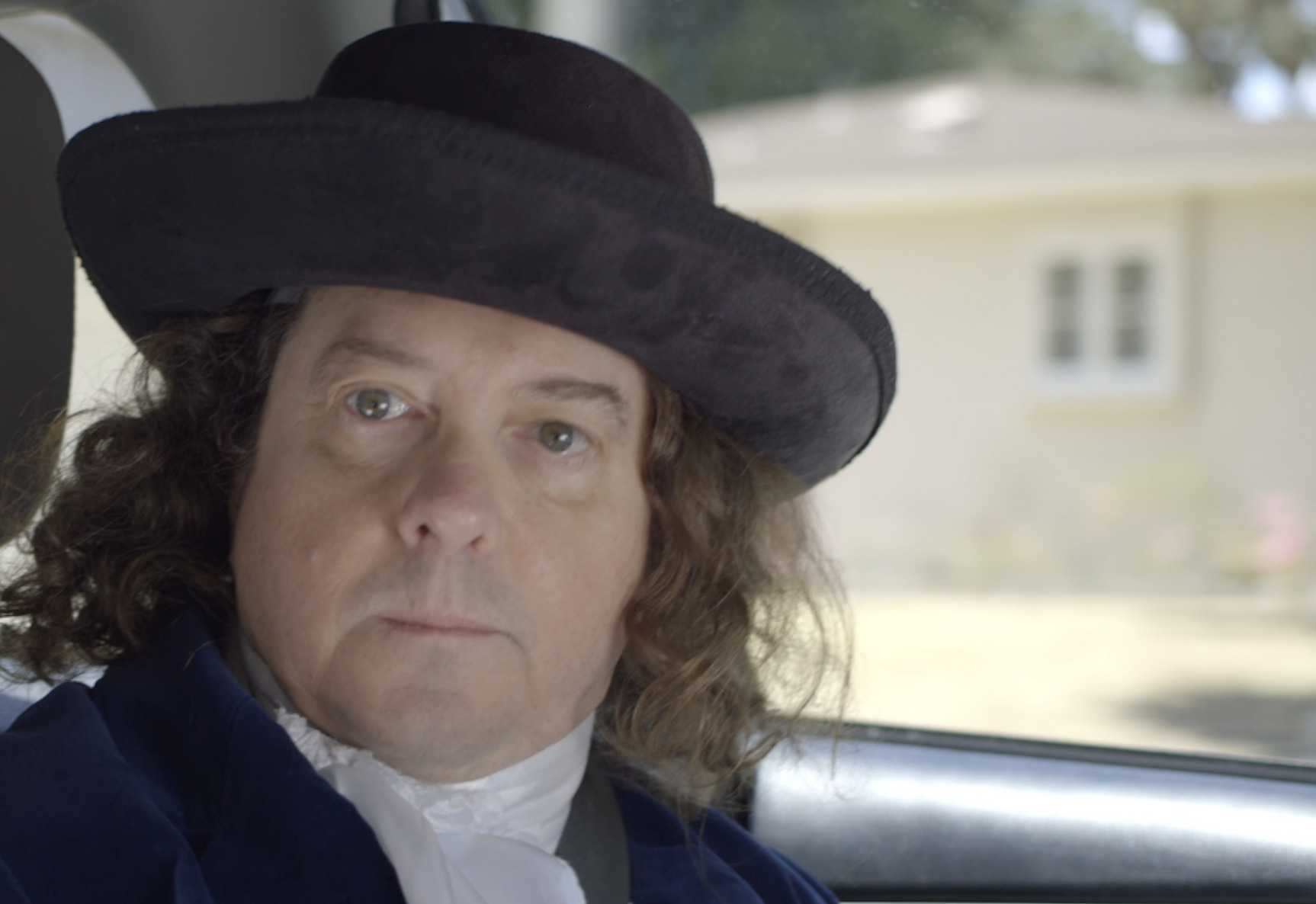
You need a clear understanding of your corporate feelings to really appreciate Driverless. If you, too, are constantly angered by selfish bosses, overwhelming workloads, little pay, and the rich running rampant, Driverless is a rudimentary but more-often-than-not funny poke at capitalism, corporations, and the bloodless world they shape and inhabit. For those of you who are pro-business and pro-getting rich no matter the human cost, then Pelletier and Foster guide you through all the hilariously stupid reasons your greed is ruining people’s lives—we shouldn’t live in a reality where even Quakers are forced into MLM schemes because nothing is affordable unless you’re already well off. Cities like Boston are already outrageously expensive (not to mention car-unfriendly), so why should anybody sit back and let prices skyrocket more? The more corporations and the ultra-rich automate, the more driverless our lives become, and the more we’re allowed to suffer because it becomes cost-ineffective for some unknown party to pay for our treatment and necessities. As one of Driverless’s many entirely original songs says, “self-driving cars are just another way [for corporations] to cut off our balls.” Haven’t we given up enough already, or do we need to lose more to remember what we have to gain? Hasn’t history taught us anything about the familiar story of “the rich getting richer and everyone else working like dogs and being paid peanuts”? For comedy short fans, corporate critics, person-less car haters, and those tired of the unrewarding slog of big business, Driverless is an amusing pick of screwball comedy that questions as much as it humiliates the ultra-wealthy.
2025
dir. Charles Pelletier
28 min.
Available to watch on YouTube: https://www.youtube.com/watch?v=udV2GScQKIk