

Do you remember your first love? How it felt every time they got near or spoke? The stomach-warmth that festered every time they’d arrive, the nervous jolts of any brief physical contact, or how crazy you wanted to confess when looking in their eyes? How about, if you’ve been lucky, the crazy highs of the adventures you shared and dates you went on, if feelings were mutual? Or do you remember mostly the hurt—the ugly conflicts and the connection’s core-shattering end? Whatever age you fall in love for the first time (and whether feelings are shared or not), it’s not something easily forgotten, as love delivers us at our most vulnerable to some of the best and worst emotional moments of our lives. Girls Like Girls details exactly that: a beautifully emotional portrait of falling in love for the first time, amplified by the central duo’s queerness and other personal qualms they endure in small-town USA. The newest expansion of longtime musician Hayley Kiyoko’s same-named 2015 song and 2023 novel, Girls Like Girls follows two lesbian teenagers—a sad loner, Coley (Maya da Costa, in her feature debut), and an extroverted competitive dancer, Sonya (Myra Molloy)—as they experience true connection for each other in a way neither of them has felt before. Backdropped by a variety of other issues, from petty reputational worries to loss and a tough relationship between Coley and her dad, Curtis (Zach Braff), Girls Like Girls harbors enough soulful sensitivity towards love and life’s bittersweet beauty to make its predictable plot easy to ignore. Tears drop, grins form, and our hearts pound like we’re 13 again in the face of naive, pure affection.
Going into or hearing about Girls Like Girls, it may be easy to presume generic teenage romance fare akin to streaming giants’ most forgettable movies. It partially is, sure; Girls Like Girls sees a new kid moves to town who “unexpectedly” falls for the popular girl, feelings are mutual and the pair secretly date despite others’ qualms, there’s some big falling out due to the popular girl’s shortcomings, and the new kid spends time working on herself and her familial issues before the pair inevitably come back together, make up, and credits roll on a happy restart to their romantic involvement. But Girls Like Girls’ characters, the added queer acceptance layer, and Hayley Kiyoko’s immensely clear (and beautifully translated in film) memory of what it was like to be a 13-year-old experiencing love, grief, acceptance, and adaptation all at once, carve the film into one of those exceptionally touchy yet realistic dives into life’s many complexities.
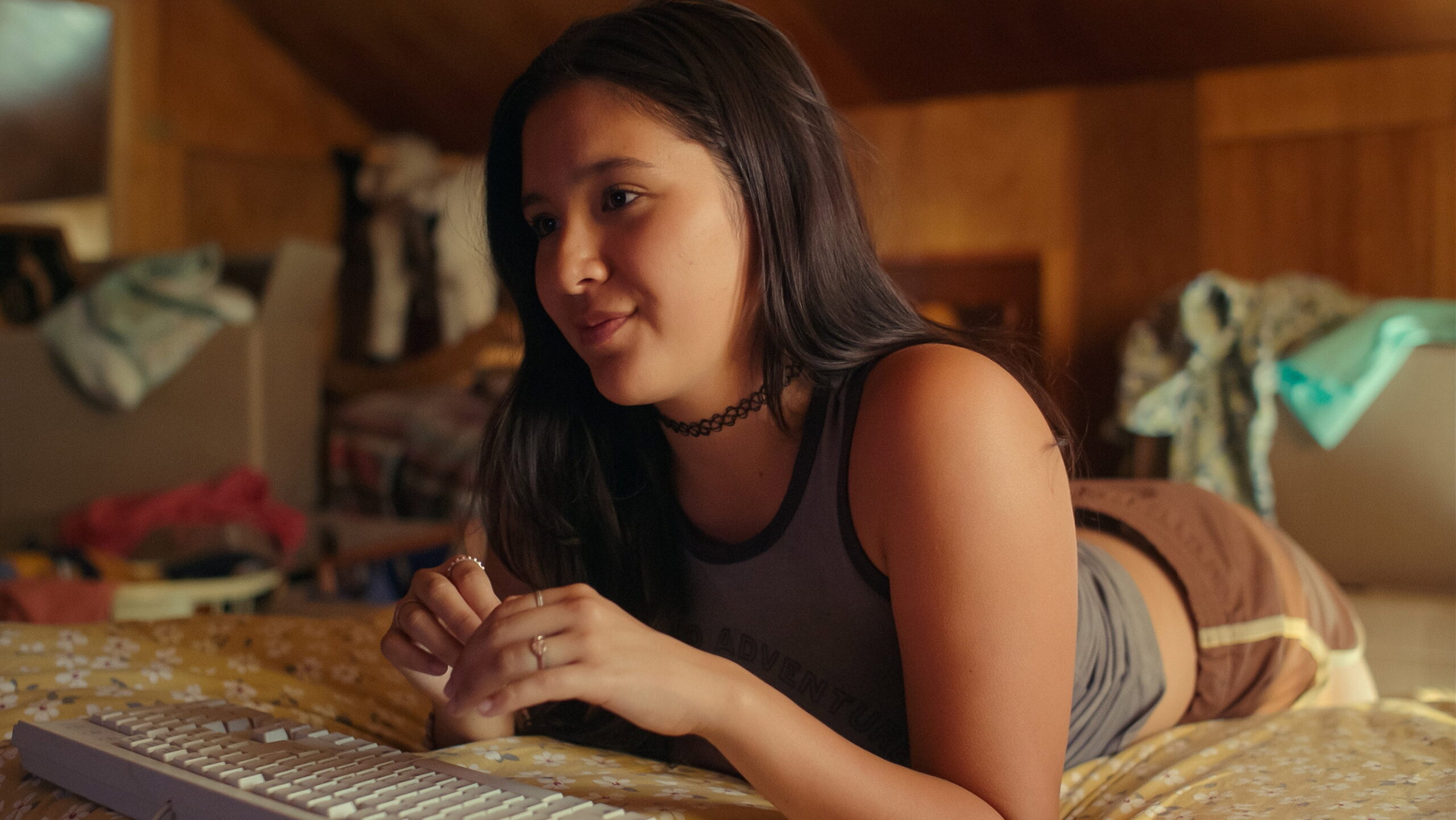
As much as Girls Like Girls is about love, it’s also about understanding people as flawed beings. Coley’s mother, who died a year before the events of the film, is a major driving force behind Coley’s current predicaments. Coley’s mannerisms, especially when pained, perhaps mirror those her mother had. Being described as someone who “was only focused on her own pains” by Curtis—alluding to perhaps an overdose, accident, or suicide—Coley’s anger towards her father and slightly reckless reactions to her breakup with Sonya feel potentially genetic. In the beginning, she gives Curtis no breathing room for redemption. Consistently treating him as the deadbeat, as he really was “never there. I was always there. I had to sit through [it all]…. You’re only here now because you have to be,” she shuts him out whenever he kindly offers a meal, support, or a simple way to get to know his kid better. Given the initial description, it’s hard not to take her side. However, as the film rolls on, Curtis’s unwavering support demonstrates there’s been a massive misunderstanding; though he “wanted us to be together, I wanted us to be happy,” Coley’s “… mom wanted… other things.” She took away Curtis’s choice of fatherhood, permanently warping his image in Coley’s young brain with his absence. This is not to pin Coley’s mother as the family villain, but more another unfortunate realization for Coley that people are disappointingly complicated. She learns, partly by watching Sonya struggle with their shared affections, that perhaps she shouldn’t follow in her mother’s footsteps by cutting off her loved ones when cornered. If only Sonya could be as mature.
Sonya is simply troubled by how she acts all put together, only to shatter the people around her because she can’t properly live for herself. Presenting herself as a confident, talented, and let-loose straight girl—whose eagerness to befriend Coley definitely supercharges Girls’ lead’s attraction to her, as it would for any middle-school teen—it’s easy for anyone with just a bit more life in their bones to see she’s devilishly good at throwing up a façade. When alone with Coley, Sonya lets out an individualistic (and dysfunctional) truth about herself: “I’m emotionally unavailable to all.” Though Coley’s none the wiser to the Sonya-caused misery she’s about to endure, experienced viewers’ stomachs should audibly churn at this point. Someone as superficial as Sonya, whose main priority is reputation and, more specifically, “What will my [homophobic] mom and [gay hating] friends think of me?”, is bound to push too far without thinking and hurt others in the process. Whatever she really wants, her destructively self-defensive nature damages the few genuine connections she obtains, constraining her to a life of conventional success and nothing more than mere acquaintances to celebrate it with. She simply can’t take that life is rich when full of simple affection or boundless love. Fortunately, a months-long dance event elsewhere may be enough for these girls to either find what they need to grow confidence and stabilize their futures—or it may be just more time to ruminate on the things we keep running from.
Girls Like Girls is as much about romance as it is a plea for more tolerable mutual understanding. None of us knows what we’re doing. We can’t guarantee that our current living standards or what we want and need in any given moment will remain constant in the next. We’re all discovering new layers of our emotions, dynamics, priorities, and beliefs as the rest of the world clashes and churns, trying to figure it all out exactly like us. Girls Like Girls thus poses the most closed-minded viewers a more important question: what the hell’s the point? Why spend your time being like Sonya’s initial boyfriend, Trenton (Levon Hawke), in putting anybody down for as pathetic a reason as sexuality (or gender, or that matter)? Jealousy aside, hatred just takes too much energy. Sonya, Coley, and just about everyone else have enough other pain and joy to endure, so why add more fuel to the fire? Enjoy your own life and find what makes you content, and good will come along the way. You just have to be kind and leave everyone’s business the hell alone. Maybe then, you’ll find the inner peace Coley attains and wants Sonya to find desperately. For those queer romance lovers, Hayley Kiyoko fans, sentimental slice-of-life enthusiasts, and those hoping to feel thirteen again, Girls Like Girls is sure to break your heart twice over.
2026
dir. Hayley Kiyoko
95 min.
In theaters Friday, 6/19—get tickets at Alamo Drafthouse Cinema Boston Seaport, Cinema Salem, Somerville Theatre, and some local AMCs