
On the subject of nostalgia, pop music visionary Brian Eno once mused, “Whatever you now find weird, ugly, uncomfortable and nasty about a new medium will surely become its signature,” and that such shortcomings “will be cherished and emulated as soon as they can be avoided.” This is certainly true of stop motion animation. That medium, with its trademark jitteriness and visible seams, was seen as primitive and dated by the time Steven Spielberg opted to switch to computer animation to create the dinosaurs of Jurassic Park. But as CG has become the norm, and even more so as AI hucksters have started pushing their slop as a cheat code to “creativity,” the handmade nature of stop motion has started looking better and better. Suddenly, all the visible thumbprints and blips between frames have become a source of comfort and pride: proof that somebody thought of this and made it and spent hours and hours making it look just right. In an age where we can trust less and less of what we see with our own eyes, stop motion animation remains blessedly and tangibly real.
This tactility is fully apparent in the delightful I Am Frankelda, the first stop motion feature crafted entirely in Mexico. Adapted by brothers Arturo and Roy Ambriz from their short-lived Cartoon Network kiddie-horror anthology series Frankelda’s Book of Spooks, I Am Frankelda has more invention packed into each frame than most live action films fit into their entire running time. It’s a breath of fresh, if slightly morbid, air.
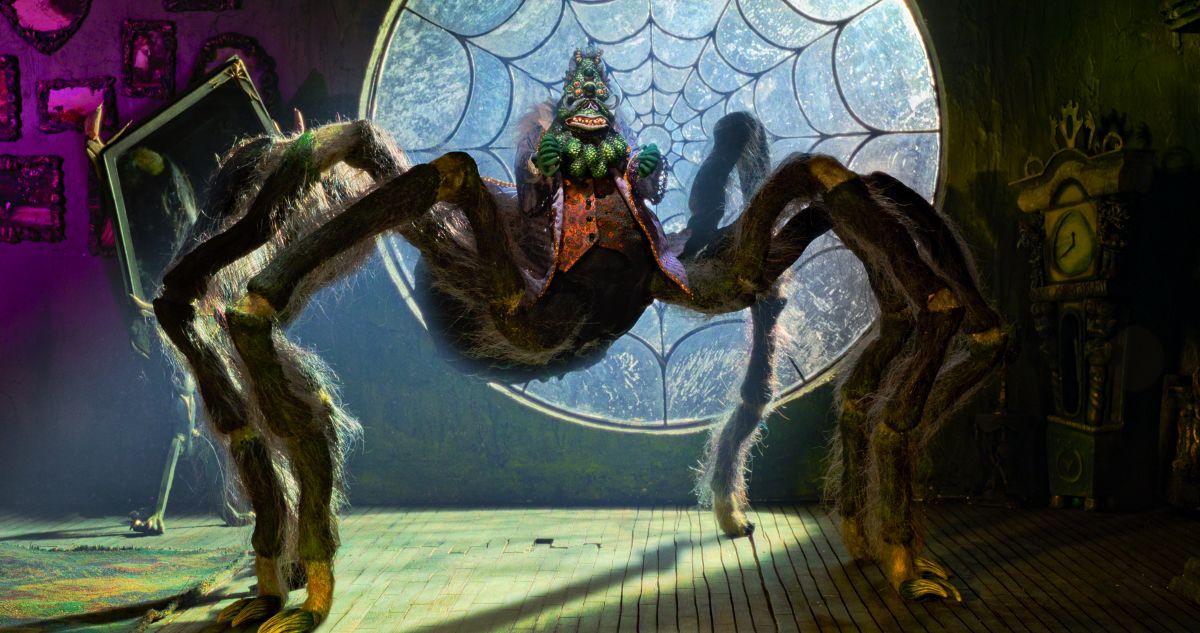
In 19th century Mexico, young Francisca Imelda wants nothing more than to be a writer, regaling her peers with tales of the macabre when she’s not being stifled by her cruel grandmother. What she doesn’t realize is that her tales lay the groundwork for the kingdom of Topus Terrenus (“Realm of the Terrors”), a gothic underworld of monsters who thrive on human fear generated by scary stories. As the years go by and Francisca is forced to go to work, Topus Terrenus grows stagnant. Following Francisca’s narrative threads, goodhearted monster Prince Herneval invites her to her realm to reinvigorate their horror-based economy. Francisca is charmed, taking on the ghostly alter-ego Frankelda and falling in love with the prince. What neither of them realize is that the “royal nightmare-teller,” the spider-like Procustes, has his own designs on the throne— and certainly won’t let an outsider usurp his role as the kingdom’s chief creative force.
Unusually for a Netflix release, I Am Frankelda is visually nothing short of stunning (it was developed by Warner Bros. for Cartoon Network before being cast off by anti-art CEO David Zaslav, making this the second time in as many years Netflix has benefited from other studios’ apathy toward animation). The characters are bold and expressive, each inventively designed to match their personality. Even the tiniest details have been painstakingly realized: the paintings of Francisca’s late mother, which must be no more than a few inches tall in real life, are clearly inspired by the great Mexican surrealist Leonora Carrington. The Ambriz brothers have created a world— scratch that, two worlds— which often feel more full of life than the one we live in.
Perhaps even rarer among contemporary children’s entertainment, Frankelda resists the temptation toward Shrek-style snark. There is a wily and perverse sense of humor at play, to be sure (particularly apparent in a blind, hilariously grotesque goat-riding cave goblin who takes part in Procustes’ conspiracy), but the story is told in perfect fairy tale earnestness. We care about these characters: Francisca’s frustration at the hurdles placed before a female writer in the 19th century, Herneval’s desire to improve and do right by his kingdom, even, to a certain extent, Procustes’ writer’s block and jealousy. They may be monsters, but they’re also real people.
Like many animated features, I Am Frankelda features several musical numbers, and while the songs aren’t as memorable as one might hope (it’s unlikely that any will become chart-topping breakouts like last summer’s Netflix animated feature), they provide the film with some of its most purely cinematic passages. In one swooning number, in which Herneval welcomes Frankelda to his realm, their passion becomes so overpowering that the animation begins hopping between mediums: from stop motion into shadow puppets, oil paintings, a pop up book, even glass sculpture. It is as if the film is so entranced with its own possibilities that it can’t be confined to a single style— as if it threatens to burst from the frame.
This is appropriate for a film which is not only the result of creativity and hard work, but about the significance of human artistic expression. A stuffy (earthbound) publisher, rejecting Francisca’s fantasy manuscript, huffs, “Art and literature should emulate reality, not create a new one!” Frankelda and Herneval clearly disagree as vehemently as the Ambrizes, enthusiastically crooning, “When you read, you inhabit the occult!” Indeed, it’s easy to imagine a child idly flipping to this film after their umpteenth rewatch of KPop Demon Hunters and feeling like they’ve stumbled across some arcane tome. Maybe it will inspire them to make their own animated movie (a montage over the credits of the film’s various artisans at work behind the scenes could certainly put them on their first steps along this path). Or maybe they’ll want to be like Frankelda herself, committing words to paper as if it’s the most important thing in the universe. Or, alternatively, it might open their eyes to the world of art and creativity that exists beyond the artificial slop being shoveled at them from all angles. The important thing is that I Am Frankelda is out there and readily available, a testament to the Ambriz brothers and all their fellow artists at the Cinema Fantasma studio. As long as minds like theirs are allowed to follow their demons, there will be no shortage of new worlds to explore.
I Am Frankelda
2025
dir. Arturo & Roy Ambriz
104 min.
Streaming on Netflix beginning Friday, 6/12