I generally feel that “Webster’s defines…” is the lowest form of introduction, but I think it might actually shed a little light on Hokum. Webster’s defines “hokum” as “a device used (as by showmen) to evoke a desired audience response.” It is not, per Webster, derived from any sort of Irish language or dialect (rather, it’s most likely a 20th century portmanteau of “hocus pocus” and “bunkum”). I assume that Damien McCarthy, the Irish filmmaker behind the recent horror faves Caveat and Oddity, knows this. However, he has correctly gauged that it sounds suitably chilling when whispered in an Irish brogue: the low rasp of the H, the glottal stop of the “um.” This could, itself, be seen as a bit of hokum, as could a great deal of the spooky goings-on in McCarthy’s film of the same name; like a PT Barnum exhibition of old, some of the scares make less sense the more you puzzle them out in your mind. But the main connotation of “hokum” is not fakery per se, so much as showmanship, and McCarthy’s got that in spades. Regardless of substance, Hokum is a damn entertaining little spookshow.
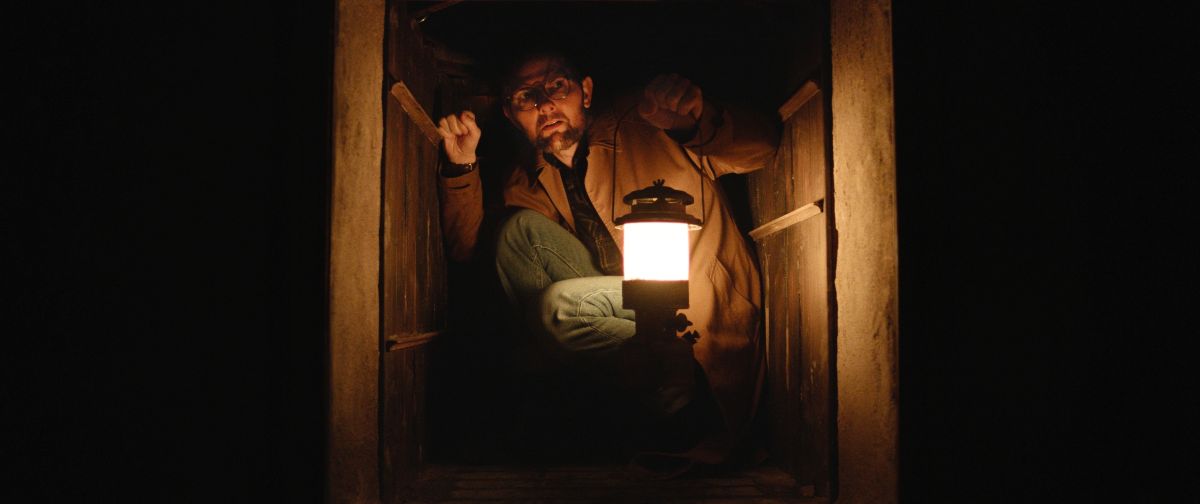
Adam Scott plays Ohm Bauman, a depressed horror writer in the Stephen King Protagonist vein. Struggling with writer’s block while attempting to stick the landing of his bestselling “Conquistador Trilogy,” Bauman pulls a procrastination power move, booking a trip to rural Ireland to scatter the ashes of his long-dead parents outside the inn where they spent their honeymoon. The Bilberry Woods Hotel is as eerie as its name, complete with unnervingly ingratiating regulars and a local legend about a witch chained up in the abandoned honeymoon suite. Ohm is aloof (read: an asshole to everyone he meets), but he does strike up pleasant conversation with hotel barmaid Fiona (Florence Ordesh). Some weeks later, Ohm revisits the Bilberry as they lock down for the season, only to learn that Fiona has gone missing— and that the rest of the staff are being particularly shady about the honeymoon suite. Compelled to redeem his previous poor behavior, Ohm sneaks his way back in to figure out what, exactly, is locked in that room.
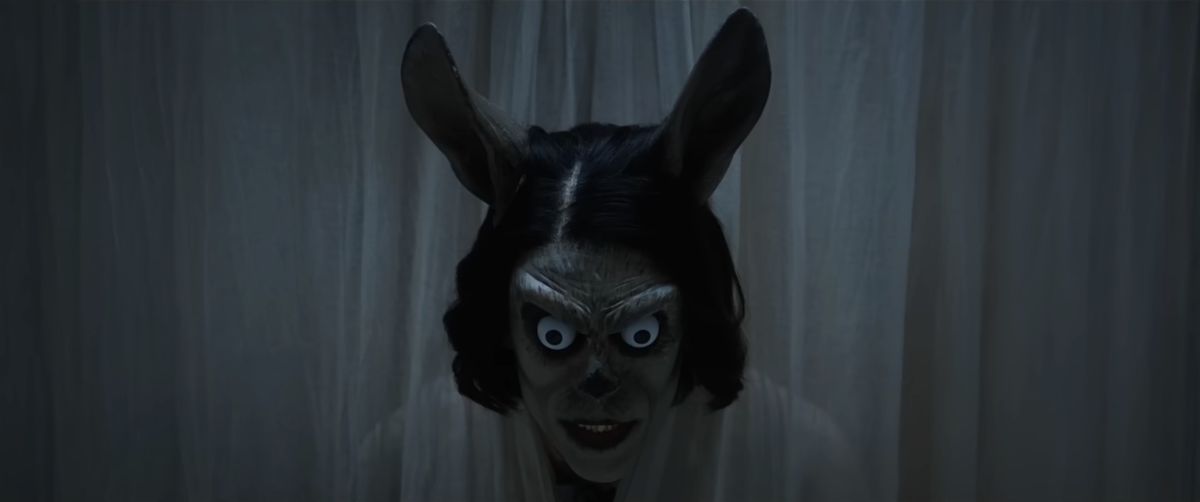
That’s the rough idea, anyway. When I got home from IFFBoston’s screening of Hokum last week and my wife asked me what it was about, I realized that I didn’t really know how to answer her, so packed is the film with digressions, side plots, and time jumps. I haven’t mentioned, for example, the strange hermit who lives in the woods outside the hotel devouring psychedelic mushrooms, or the byzantine interpersonal relationships between the members of the staff (who, I will confess, I at times had trouble telling apart). There is also the obligatory backstory of Ohm’s traumatic childhood and fraught relationship with his parents, which seems to be just as much a requirement of modern horror movies as postmodern meta-commentary in the post-Scream era, or tits in the ‘80s. Then there is what’s likely destined to become the film’s defining image, a demonic, rabbit-like children’s show host who Ohm occasionally hallucinates, which is so far removed from the rest of the film’s imagery that it feels at times like a leftover scrap of a different movie. In short, there is a lot of stuff packed into what is, functionally, a fairly modest haunted house movie. If Ohm Bauman filed the screenplay as a manuscript, one imagines his editor would respond with significant notes.
But in horror, perhaps more than any other genre, a messy script is not necessarily the end of the world. The important thing is that it scares you, and at that Hokum is singularly successful. The early scenes at the hotel are filled with folk-horror dread, from the crudely carved jack-o-lanterns which fill the halls of the Bilberry to the halls themselves, which are appropriately dimly-lit and twisty-turny. Ohm’s descent into the hotel’s bowels is truly nightmarish, especially when viewed in a theater with a proper sound system. And while jump scares get a bad rap and are not for all tastes (they’re the reason the aforementioned wife did not accompany me to this screening), the ones here are exquisitely crafted. It’s easy to make someone jump with a sudden loud noise (as anyone familiar with this image knows well). Hokum’s noises are loud, but they’re in service of truly hair-raising images, made all the more unsettling by the fact that we only catch a glimpse from them. McCarthy knows how to play an audience, and it’s a pleasure stumbling through his house of horrors.
Which brings us back to that definition of “hokum.” Is there much in the way of substance underneath all the cobwebs and strange? I’m not sure that there is (though ask me again once the festival hype has worn off; when I revisited Longlegs last October I found that many of my initial reservations had come out in the wash). But the showmanship on display is impeccable, and when it comes to horror that’s at least as important. In the end, Hokum does exactly what it says on the tin: it evokes its desired response with all the flash of a canny circus barker. It may not be art, but you’ll be happy you plunked down your dime.
Hokum
2026
dir. Damien McCarthy
107 min.
Opens Friday, 5/1 @ Coolidge Corner Theatre, Alamo Drafthouse Boston Seaport, and all local AMCs