
I spoke with animator Julian Glander about his colorful, charming, and hilarious new film Boys Go to Jupiter, which opens 9/5 at the Somerville Theatre. The interview is lightly edited for coherence. Cut for time, sadly, is a discussion about Tron. It always comes back to Tron!
JULIAN GLANDER: I’ve been looking forward to this one because I went to school in Boston. I was there when Boston Hassle started. A couple of my friends wrote for it in the earliest days.
BOSTON HASSLE: Nice– full circle! Boys Go to Jupiter is exactly the kind of movie that we want to help promote and talk about. And I’m just a big animation person, especially independent animation like this. How did you even pull this off? It seems like such a production. We’ll get the giant voice cast and how everything looks and the music and how it all fits together.
JG: It’s funny, because now, a year after finishing the movie, it feels like someone else made it. It was me and my best friend Peisin [Yang Lazo], who serves as producer. We met at school working on the talk show on the BU closed circuit. Is that what it’s called? The closed circuit TV, which I don’t think the schools have anymore, probably. It was really a year of crazy production and ten years of shortcuts that I learned and cheat codes and work arounds. The movie just came out of those days.
BH: The film has such a unique visual style. I was looking at your website and realized I’ve seen your work because I’ve watched Adult Swim. So you’ve learned a lot from doing miniature animation, but this is a whole feature length movie, which makes it so impressive. Did you do any of the voice directing? It’s such a big crowd. How do you get performances for this?
JG: I think like once the cast was locked in, I served as the voice director, but there wasn’t really much to it. These were people that I was just a huge admirer of and it was more about kind of letting them find what they wanted to do. Chris Fleming, who plays this hot dog stand operator in the movie, basically came in and actively resisted direction. I asked him to do it because it’s a lot of dialogue and I thought he could get through it very quickly. And instead he was like, “No, I want to chew on this. I made this character for this. It’s like a guy you’re talking to in the morning at an airport bar.” His whole thing is very loosely based on the script I wrote and we have like an hour of it that could be its own movie, just him talking as the hot dog man. When you have the right people, the job of director is very easy.
BH: You go to Sarah Squirm and tell her “You’re a giant face that’s coming out of a minivan, screaming.” She’s like, got it.
JG: Yeah, she gets it.
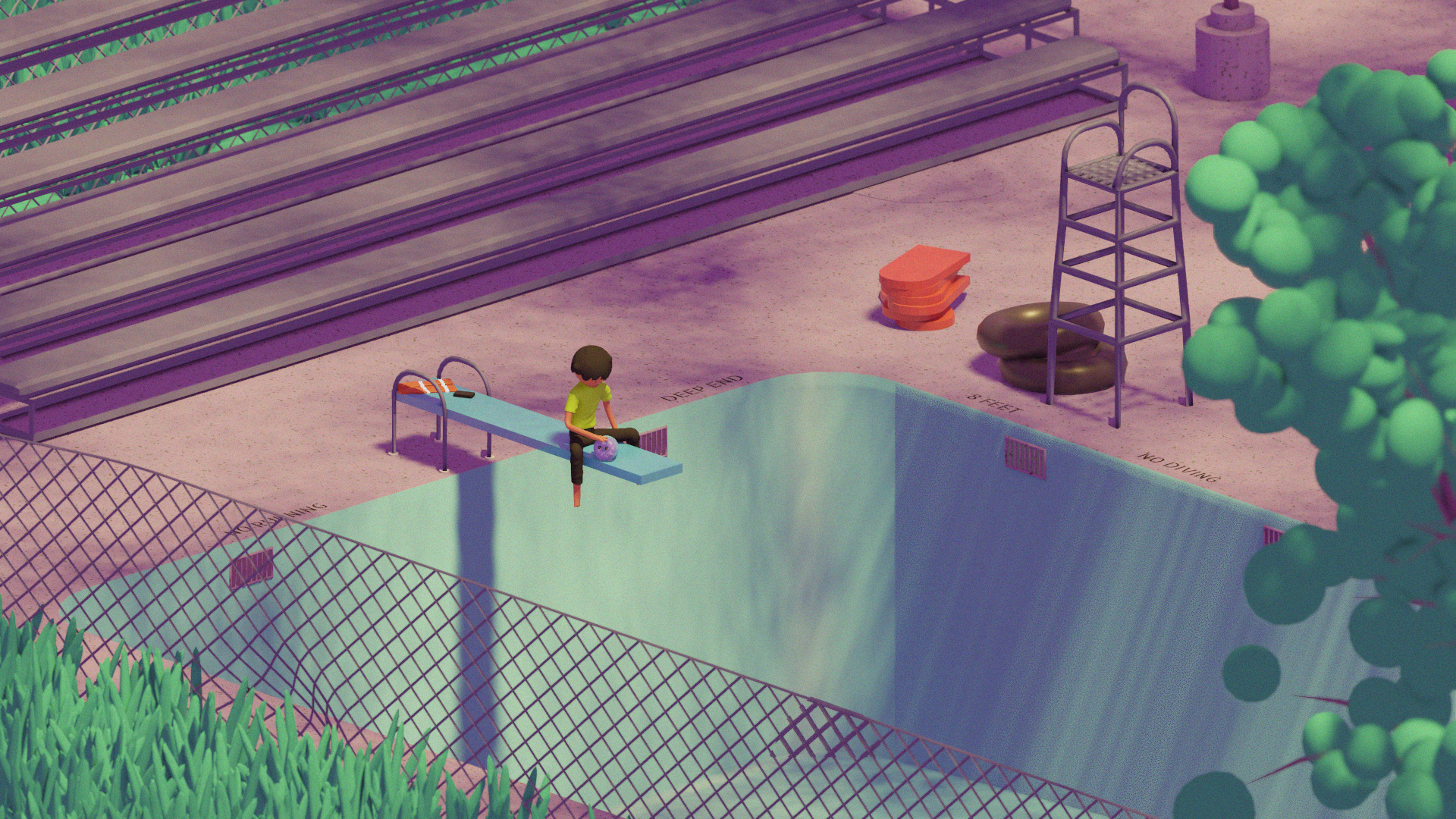
BH: That’s what makes it so interesting. There are all these different characters and situations, but it all feels like it’s really taking place in one world where it’s just a bike ride from the beach to a house to a secret lab. The visual style reminds me of a narrative indie game in a sort of way, like Donut Country.
JG: 100%, and donuts are a big part of the movie.
BH: Exactly. Was it always going to be a feature? Or had you played around with it as some sort of video game or a point-and-click adventure?
JG: I think before I knew what it was, I knew that I wanted to do a big project about food delivery. And I tried it a lot of different ways. I just thought, there is something very video-gamey about this. At the beginning of the movie, he’s basically going from place to place on his little contraption and meeting these characters who info dump in the way that somebody would in a role playing game. He’s trading things, and he’s trying to level up and get to a certain number. That story about the way that all of our lives have been video gamified, felt more interesting to me in a narrative than it does in a game, because there are already so many games like that.
BH: I was just like, yeah, it feels like Billy [the main character] is turning his own life into a video game in order to get through it. And there’s essentially loading screens when he’s going from one place to the next. The commentary on the grind without it really hitting you over the head. So much of this movie is about ways of bucking the system.
JG: What Billy learns is what we all learn, which is that oftentimes the system will let you think that you’re winning, that you’re tricking it, when in reality, it’s all part of the design. I used to do this thing at the Wendy’s downtown in Boston, where if you got the hamburger, on the back of the receipt, there was a survey you could fill out to get a free hamburger. And I turned it into this infinite hamburger glitch where I got a free hamburger, I got the receipt from that and did the survey again and kept getting free hamburgers. I did that for a couple months of eating nothing but singles for lunch every day. But again, I wasn’t really winning. I was making myself sick eating these free hamburgers. And I was also buying fries and a drink. So Wendy’s is coming out on top no matter what.
BH: I did something similar with Dunkin’s point system for a long time. I would just get free coffees all the time, but then they changed the point system. And now I just don’t even go because I’m like, well, I don’t feel like I’m winning anymore.
JG: The McDonald’s app is crazy. I had it for a month. I had to get rid of it. It’s like a little demon that’s just pulling you in. I feel you just can’t get in your car and go to McDonald’s and then come home. That feels really wrong. You have to be getting McDonald’s on the way to or from something. The first time that I went to McDonald’s and just had McDonald’s and came home, I was like, I can’t believe I just did that. I feel like I crossed a line there.

BH: I assume you’re also obsessed with Chick tracts, since they made it into the movie.
JG: Oh, yeah, I have a few lying around the house. My wife did the drawings for that one in the movie. They’re so cool. They’re so funny. And they make you want to be so satanic.
BH: It’s an interesting comparison between the Chick tracts and Mr. Moolah, his grindset.
JG: That was a way in for the characters for me. If economics is like America’s religion, each character sort of has a different denomination. Like Mr. Moolah believes in this very new form of mystical capitalism, this idea that you can manifest money and that you can use numerology and astrology, which really is not that far off from traditional economics. Billy, the main character, is into hustle culture, but he’s going around meeting all these different people and each person has one piece of the puzzle. Even Miss Sharon, who’s handing out the Chick tracts. She kind of sees heaven as like, the ultimate ROI. And she sees punishments from God as something that are very numerically defined. Almost like a sort of currency. And then there’s the kids on the beach who kind of opt out in their way because they’re sat down there making songs.
BH: Did you grow up going to the beach like that, where you’re just tooling around, not really doing anything?
JG: I grew up outside Tampa, so we had some pretty nasty local beaches, like the beach next to the power plant. It was the closest one that we used to go hang out at where you really weren’t supposed to go in the water. But I think one of the real joys that people have found in the movie is the scenes where the boys are just hanging out. They haven’t had the whole world infiltrate their minds yet so they’re free to spend the day bumming around doing bad freestyles on the beach and shoplifting. As kind of evil as they are, they are also so innocent. And yeah, they’re sweet little boys, I feel like they’re real. I’m realizing like, oh, yeah, I’m insane. But they’re my friends, the children at the beach.
BH: What’s your relationship to mainstream animation these days, because it’s really up and down. It’s something I focus a lot on. I’ve been going through a Pixar rewatch for my newsletter, focusing on what I like about these things and what’s not working anymore. Do you even watch the new ones at all?
JG: I love all animation. I basically love every movie, but I really love animation. I love every Pixar movie. I love KPop Demon Hunters. I think Pixar has made this really incredible machine for making a Pixar movie that is going to go on forever and continue making satisfying and interesting movies. My macro take would be that they’ve done that so well that that’s what the entire animation industry has become. What we’re trying to do here is just create more of an ecosystem where there’s different kinds of projects. If the huge massive family stuff is coming out, we can also get a few independent animated features a year, everyone would be more well served.
BH: I totally agree. There’s a whole thing of like, the animation is cinema crowd, but then they’re still just talking about Spider-Verse. And I like Spider-Verse.
JG: They’re talking about $100 million movies. People have this idea that animation has to be big and expensive and this huge pipeline. One thing I was thinking about with Peisin was, what if the animated feature was more like a novel, where the same person who designed the characters was the person who did the music and what would that feel like? As janky as the movie is, I think there is a sense of care that has resonated with people.

BH: You got to design a lot of little guys for this. Do you have a mindset for little guys, when you know it’s perfect to show up on screen? You’re like, ah, yes, this is my favorite creature, he will be in the film. Or like, he’s not quite there yet. And you add a cone or something to him.
JG: Yeah, the cones I’m adding all the time. I would call it like an eye doctor test where at some point, you’re kind of lying if number three or number four is different. When you start keeping different versions of things, it gets really confusing. I generally don’t like to have ten different models of an alien that I have to look at. I try to just work through it. I think this is a trap for all artists, but it’s endlessly intoxicating in 3D using Blender, which you can just futz around in forever. You can add another layer of texture, you can add more detail, you can change the color of something and you can try connecting different nodes. And knowing how to move forward through that stuff is a challenge that I actually find myself not succeeding at all the time. You make a new creature and you’re like, does this count? Does this fit in my world? Am I limiting myself? That’s the beauty of a pipeline like this, nothing’s permanent. The character Donut, who is sort of the central alien in the movie, actually was changing designs all the time. And the version that we sent into festivals, he’s kind of ugly compared to how he turned out. He was more like E.T. where he’s nasty. He’s like a disgusting creature, but you gotta love him. That was the thing that I really loved about working on this. I didn’t feel like I was following someone else’s instructions. I didn’t feel like things were set in stone. I had to see them through. The whole movie was alive the whole time.
BH: Do you have like one random tip for Blender that you think could really help anyone who’s just like playing around? Like a shortcut that you figured out or just something you do whenever you’re in there?
JG: If anyone doesn’t know the wave modifier, it’s the one thing that just instantly adds some animation. A hack that I use a lot is throwing away a modifier on something. Well, your Blender head readers probably already know about it. I have to say I’m not the most advanced Blender user. I think that would be my tip. You don’t have to learn everything. You have to learn just enough to get it going.
BH: I think it is safe to assume that people reading Boston Hassle know how to use Blender.
JG: These kids in Boston are smart.
Boys Go to Jupiter
2024
dir. Julian Glander
90 min.