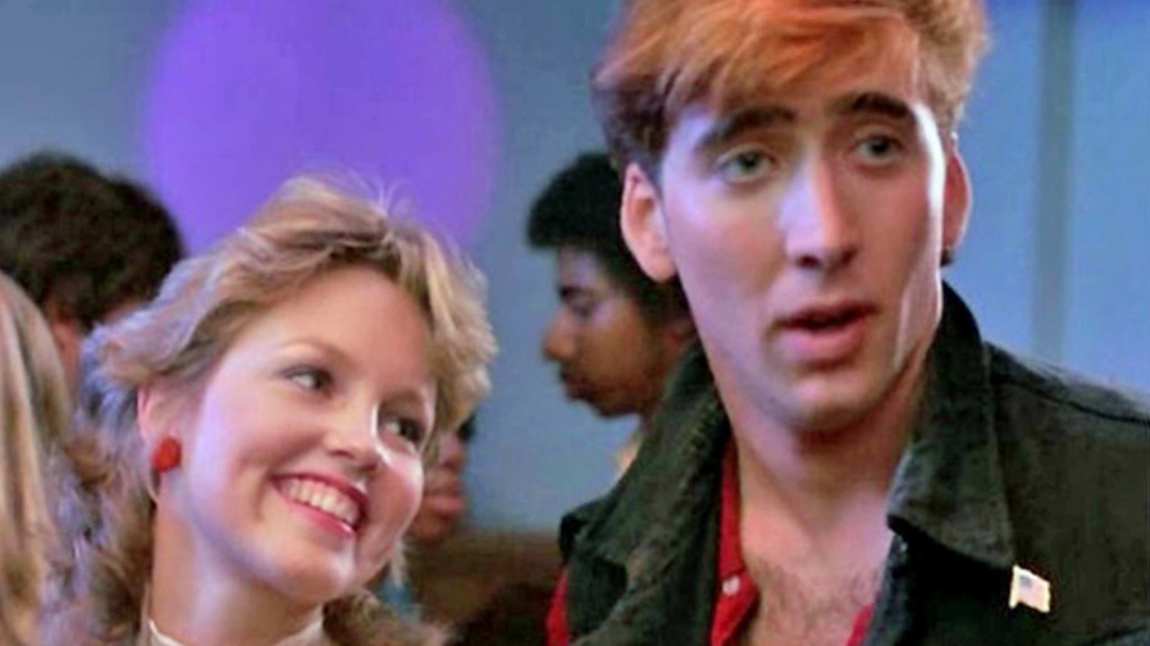
Valley Girl is a quintessential ’80s Hollywood movie depicting a swift, slightly mind-widening, and entertaining love story in upper(ish)-class White America. It follows a pair of LA-based opposites and high school kids, Randy (Nicolas Cage) and Julie Richman (Deborah Foreman), as they enter a (barely) socially unacceptable relationship—with Randy being a punk-rock, working-class rebel and Julie being a popular pretty girl in her heteronormative high school, they face nothing but shame and judgment from at least Julie’s peers. As the pair explores their fresh feelings and connection, they learn quickly how her social circles are strict with a capital S. With magnifying naivety displayed by both Foreman and Cage, the world around them of Coca-Cola advertisements, dingy dive bars, bright-lit theaters, shady music joints, and squeaky-clean rides comes crashing down because Randy’s punk-rock, anti-establishment/anti-conventionalism nature is too foreign to conventional White suburban living. Forget if they were anything other than straight White folks; walking around with messier hair and a direct attitude is too much for American boys and girls! But despite it all, Julie and Randy have to live—for themselves and each other—so with their dynamic and the drama that surrounds it, a lineup of classic new wave ’80s music and a colorful look at America from its cleanest school rooms to its grittiest, barely legal businesses, Valley Girl is a societally critical flick that firmly enlivened by a culturally referential, ’80s-ditsy tone. Or, as Randy himself puts it, “Simplicity at its finest.”
Reputation should not define life. With 8 billion+ people, there should not be much room for looks, financial background (privileged inheritance), or social status—but the U.S. is a morally plastic environment. As President Donald Trump continues to tear down governmental institutions and reinstitute a consumerist, heteronormative centrality in the U.S., Valley Girl becomes not just an ’80s icon but a reminder of how vastly restrictive these norms are. When a country gets treated like a business, each person is a product, and they must fit all the rules and regulations—women must be pretty, men must be hardworking—to make themselves as enviable a product as possible. Heteronormative conventionalism, as White and wealthy America live it, is the only path to success, and anyone else who cannot attain it is somehow to blame. If there is doubt about the Trump-Reagan administrations’ similarities in their country-as-company leading models (not to say Ronald Reagan was as openly greedy or destructive as Trump, though), Valley Girl is a poignant reminder: Julie hates how much of a product she is, a sticking point far larger than which boy she should pick to prom. While this is still the ’80s—again, minorities’ struggles in the ’80s are not even glanced at—the film elevates itself beyond the U.S.’s then-concrete over-consumerism and intolerance through Nicolas Cage’s rebellious and almost anti-protagonist.
Before Randy’s appearance, Julie lives a typical life of a popular teenage girl: she has her circle of vicious, status-focused friends who are desperate to get her back with her pigheaded, narcissistic boyfriend Tommy (Michael Bowen) because he is their school’s football captain, even though Julie makes it abundantly clear she wants something else. Enter Randy, a direct, ruggedly clothed guy who takes no shit that isn’t straight. As the literal valley girls ooze over another similarly looking white kid with a football jersey on—”Sure, I mean Brad’s totally hot,” one girl admits. “Brad is totally not,” her stereotype-reinforced but mildly quippy friend retorts—Julie can’t help but find herself attracted to Randy’s more straightforward way of living. As she nervously clambers into her first dive bar with Randy and their two friends, she gets her first lesson in real-world understanding: “We go to normal parties. We go to normal places,” Julie’s much uptight friend says. “That’s the same as what we do;” “It’s the way we do it that makes the difference,” Randy’s friend and he respectively respond. By breaking down “the difference” between these groups as something only disguised as such by their opposing preferred hangout settings, Randy teaches a more open-minded Julie her first bit about human variety and why it should get accepted. While Julie struggles with choosing reputational security over love and peace throughout the rest of the film, that change in perspective on both sides is the foundation of Valley Girl‘s magic.
It isn’t exactly sunshine and daisies to be conventional, either. Tommy, aside from his self-absorbed nature, is a sleaze. Not five minutes in, he fools around with Julie’s friend only to insult her immediately after she rejects full sex: “I think it means, like, uh, you’re a pretty lousy friend, messing around with your friend’s boyfriend while he’s in a bad way.” This near-sexual harassment is clearly encouraged throughout the valley, as the encounter is never mentioned again, let alone dealt with by the friend who dealt with Tommy’s degrading actions. Even if Julie “can, like, kiss all the bitchin’ Val dudes goodbye” by dating Randy, there is little beyond social acceptance to return to. Randy, meanwhile, goes above and beyond in funny (but not endangering) ways for Julie, making it clear he is committed to her even if it comes off weirdly in everyone else’s eyes. Of course he would jump in a car he spots her in and justify it with a “Because I love you!”. It’s simple, direct, and meaningful, all traits that Tommy would struggle to come by. Why should such unrestrained love be an issue?
Thus, while Valley Girl is still backward in many ways, and it certainly could have done more than question relatively basic straight, White boy-girl social norms, it does a lot in the name of change and togetherness. Through irresistible characters portrayed with ease (especially from Nicolas Cage in his first role under that now-famous stage name), culturally crafty interplay, and a sharp understanding of White America’s unnecessary societal restrictions, Valley Girl ensures viewers walk away with more than a valley’s worth of new or reinforced knowledge. ’80s film fans, comedy fans, and Cage or Foreman fans will find lots to love here, even if it could have done a bit more.
1983
dir. Martha Coolidge
99 min.
Screens in 35 mm Monday, 3/31, 7:00 p.m. @ Coolidge Corner Theatre
Part of the film-adjoining Seminar and the ongoing repertory series: Spotlight on Women and Totally Trailblazers