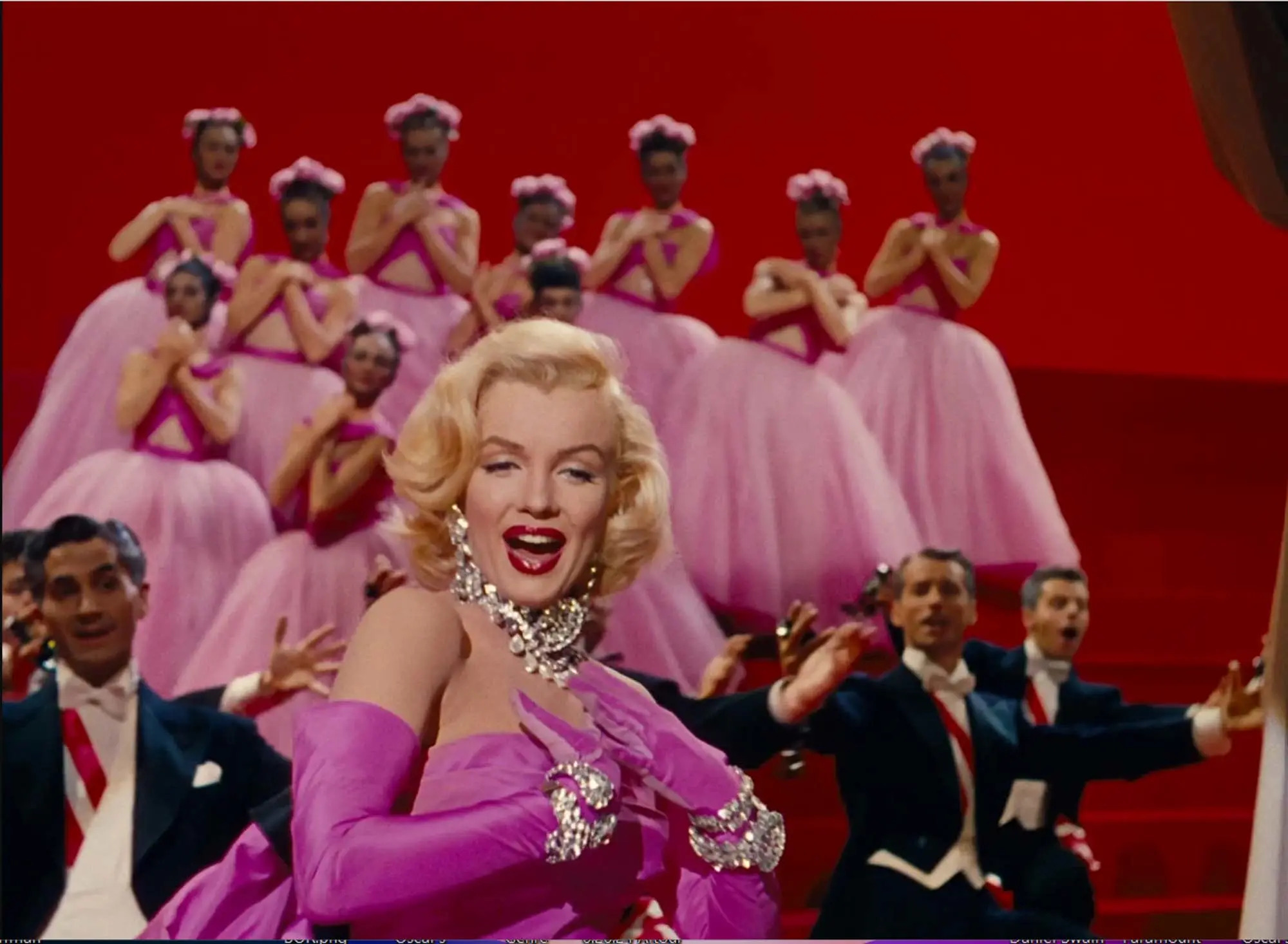
Gentlemen Prefer Blondes is a funny, quippy, and relatively socially aware (given its insanely dated stereotyping—it was 1953!) flick about different love-related priorities. The story follows two renowned showgirls and best friends, Lorelei Lee (Marilyn Monroe) and Dorothy Shaw (Jane Russell), as they embark on a journey to France because Lorelei is set to get married to her rich husband, Gus Esmond Jr. (Tommy Noonan). Despite Gus revealing to Lorelei and Dorothy that his father would cancel their marriage and any paid-for trips like this one to France if Lorelei misbehaves, Lorelei and Dorothy travel on their own to France anyway—searching for new love. The pair have opposing views on love’s central necessities; Lorelei looks for a man’s wealth while Dorothy wants nothing to do with it, instead focusing on looks, fitness and personality. As they explore their new options aboard their France-destined boat, they meet various new faces including sharp Ernie Malone (Elliot Reid), who falls for Dorothy despite his mission to keep an eye on Lorelei, as he is a secret private investigator hired by Mr. Esmond Sr. With their reputations and hearts at stake, Gentlemen Prefer Blondes becomes a half cat-and-mouse, half love affair kinetic musical romp that entertains in its silliness (for the most part) right to its end.
First and foremost, which cannot be stressed enough, it is important to remember that much of what this film deems important is in fact sexist, backwards and rigid—everyone is a Hollywood-sized stereotype. Both Monroe and Russell’s characters are focused entirely on love and/or wealth; men are entirely work-dedicated and almost moronically hard-headed; there are no Black characters, other POCs or any queer people of any sort, which is definitely for the best when considering the film’s stereotypical nature with more back-then “normal” people anyway. If Gentlemen Prefer[red] Blondes maybe 20 years later, if not sooner, these characters would probably feel much more organically designed. But alas, their cartoonishly stereotypical nature is partly what makes this film satiatingly hilarious.
As the main pair stumbles around new environments, either laughably bungling themselves with weird characters or pleading each other to see men differently, both Russell and Monroe shine in their varying roles—and their unlikely friendship is all the more appealing for it. Monroe needs no real introduction. Singer, actress and at one point JFK’s supposed love (affair) interest, Monroe dazzles as the plastic persona’d Lorelei, whether she sings or self deprecates: “This is the first time I’ve been shopping without a man along!” she exclaims in a taxi with Dorothy, eyes widened with naive excitement over… shopping only with her friend. While other actresses, including Monroe’s co-star Russell, can self deprecate, it is especially charming considering Lorelei is the titular blonde in question. Monroe ensures that Lorelei is just a little too sure of herself to not seem silly. “You did say diamond. I can tell,” she says to her next victim before softening the rich old man with a doe-eyed look and falsely admiring—and very practiced—voice. This also makes Lorelei as a character compelling, because as fixated as she is on diamonds, she is still open-minded enough to understand both her own faults and that there is nevertheless more to life than wealth. A feat that she and her dear friend share.
Russell, though not as immediately recognizable as her blonde counterpart, is equally charming, but through daring conversation and a sincere personality. Dorothy does not fear prodding at her friend’s ways, like many male counterparts often presume: “You know I think you’re the only girl in the world that can stand on a stage with a spotlight in her eye and still see a diamond inside a man’s pocket,” she says backstage after their film-opening dance performance. She very much sees Lorelei’s flaws, imploring that Lorelei look past the “diamond inside a man’s pocket” and instead focus on his virtues and appearance, with Lorelei returning the favor in ensuring Dorothy does not forget about wealth. Nothing is ever friendship-ending between them, so jokingly suggesting life changes are beneficial for the both of them. With this playful conflict central to the film, it is clear that such criticisms silently ensure they keep themselves open-minded. “Nobody talks about Lorelei but me. She’s quite a girl. You just don’t know her,” Dorothy says after a man dares to criticize her best friend—they only have that right to each other because of such an unspoken rule. Separate, Lorelei would be swept into the decrepit lifestyle of ultra-wealthy living, and Dorothy would live on the fringes because she forgot what makes (capitalism) the world go round. Keeping each other in check, no matter how grave the circumstances, has thus become vital to their living patterns.
While things entirely derail in the last 20 minutes, really leaning into implausibly stupid comedy to sell something of an ending to an ultimately pointless legal subplot, most of the film is a subconscious class analysis folded into two friends’ opposing outlooks. It questions what makes life worth living through two opposing personalities, demonstrating that such open-mindedness the pair reinforce is necessary to live life wholly. On top of well-choreographed performances that features one of Monroe’s biggest hits, “Diamonds Are a Girl’s Best Friend,” Gentlemen Prefer Blondes is a quirky and entertaining—if severely backward—rom-com. Viewers will probably Prefer Blondes after this, so long as they are fans of either of the film’s stars, old Hollywood, or musical-comedies.
1953
dir. Howard Hawks
91 min.
Screens Monday, 3/24, 7:00 pm @ Coolidge Corner Theatre
Part of the ongoing repertory series: Big Screen Classics