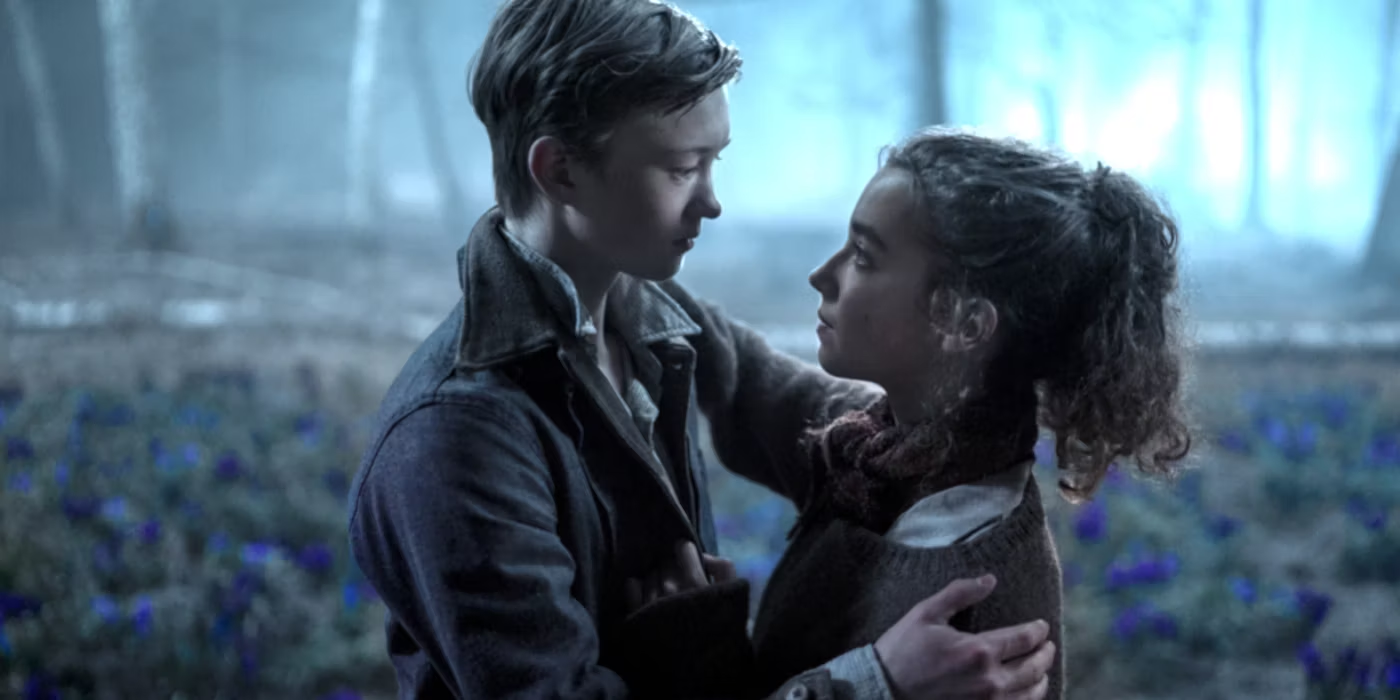
White Bird is a sentimental, poignant, and oft overly schmaltzy war flick about kindness’s miracles. Both a spinoff and prequel to the 2017 film Wonder, White Bird starts by following the previous film’s main bully, Julian Albans (Bryce Gheisar), as he ventures high school isolated from his peers after having been expelled from his old school in Wonder—he’s ostracized by many around him. Coming home sad from such loneliness, he arrives to a surprise visit from his famed Jewish artist grandmother, Sara Bloom (Helen Mirren), who, upon seeing his state, decides to explain a personal story of kindness she doesn’t share with many. Thus the majority of the film is spent in occupied World War II France, where a Young Sara (Ariella Glaser) almost gets arrested by Nazis at school before being hidden away by a fellow student, polio-half-paralyzed Julian Beaumier (Orlando Schwerdt). Despite her making fun of him in school for his crutch and deficient leg, Julian looks past that and takes her in, introducing her to his family and distracting her with games, views, and conversation over a year. The two grow inseparable, and Sara learns what Julian already knew: kindness harbors miracles, even if fatal results come with it—something the present-day Julian needs to understand.
White Bird is cheesy; there’s no getting around that. It spends much time exploring intimate relationships borne from fatal chaos like war, with the past Julian and young Sara a shining beacon of hope in the darkness. If that sounds cliche, it is. Before their separation, Sara’s father, Max (Ishai Golan), says “To fight against the darkness, we must be the light,” referring to kindness being the true enemy of evil. The idea repeats from different sources until the pair reunites after the war’s end, to which Max repeats the phrase. This kind of usually frowned-upon sentimentality oozes throughout Bird‘s run. But given the film’s highly emotional themes, it’s hard to avoid.
Fortunately, a splendid cast, grounded direction, and dazzling imagery make Bird feel more touching than touchy. As the older Sara, Mirren is a wise mentor for the present-day Julian, who needs to learn why kindness is important. Mirren carries the film beyond its near mediocrity with grace and nostalgic sorrow in a rushed ending. As young Sara, Glaser portrays with effective poise, initially a typical teenager who yearns for companionship and adoration of her art skills with an underlying shyness that slightly separates Sara from her peers. Even before his entrance as the co-star, Schwerdt carries himself with an outcast’s confidence as past Julian; his leg keeps him out of step with everyone else, but he knows his strengths. Together, they’re magnetic, and the eventual love blossom is satisfying—if cut too short due to Bird’s bittersweet close. When they wander through their imaginations of different places, Julian tells Sara of school knowledge and gossip, and they bond over other similarities, the film’s at its most touching. Through Julian’s parents, Sara even gains a family, further driving how far kindness and basic humanity can get you.
Bird’s also just an organic movie about living under Nazi occupation anywhere in Europe. Director Marc Forster balances the film’s sentimentality with hardcore moments, from wolves mauling a teenage Nazi soldier to watching Nazis round up kids for concentration camps. The heartfelt bits of the film strengthen further because the war bleeds in cruelly and quickly, making even the cheese feel justifiable. Thus, White Bird may not be that well-penned, the ending dashes and the story can be pretty simplistic, but budding chemistry, a robust overlaying message, and even stronger performances imbue truly inspiring moments more often. This film is undoubtedly a feel-good option for war, drama, and romance fans.
2024
dir. Marc Forster
120 min.
Opens Friday, 10/4 @ West Newton Cinema, AMC Boston Common, and AMC Assembly Row