
Bikers, as big screen icons of Americana, have largely fallen out of fashion. There was a time, of course, when the young motorcyclist was a go-to signifier of with-it American independence, a lone outlaw thumbing his nose at conventional society and riding his faithful steed across the wild frontier– in other words, a modern cowboy. This, perhaps, speaks to the relative lack of biker movies; westerns themselves have fallen out of favor over the past half-century, which pretty well hampers the social relevance of the biker-cowboy mystique. There are still bikers, of course, but a good biker movie needs a fresh angle if it’s going to bust its leather jacket out of the mothballs.
It is clear within the opening minutes of The Bikeriders that director Jeff Nichols has found his angle. Austin Butler, as a typically soulful member of the Chicago motorcycle club the Vandals, gets into a fight with a couple of shitkickers for refusing to take off his colors. Fists are thrown, then barstools, then chains. They take it outside, and then, just as an enormous shovel makes contact with Butler’s skull, the action freezes, and Jodie Comer begins dryly narrating how she came to be involved with this dangerous underworld. The scene doesn’t recall classic biker/western iconography so much as Ray Liotta’s famously detached narration in Goodfellas. In this moment, Nichols makes his intent clear: this isn’t just a biker gang movie, it’s a biker gang movie.
The Bikeriders draws its inspiration from a book of the same name by photojournalist Danny Lyon, who spent several years photographing and interviewing members of a real-life Chicago motorcycle gang (Lyon is here played in avatar by Mike Faist, whose scrawny frame and folk-music beard cut an amusingly collegiate “pinko” counterpoint to his rough-and-tumble subjects). It’s not quite correct to say we see this world through Lyon’s eyes, though; rather, our entry point is Comer as biker-moll Kathy, who is drawn into the fold via her infatuation and whirlwind romance with Butler’s Benny. Comer is disarmingly hilarious, her matter-of-fact midwestern drawl heightening both the drama and the absurdity of the biker’s world. Kathy is, by all appearances, a normal person, which makes her presence in the midst of all this madness even more counterintuitive than Lyon’s.
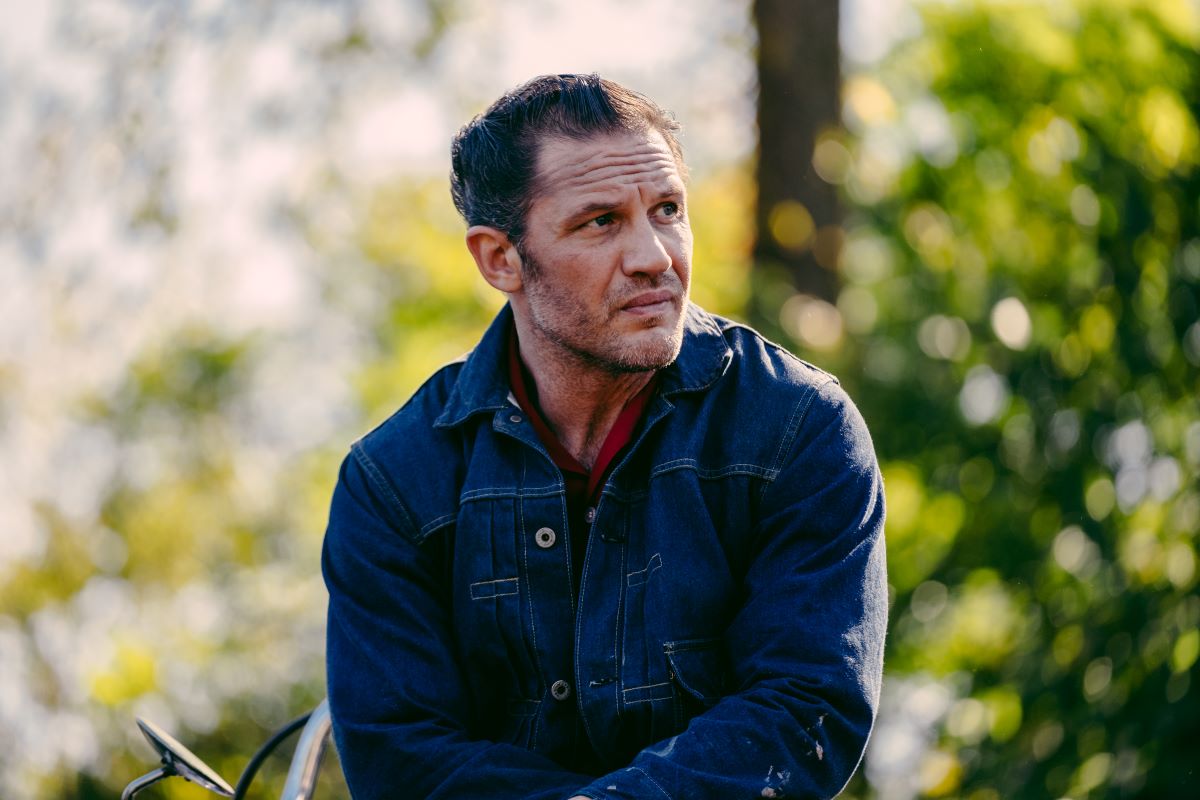
So what’s a nice girl like her doing in a place like this? The fact that Benny looks and acts a lot like Austin Butler has something to do with it. The core of the film is a barely sublimated love triangle between Kathy, Benny, and Vandals leader Johnny, played with characteristic weirdness by Tom Hardy. Right down to his character’s name, Hardy is doing early Brando just as surely as Michael Cera in Twin Peaks (a fact lampshaded by an “origin story” flashback in which Johnny catches The Wild One on TV). This is a feature, not a bug. Hardy’s every mannerism is an oddball joy to watch; he plays his character with a squint which seems to extend to his entire body. His voice, too, rarely rises above a whisper, but he commands every scene he’s in. It’s clear how this gang coalesced around him; if you met someone this weird, you’d probably follow them around too.
Butler, for his part, gives an icon’s performance more than a tour de force. Benny is the strong-silent type, the sort who spends most of his time leaning against walls and gazing soulfully at his bike (uncharacteristically, Butler resists the opportunity to indulge in a silly-voice, despite the gauntlet thrown down by Comer and Hardy). Benny is the center of the film, but he isn’t its star so much as its McGuffin, the object the pursuit of which drives the actual protagonists. Kathy wants Benny to settle down and be her man; Johnny wants Benny to step up and take control of the gang as he nears too-old-for-this-shit age. Benny, for his part, doesn’t seem to want to do much of anything but to ride around and look cool. There’s not a whole lot more to Butler’s performance, but there doesn’t need to be. One senses he was cast to anoint his character with residual Elvis-ism (indeed, there’s a bit of some of Butler’s other best-known characters as well: the dopey obsequiousness of Tex Watson, the blank psychopathy of Feyd Rautha). Stuntcasting? Perhaps, but stuntwork is an art in its own right, and it plays well enough on screen that it’s difficult to mind.
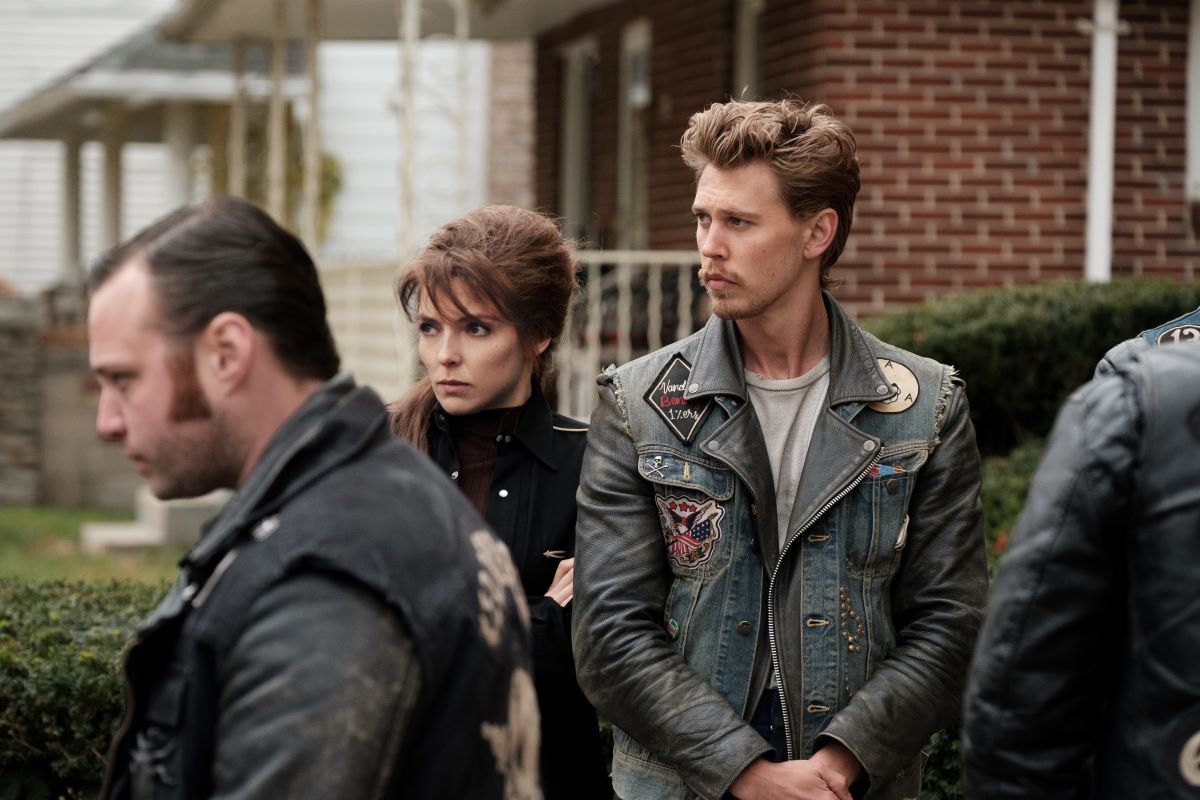
If I haven’t spent as much time as usual discussing the plot of The Bikeriders, it’s because I pretty well covered it with that Goodfellas comparison. The Bikeriders follows more or less faithfully the classical gangster movie arc: the entry into a life of crime, the debaucherous rise, the inevitable souring, the crash back to earth. But the point isn’t the plot so much as the feel. Just as Lyon did with his book, Nichols’ goal is to immerse us in this grungy world and its outrageous inhabitants. My favorite scenes consisted of nothing more than Comer nonchalantly introducing us to men with names like “Wahoo” and “Shitty Pete” and “Cockroach” (“On account of I like to eat bugs!” Cockroach helpfully explains). The supporting cast is a veritable murder’s row of gnarly-faced character actors, including Norman Reedus as a west-coast hippie biker with filed-down teeth, and, inevitably, Nichols regular Michael Shannon. Shannon, who was seemingly born for this material (can this really be the first time he’s been cast as a biker?), fires off two hysterical monologues, and I could have listened to dozens more.
But for all the savage violence and unfortunate hygiene on display here, there is a strange sort of beauty as well. It makes itself known early on in Kathy and Benny’s first ride together, which plays in silence save for the swoony girl-group strains of “Out in the Streets” by the Shangri-Las; as the film goes on, that song’s eerie opening keen becomes something of an act-change motif (in the interest of full disclosure, I should mention that “Out in the Streets” is one of my very favorite songs, and I am near-powerless against its use in a movie). That beauty recedes to the background, to be sure, but it’s there in the purity of these characters’ boneheaded lifestyle. It’s certainly apparent when it goes away, as the Bad Vibes of the late ’60s fully take root. Notably, “Out in the Streets” is replaced by the Stooges’ “Down on the Street” at a particularly noxious point-of-no-return party.
Ultimately, The Bikeriders is just as much a paean to the irresistible iconography of the mid-century biker gang as classic biker films were to the wild-west outlaw. In the way its camera hangs on its characters, it shares more than a little of the tongue-in-cheek fetishism of Kenneth Anger’s Scorpio Rising (whose use of music was, incidentally, a stated influence on Scorsese while making Goodfellas). As in any changing-times period piece, there is a certain reactionary bent under the surface, particularly in its eyebrow-raising distinction between the “violent, pot-smoking” second-generation bikers and the genial camaraderie of the original beer-drinking contingent. But The Bikeriders is a rare and undeniable work of pop filmmaking, combining genre-pulp thrills with shafts of Malickian wonder. It might not make you want to go out and buy a hog, but you may at the very least invest in a good tin of pomade.
The Bikeriders
2023
dir. Jeff Nichols
116 min.
Opens Friday, 6/21 @ Coolidge Corner Theatre and theaters everywhere