Review of Future Visions: Fall Regional Juried Exhibition
Sept 1 – Oct 1, 2016
http://gallery263.com/exhibitions/current/
While the title Future Visions evokes a wide range of possibilities about the future of Earth and humankind, this particular exhibition strikes a balance between frightened and tongue-in-cheek. Twenty-three works, selected by Nancy Adams (Communications Administrator at MIT D-Lab and Mobius affiliate), range from painting and textile to photography and video, and are united by their aesthetic appeal, even in the face of the uncertain dystopia of the future.
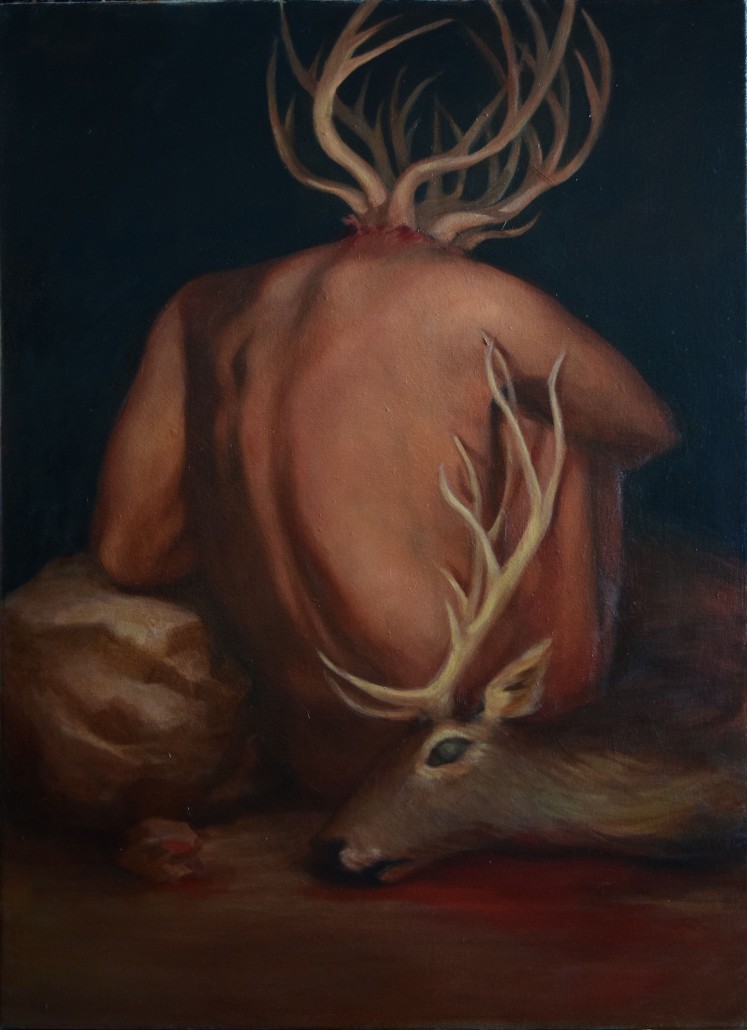
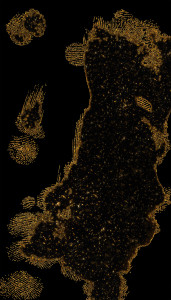
What is probably the exhibit’s most visceral and physical work, Delia Cadman’s The Becoming, uses dark and earthy colors to transform the banal object of the dear head into a striking commentary on humanity’s greed and the violence inherent in satiating our hunger. It also suggests that despite our current domination over nature, our relationship with it is ultimately a reciprocal one. Several other works also address this relationship, focusing on themes such as the contemporary city and global warming in particular. Another topic touched on by most of the works is the role of the latest technologies in our society. Alycia Thompson’s paintings translate emojis used in texting conversations into the equivalent human expressions—a particularly fascinating endeavor to me since I’ve always wondered how “ :-p ” corresponds to joking, as much as I use it in text conversation. (“ :-p ,” sadly, was not addressed.) Melissa Gollance’s Surge ⇌ Diffuse is innovative in its exploration of the danger of new technology, turning the hidden hazard of germs into something large and mesmerizing. And by combining different media and technologies, Gollance creates new kinds of geographies, forcing us to reconsider our relationship to our networks of communication and the physical and imagined space around us.
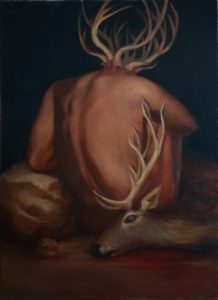
Delia Cadman, The Becoming, oil on canvas, 2016
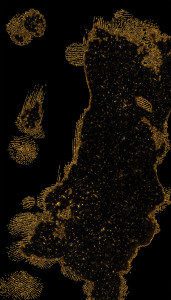
Melissa Gollance, Surge ⇌ Diffuse, c-print, 2016
A few works do not address Earth or the role of technology, but the direction of art itself. In Khalid Sabree’s painting The Art of Dog Walking, the artist fits himself into the progression of famous modern artists by portraying himself walking Keith Haring’s loud and vibrant canine, Charles Schultz’s classic and thoughtful Snoopy, and Jeff Koon’s stiff and shiny balloon dog. By harnessing the styles and subjects of these earlier artists, and transforming them from three different media into one, Sabree situates himself between a recent artistic past and a future which artists like himself will help to determine. Additionally, the associations made with these three artists—the freneticism and immediacy of Haring’s work; the calm and predictable quality of Schultz; and the controversy of Koons’ sculptures—pose the question of the direction of contemporary art. Is it apocryphal, predictable, or kitschy?
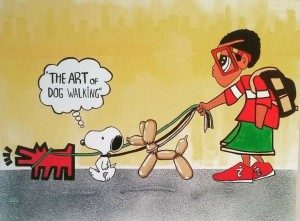
Khalid Sabree, The Art of Dog Walking, acrylics and marker, 2015
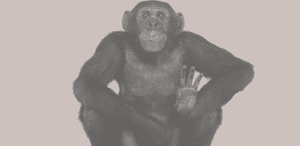
Joseph Bacou, Still from: l e t t uc e xvi, HD video animation, 3:50 min (looped), silent, 2016
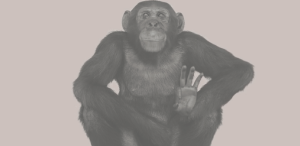
Another work that does not appear to address the role of technology as directly, but upon examination does so eloquently, is Joseph Bacou’s video l e t t uc e xvi. Based on a chimpanzee from the London Zoo who responds enthusiastically to the poem Private Eye Lettuce by Richard Brautigan, this piece recreates Miles the chimp in 3D, using American Sign Language to communicate lines from the poem “as well as the algorithmic code used in the computer generated modeling process of sculpting this primate in 3D space.” This mixing of languages pushes the viewer to ask the question of not only what we mean when we say “communication” and “language,” but also how communication will continue into the future. That the chimpanzee speaks the code that has created him begs the question of whether the art of the future can be self-sustaining, and if so, if it will erase or minimize the role of the artist. This piece speaks to the currently reality that, during a time of concern over the outcome of increasingly advanced robotic and cyborg technology, less attention is being paid to the innovative ways in which humans—and those like us—might adapt on our own.
Through different media and approaches to contemporary lifestyles and artistic practice, these twenty-three works offer exciting—if at times terrifying, tongue-in-cheek, or both—views of what is to come. Only time, and human action, will tell if their predictions are correct.
– Lydia Harrington
Future Visions is on display at Gallery 263 until October 1st.

Wonderful review! Just noticed that Delia Cadman is spelled correctly under the photograph of her work, but incorrectly in the text.