I am unaware of a director anywhere in the world who has more thoroughly and philosophically navigated the complicated contradictions of the contemporary world than Jia Zhangke, a titan of the Chinese Sixth Generation and one of the world’s leading political filmmakers. He never approached his project to film modern life in a modernizing and technologizing 21st-century China from a place of simplistic dichotomies or myopic ideologies. His fluidity around political binaries has helped him to avoid becoming a state propagandist while never being adopted as the party’s favorite filmmaker either. His newest released film, Caught by the Tides, is the apotheosis of his life’s work and one of the most profound and emotional wrestlings with one’s own artistic catalogue ever released.
Jia’s films can never be summarized the way most narrative fictional films can be, and that’s because he also avoids narrative conventions as well as he avoids political ones. His partnership with Zhao Tao, his wife and life-long artistic collaborator, is the most consistent throughline in his filmography. Her name means “waves” in Chinese, and Caught by the Tides more or less rides the waves of her life. We watch her age across 25 years as Jia reuses footage and outtakes from his old films (mostly Unknown Pleasures, Still Life, and Ash is Purest White), decades old footage for a project he began but never completed called Man with a Digital Camera, an obvious reference to Dziga Vertov’s Man with a Movie Camera, and original pandemic-era material. The younger Zhao loves a man named Guo Bin (Li Zhubin, also in the older films), and he runs away from Datong to Fenyang, where Zhao searches for Guo and eventually leaves him for good. They meet decades later in pandemic-China.
Old characters become new ones, and the degree to which Zhao’s Qiao Qiao is a continuation of the character with the same name in Unknown Pleasures or the woman with a different name in Still Life is up for debate. (I recommend reading Sean Gilman’s write-up on The Chinese Cinema to better understand the film’s relationship with Jia’s earlier work that it reimagines.) The film is dependent on Jia’s former works, and that might be the biggest limitation: his greatest works build extraneous barriers of entry upon themselves that, though rewarding, reduce their long-term viability in a short-attention-span global cinephile community. I imagine a complete newcomer to Jia’s filmography would be completely lost in the tides of his newest work, incapable of piecing together the impressionistic threads of lost loves and rapid industrialization into something comprehensible. Even as a long-time Jia-appreciator, I needed multiple viewings to parse the romance fully.
Zhao ages with the passing years as does China. The fortune teller might be the most symbolic representative of this, but the passing years are more often literally depicted with the aging images. Industrialization and later commercialization take up more and more of the mise en scène. An animated McDonald’s even makes an appearance in a sequence reflective of the surprise animation of The World. The construction of the Three Gorges Dam from Still Life moves China into the future unforgettably and painfully. Social issues bubble up with the rapid progress. Local dialects lose their social preference in the face of “proper Mandarin,” as one character instructs another to speak.
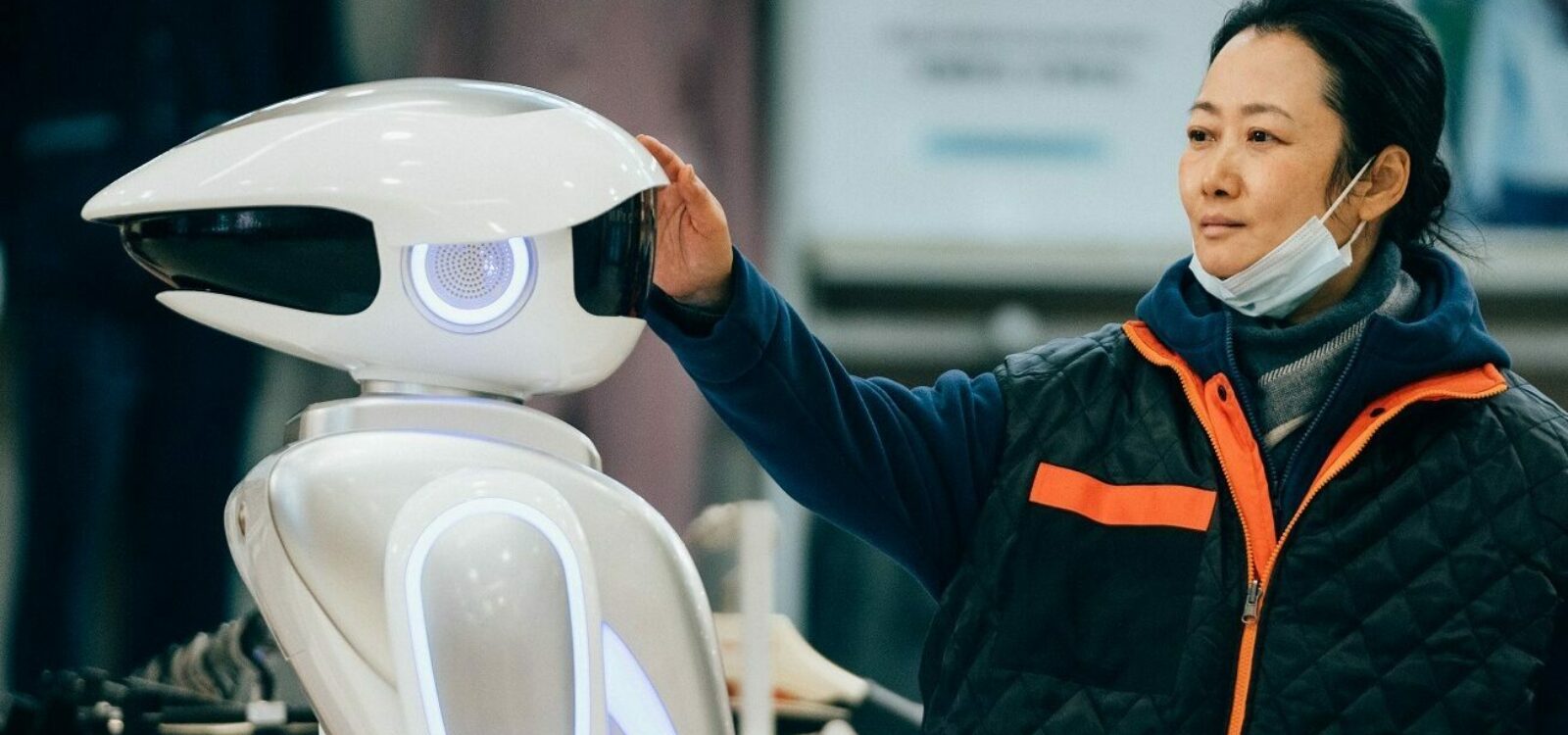
Technology becomes more and more part of life, with AI robots eventually moving from a hypothetical future dreamed about in a commercial advertisement into an arrived present as a robot full of pleasantries and welcome greetings approaches Qiao Qiao in a shopping area. The pandemic era ends the film, of course, re-grounding it in the present. The evolution of the equipment at Jia’s technological disposal evolves with the years too. While Jia has been using digital cameras since as early as 2002 with Unknown Pleasures, the quality of the pictures improves with the technological advancements in consumer cameras. The pandemic footage could have been shot on almost any mobile phone camera available. The effect of the changing qualities and preferences replicates the rapidly changing China that he sets out to capture with this viewfinder.
Music has always been important in Jia’s films, but never more so than in his newest. The music never really stops. Sometimes it is the original score composed by the Taiwanese composer Lim Giong (who also composed for Hou Hsiao-hsien’s The Assassin and Jia’s Ash is Purest White). Other times, the film uses pop music from the soundtrack. And still other times, the music comes from the world of the characters. Most of the time, the music speaks to themes of change, regret, or aging. I counted at least three songs with lyrics specifically about these themes in just the film’s first 25 minutes before I stopped keeping track. The styles change, too. The first song we hear with the credits is some sort of hard rock. The next music we hear is from middle-aged women singing to each other impromptu a cappella.
One of the most consistent features of Jia’s work is his ability to make indelible final shots. So many of his films end on unforgettable moments that linger past the final runtime. He doesn’t hold back with Caught by the Tides. Qiao Qiao and Guo cross paths in pandemic China. She works at a cash register and he is a customer, pulling down his face mask so she recognizes an older version of the face she used to know. They hardly speak. Outside, they stand a few feet apart — perhaps because of social distancing, but also reflective of the distance the years have put between them — and he does all of the talking. He, more or less, wants her back; at the least, he wants to make amends for the way he ran away. Without saying a word, she bends down, ties his shoe, and joins a large crowd of runners on the street. She races toward the camera (not away) as if the only thing we can do is to carry on. His body becomes small in the background before being overtaken entirely by the runners. Now a figure permanently tied to her past, she runs into the future.
Caught by the Tides
2024
dir. Jia Zhangke
111 min.
Screens Friday, 5/30 through Thursday, 6/5 @ Brattle Theatre – click here for showtimes and ticket info
Joshua Polanski is a freelance film and culture writer who writes regularly for the Boston Hassle, In Review Online, and Midwest Film Journal. He has contributed to the Bay Area Reporter, Klassiki Journal, Off Screen, and DMovies, among an endless list of other places. His interests include the technical elements of filmmaking & exhibition, slow & digital cinemas, cinematic sexuality, as well as Eastern and Northern European, East Asian, & Middle Eastern film. His column on Baltic cinema is the only column covering the beat in the English language.