En Marfa, TX: Horror Vacui, Amor Infiniti
This is a short story about nothing and the infinite, and the oddly transformative power of both. This is also a story about Marfa, and how it oddly embodies the concept of eternity in several ways, both natural and contrived.
Marfa is the town that Donald Judd built, a square, flat outpost misplaced in the high desert of West Texas. It gained status as a cultural destination over the course of the 1960s, driven by Neo Dada, cultivated with oil money, and supported by the cult of the Cadillac, an extension of that long-abiding and peculiarly American penchant for roadside attractions.
This is a story about a town, and its mixed legacy, and its imported haut couture, and its Texas lineage, and its trending identity, which approximates, but does not (in true fashion) achieve the limits of the infinite.
Infinite Sky: Endless West Texas
Texas highways are a good place for the contemplative soul, largely because driving in a long, straight line with little roadside company or distraction (in the form of buildings or other cars) leads to a kind of lulling, introspective trance. From Texarkana to the very edge of New Mexico, the drive across the state can take at least 13 hours, and it is the very tail end of it, through West Texas, that best encapsulates what can only be described as monotony bordering on Edmund-Burkian levels of sublimity.
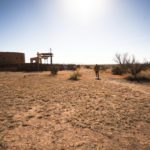
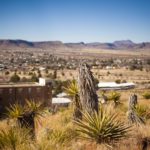
West Texas is the part of the state that it feels like God forgot, and it has some pretty characteristic features. It is flatter than flat; its flora are the tumbleweed (whose earlier genetic ancestors, like the Mongols, roamed the Central Asian steppe) cacti, several varieties of dead, stringy grasses, and the occasional wildflower. A journey across this region might also include: endless rows of short telephone poles, fences fencing in nothing in particular, penumbral shadows, scattered piles of cotton, and a horizon that yields every color at the end of the day in thin fuzzy strips, un-obscured by trees or buildings.
This is the part of Texas best know for its poop farms, its sensitivity to drought and brushfire, and for the tiny, nearly indiscernible towns that dot the roadside. These little towns pop up unexpectedly and are easy to miss. In West Texas, you will be galloping along at 110 miles per hour and find you are forced to rapidly decelerate, because someone else’s main-street has just coincided with your highway. For a second you see the following: a water-tower, a bill board about Jesus, some non-descript buildings made of cement and aluminum siding, ominous looking farm equipment, and the altogether annoying city sign: “Welcome to Alpine; there are 2,500 people here, and only a few of them are grumps.”
Marfa is, first and foremost, a Texas town of this sort. It can only really be understood as a place set against the backdrop of those flat brown fields and that tremendously open horizon. (By the way, fear of being swallowed up by the sky is a fairly common neurosis for people from this part of the country.) Before it is anything else, it is a space silhouetted by desert, defined by the journey required to make it there. Pressed to pick a single location on earth that best defined infinity, approximated it most closely in sentiment and flavor, I would surely select Marfa.
Infinite Irony: Recursion and Self Deprecation
Marfa is sometimes derided as a cowboy-themed version of Brooklyn. True, it has the artisanal food fixation, the post-industrial converted gallery spaces, and the teeming hordes of alt-culture devotees, just like its New York counterpart. Still, it would be unfair to say that Marfa is just Greenpoint in a ten gallon hat, just a copycat cultural program exported wholesale to the desert by snobbish east-coast aesthetic entrepreneurs; it’s worth remembering that the artists who came to work in Marfa did so out of a desire to remove themselves from the New York art world, from its corrupting financial influences, its noises and crowds. The stuff they made here, in those heady days truly distanced them from their urban base as they focused intently on West Texas, with the dual goal of dissecting and duplicating its materiality in a light-hearted, distanced way.
The progenitor of the Marfa project was Donald Judd. Judd was an American minimalist with a philosophy degree from Columbia and a pretty significant chip on his shoulder about the commodification of the New York art scene. He came to Marfa in 1972 to make site specific works that would resist both formal categories (sculpture, painting) and absolute interpretation.
Judd’s reclaimed airplane hangers, which are filled with 100 aluminum boxes, or his redecoration of a former military gymnasium with his identifiable minimal furniture, are a good example of this. In both cases, the space is used in parody of its former use. Though Judd is often seen as humorless, I would argue that there is definitely something funny about taking a space once used to craft and maintain smooth, aerodynamic, metal birds on-the-go, and giving it over to a set of hard-edged, sedentary, aluminum sentinels. The same goes for a gymnasium filled with furniture; however lovely and respectful austere the furniture might be, is a funny inversion of use.
You can see a similar thought process in the work of Judd’s peers. Dan Flavin repackages the ubiquitous 1960s neon signage seen all over Texas (and used in advertising everything from titty bars to furniture shops) into straight, serene and streamlined forms, devoid of compromising content, pared down to their essential luminosity. John Chamberlain crinkled up Chevys like they were paper cranes, gave visitors a new way to pay homage to the car. His work reminds me of that most medieval of practices, where the fragment or relic is meant to substitute for the whole body of the dead saint. The mashed up auto parts, joyful in their partiality, lionize memories of the road and eulogize the car as an experience greater than the sum of its parts. Claus Oldenberg, the ham of the bunch, left in Marfa a giant metal horseshoe, commemorating the grave of a historic, much-loved four footed creature buried in the town during the days of the first transcontinental railroad. I hope these examples have made my point; these artists may have worked in New York, but here they are working in Texas and on Texas, are obsessed with Texas vistas, and are satirizing (though lovingly, it seems) its materials, culture, and history.
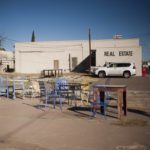
In Marfa, though, such gestures have since migrated beyond formal art spaces; parody and sarcastic duplication affects eateries, shops, and public spaces. Sites are genuinely re-used, but with a sarcastic nod to their former status and their current patrons. My favorite example is the Marfa Contemporary Pizza Foundation, a space that is a gallery and a pizza place housed in a former auto repair shop. My second-favorite example is a food cart housed in a rusted white trailer with “Boys 2 Men” scrawled on the side, that served killer breakfast tacos with a pre-emptive, laminated side of sarcasm pinned next to the tip jar. Neither is what it appears to be; both are run by proprietors who (evidentially) take great pleasure in this kind of ambiguity, in offering a space that appropriates the sineage and elements of many things and becomes none of them.
And on and on it goes. Duplication at a distance. Copying, but in an overwhelmingly alienated, self-aware, and infinitely recursive manner. Gas stations that are not gas stations but converted coffee shops; checkout girls that are not checkout girls, but art critics; everywhere in Marfa, 1950s America is in the process of rusting and yielding to something else, but not quite getting there.
This is why the ironic faux-Prada installation stays, but the completely serious Playboy sculpture (funded by the self-same corporate entity) is driven violently away. The chain fast food venues and payday loan places that exist as a blight on nearly every other Texas town cannot exist here. There is a kind of Zeno’s paradox at play. Objects and things approach their real Texas counterparts, but never quite reach full simulation. This kind of self-referentiality, employed to keep mainstream commercialism at arms length, is what keeps Marfa from being Albuqerque, its artsy neighbor to the south and west. Albuqerque is a craft fair extraordinaire, where bohemian bourgeoisie go to pick up wholesale beads and turquoise jewelry set in silver, to check out the fake adobe architecture, to take in indigenous kitsch, to embrace the illusion of authenticity.
There is something less celebratory and more dead-serious going on in Marfa, in this semi-ascetic outpost that spurns advertising more aggressively than the Sao Paulo billboard ban.
Infinite Void: White Men, Minimalism, and the Holy Mediocrity of the Great Beyond
The majesty or mediocrity of art, culture, and space in Marfa neither begins nor ends with Donald Judd. Though much is made of Judd’s personal investment in the town (he moved his family there in the mid 90s) equally key is the Dia Foundation, the Houston-based art group created by the Menil family. It was the Menils who gave Judd the cash to buy the old base, a few aircraft hangers, the town bank, 40,000 acres of land, some commercial buildings, a hotel, a Safeway, and a hot springs. It was they who encouraged him to build the aluminum boxes, to bring other artists to Marfa, and to relentlessly renovate the tiny town.[1]
The Menils, often referred to as the Houston Medicis (both for their fabulous oil-derived wealth and their willingness to buy art), were major patrons of the Minimalist school. In particular, it was the husband-wife pair, Friedrich and Philippa de Menil who aggressively pursued Minimalist and Neo-Dada artists. Friedrich and Philippa had characteristically odd sensibilities; they had converted to Sufi mysticism (Philippa wore the head scarf assiduously), spoke of the promiscuity of mobile contemporary art works (“Art goes up, comes down, goes out the door, gets in the truck, goes to Europe—like clothing! Like chattel!”[2]) and were on the board of MOMA and the Museum of Primitive Art. They dreamed of putting Texas on the high culture road map, speaking mysteriously about “miracles in the desert.”
In this way, their patronage drove the work of a number of white male minimalists working in this particular part of flyover America. Walter de Maria’s Lightening Fields in New Mexico, the Rothko Chapel in Houston, James Turrell’s Roden Crater; all of these were paid for by Dia, whose exuberant patrons compared Dan Flavin to Michelangelo and Rothko to Giotto.
If that comparison seems hyperbolic, you are not the first to think so. The author Mark Roller, in his wry review of Marfa from 2010 on the culture blog The Millions, suggests that the post-war desire for cultural hegemony in 1950s America led to some fast and loose spending on odd art projects by people with more money than sense. Put bluntly: “In the post-war decades, for America’s art world taste makers, a driving concern was to demonstrate, to one and all, that this country’s culture had come of age.” [3]
This may be so. Questions of taste and effectiveness aside, the curatorial goals of the Menils are fairly clear. These works are for and about looking into the void. The desired experience is neither entertaining nor intellectually stimulating. It is, or should be, religiously transformative. The desired effect is not unlike the Om moment you are supposed to experience in Quaker churches (that incredibly American yet remarkably Buddhist group) when you contemplate the empty square at the center of the meeting hall, toward which every bench is pointed. Forever as possibility, as the extending wish, the infinite consummation of space, the manifest destiny of the mind. And so on.
Ending Thoughts on the Infinite
Art often concerns itself with the infinite, in fashions both mechanic and mystical, both modest and transcendental. The geometrical stars on the roof of the Alhambra were the Nastrid Muslim’s exhalation of endless self-duplication, the perfect carpet of ever-extending harmony. Escher’s tessellations, albeit in a more humble way, express the same concerns.
The concept of infinity inspired Babylonian astronomers and terrified Greek geometricians. In the Middle Ages, a humanly postulation of infinity sent Giordano Bruno to the Inquisition. Descartes trembled to behold it (“The eternal silence of these infinite spaces terrifies me”). Van Gogh exuberantly pursued it (“I am painting the inifinite!”). William Blake recounted it in images both terrifying and novel. Historically, responses among mathematicians and artists toward concepts of the infinite have typically ranged in the extreme: fear or love, incalculable attraction or ineffable repulsion.[4]
Judd is one of those who took infinity seriously, pursued the experience with a kind of religious mania. Still, his commitment may not have yielded the desired results. Judd’s concern with ratios, a kind of weird modern numerology, would make a kabbalist sneer. He lacks the showmanship of Turrell and the playfulness of Chamberlain. His aluminum boxes are subtle to the point of being indiscernible, and repetitive to the point of being dull. He had the personality of a Mobius strip; conceptually interesting, but descriptively flat.
Judd was a third-rate sculptor, but in truth he was at least a second-rate visionary, whose power lay in his curatorial ambitions and sensitivity to place. Judd did not love the desert the way Georgia O’Keefe did, but he respected its authority and power, and as far as his patrons were concerned, he knew how to package it. Like a salesman who could sell a ketchup popsicle to a woman in white gloves, Judd sold the Texas art tycoons on the thing they needed the least and got the most in Texas: space, emptiness, and time. He even sold it in the libertarian-speak so common to Texans today: “Government is the greatest threat to my work. And the death of an artist increases the value of the art enormously. The IRS recognizes the money; the USIS recognizes the reputation; but they and few recognize the conditions necessary for creating art.” [5] Take that, statist New York elites!
With that in mind, let’s catch ourselves up: Sufi mystics, oil money, American minimalism, a sarcasm that is uniquely Texan, and a wager that infinitely can be seen in a kaleidoscopic view of the ordinary.
Did Judd’s wager work? And by that I mean, did all the site-specificity, de-commodification, art-as-life nonsense create the desired effect? Do we risk looking at nothing, on the chance that we might experience gazing into infinity? How can we today view American Minimalism as a possible response to the infinite?
With a yawn, and possibly a sigh. Sometimes, the infinite is just too passé. We don’t react to this kind of void-staring with the gravitas that Judd envisioned. We are wearied by the infinite, and we have neither the time nor the energy to contemplate it with sincerity. We refuse to have a religious experience with nothing, as the Menils so ardently hoped we would.
Instead, we struggle to tell the difference between a Donald Judd and cheap Ikea furniture, perhaps best evidenced by a nine year old girl who recently had a lie-down on one of Judd’s plexiglass stacks in London.[6] We recycle Frank Stella and Barnett Newman canvases as forgettable dorm-room interior decoration. We do not much appreciate simple forms that outsource the hard thinking to us.
And yet many continue to make the pilgrimage to Marfa to pay tribute to the Great Void. It has an unknown gravity, like a black hole, as though its something-nothingness is a more powerful negative than even the desert around it. Maybe in nothing there might be something, after all.
Notes
1. 1992, Mark Stevens at Vanity Fair : “Art Oasis.”
http://www.vanityfair.com/society/features/1992/07/marfa-community
2. 1996, Bob Collacello at Vanity Fair, : “Remains of the Dia.”
http://www.vanityfair.com/magazine/archive/1996/09/colacello199609
3. 2010, Mark Roller at the Millions: “Donald Judd’s Meloncholy Moment.”
4. 1991, Eli Maor: To Infinity and Beyond: A Cultural History of the Infinite; p 2-4
5. 1977, Donald Judd. “In Defense of My Work.” p. 1
6. 2014, Hrag Vartanian, “What not to do with kids in a museum,”:
http://hyperallergic.com/105448/what-not-to-do-with-kids-in-a-museum/
* * *
Infinite Scroll is a literary and arts magazine published in Boston, MA. IS invites writers, poets, authors, essayists, photographers, artists, draftsmen and draftswomen, painters, pixel pushers, and all around creative type people – you get the point – to submit their wonderful content. Each issue is themed. Previous themese have included infinity, space, bread, and romance. If you are interested in submitting to IS then send a message to us @ infinitescrollmag [at] gmail [dot] com. IS can be purchased on the web at infinitescroll.bigcartel.com and can be purchased in the flesh aka “meat space” at Magpie in Somerville, MA.