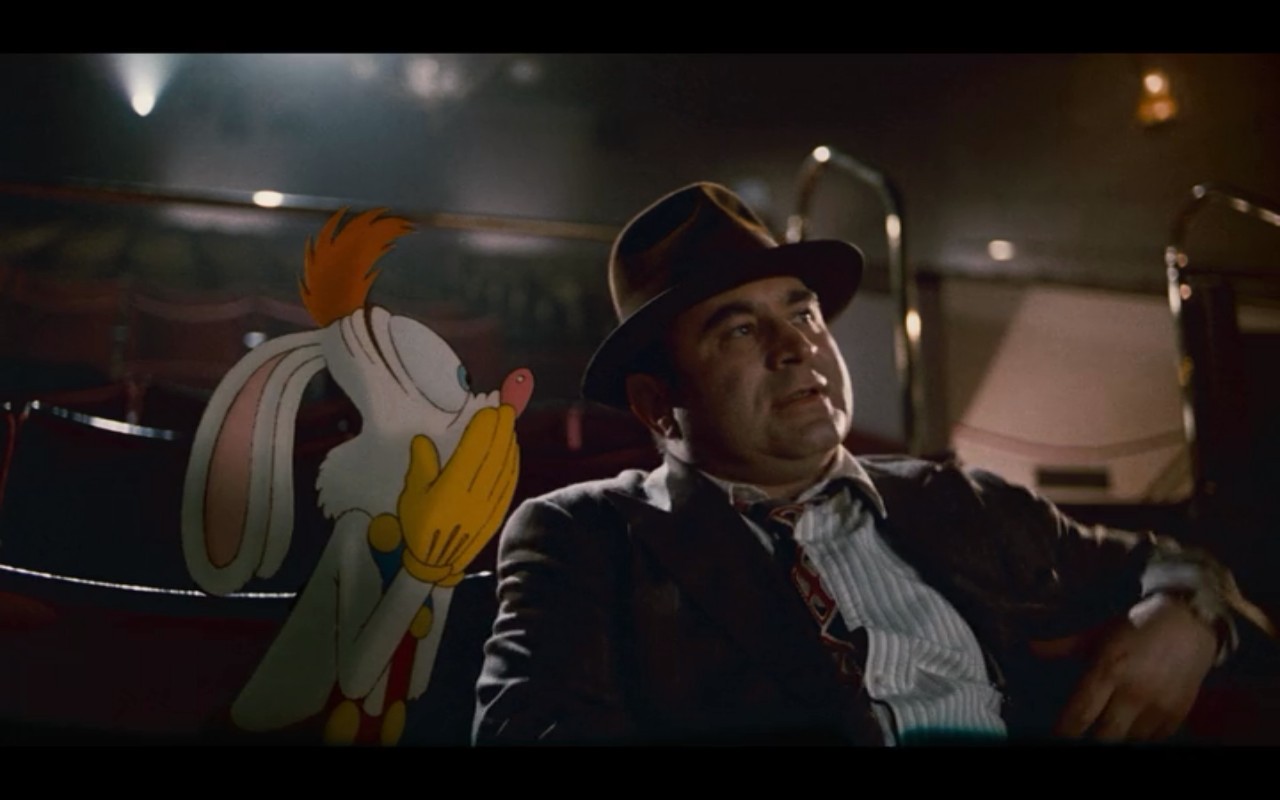
For a film that blends two-dimensional animation with the real world, Who Framed Roger Rabbit? kind of makes you forget you’re watching a movie. This constructed world where cartoons (rather, Toons) and humans coexist is so detailed, so lived in, that you just accept it for reality. Couple this with a plot as propulsive as a Saturn V engine, and you’ll find yourself losing sight of how ridiculous the whole thing really is.
It’s a film often labeled as a noir, and don’t get me wrong: it is. There’s crime, twists, dark visuals, a femme fatale, and a run-down, hard-shelled detective with a hint of sentimentalism simmering beneath the surface. But if you watched Hitchcock’s Notorious and thought, “Noirs aren’t for me,” you’d be doing yourself a disservice to write off Roger Rabbit on the basis of genre. While those noir conventions are clear, the film is equally obvious in its irony. Everything is tongue-in-cheek; “Who needs a car in L.A.?” one character asks, “We’ve got the best public transport system in the world!” And yes, there’s a villain, but his name is Judge Doom. He’s played by Christopher Lloyd. He’s dressed in all black — and his newest invention, a green and gloppy goo called “dip,” is capable of killing all the Toons in Toontown.
Don’t get me wrong, he’s a scary guy, but the magic in Roger Rabbit is neither in the sky-high stakes nor in the actual solving of the film’s mystery. Rather, it’s because the film itself feels impossibly fun. Perhaps its joy comes from the jazzy score, or perhaps it comes from the lighthearted visuals of seeing a real life man (Bob Hoskins) hop in a cartoon taxi-cab and chase down Judge Doom as he sets out on his plan to destroy Toontown. But more so, Roger Rabbit’s spark comes in that dichotomy of serious and unserious.
In proper noir fashion, the film is riddled with twists and turns that, in themselves, are quite bureaucratic. But the reason you stay seated through Roger Rabbit isn’t the plot structure. The so-what of the film exists beyond its story framework. It’s about Tweety Bird playing “this little piggie” with someone on the verge of falling to their death. It’s about watching Roger Rabbit — whose day job is as a film actor — get yelled at by his director because he sees birds instead of stars after a refrigerator falls on his head. It’s about Jessica Rabbit saying, “I’m not bad. I’m just drawn that way.” It’s about the Wizard of Oz references and the Star Wars references. In Roger Rabbit, corporate execs have affairs with cartoon sex icons, and detectives realize their big breaks when a whiskey glass sits ever so perfectly atop a newspaper and accidentally magnifies an overlooked detail below.
It’s a film that feels impossibly made. Which, I suppose, is as good as a compliment can come. But as the plot continues to sprawl and the film takes us to detectives offices or dimly-lit streets or to Toontown or to the Mount Hollywood Tunnel in Griffith Park, there’s never a moment where you can point to the screen and say, “Oh! That’s how they did that.” I’m sure that I could Google it. It’s probably on YouTube, some behind-the-scenes short documentary that would bring it all to light. But, you know what? I don’t want that. I like this unknown. I like the magic. I’ll probably watch this movie for the rest of my life. I’ll probably show it to my kids. And I just hope the mystique never fades. May the mystery shroud me forever.
Who Framed Roger Rabbit?
1988
dir. Robert Zemeckis
104 min.
Screens Thursday, 1/29, 7 p.m. @ Coolidge Corner Theatre
Author and Roger Rabbit creator Gary K. Wolf in person!