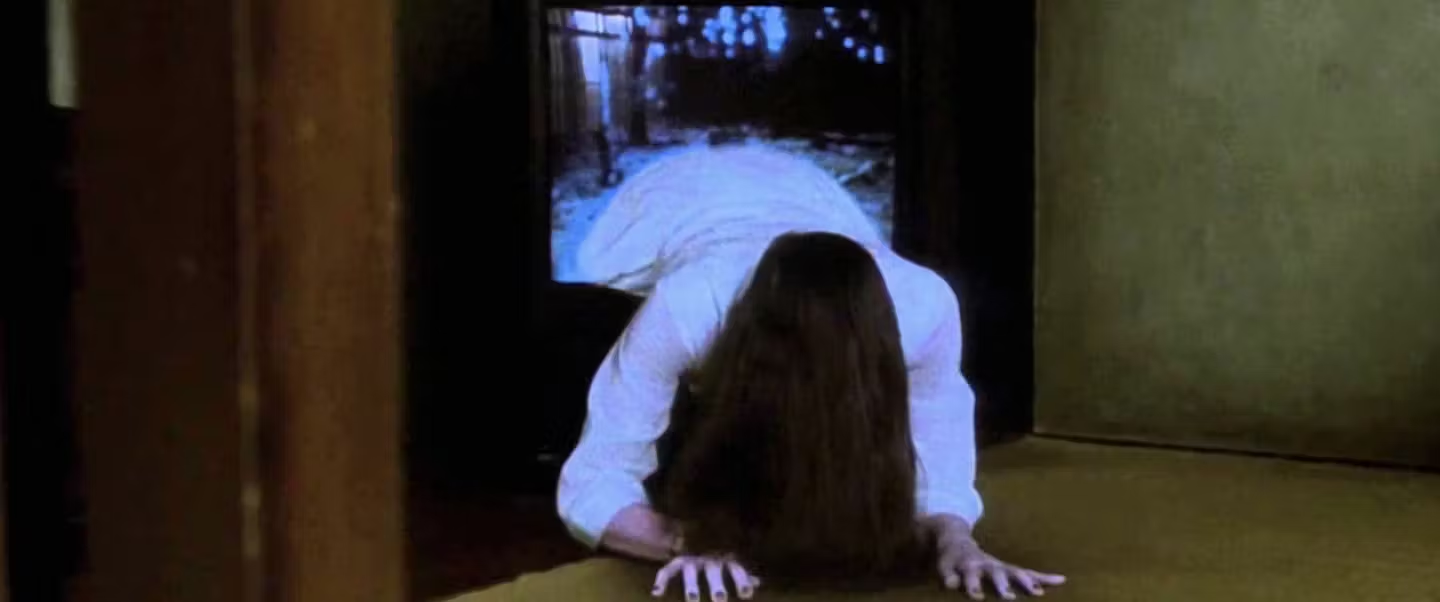
Ringu is an atmospherically charged, cryptically anticipatory horror film exploring a variety of themes, from familial trauma to demonic and otherworldly rage. Two girls, Tomoko (Yuko Takeuchi) and her friend Masami, discuss a local legend at a sleepover, involving watching a strange video that is immediately followed by a real phone call, promising the watchers that they have a week to live. After admitting she watched the video with her friends, Tomoko is found dead with nothing but a shocked face as evidence. Her journalist aunt, Reiko Asakawa (Nanako Matsushima), decides to investigate her disappearance and others connected to the same story as she juggles her job and raising her son, Yōichi Asakawa (Rikiya Ōtaka). While initially not a believer, upon investigating and watching the video herself and receiving the same accursed phone call, she realizes she only has a week left to uncover this curse before a demonic girl named Sadako (Rie Inō) kills Reiko through sheer will. Calling in the help of her ex-husband and Yōichi’s father, Ryūji Takayama (Hiroyuki Sanada), Reiko must discover the roots of this evil and the video’s origins, and stop the curse before she or anyone else gets killed.
Director Hideo Nakata effectively instills Ringu with a dark, discombobulating atmosphere that keeps viewers on their toes. While typical jump scares are entirely avoided, Nakata understands what makes any even standard setting creepy. From darkly lit wide-shots of cramped city streets and lonely skyscrapers to rooms showcasing either typical residential clutter or abandoned, unkempt filth, Ringu instills a sense of ever-present dread, either from the presence of the invisible Sadako or from already depressing realities. Plus, with Kaidan Kimodameshi’s unbeatable score of depressingly sonic hues and sharp violin scrapes, the world feels all the more jumpy. Even without Sadako, living isn’t paradise. With work stresses, child-rearing obstacles, and all the other in-between issues, a Western-Asian blend of capitalist desires and woes, where legends aren’t to be listened to, life is always in motion without much rest. By capturing such a bleak outlook through a terror-charged lens, Nakata thus suggests that the practical, non-mythical way of living that most people in Japan adhere to may partially drive Sadako. It’s a world where possibility only exists as far as human minds can conceive it, rather than humans existing in a universe filled with unknown potential—including a demonic girl. The video, therefore, “Is not of this world. It’s Sadako’s rage.” Her rage against those she curses, her screwed up backstory, and a world where she doesn’t get any recognition of existence anymore, even after death.
Screenwriter Hiroshi Takahashi also ensures Ringu remains subtle through its many twists, turns, and revelations. He had an enveloping cast to write for, true—Matsushima is firm even in her most frightened moments, Sanada stands tall as the mysterious supporting character with hidden motives and skills, and Inō as Sadako herself is beyond terrifying even when she just stands and stares—but he ensures writing allows them to bring their all, covering a range of ideas from ruined relationships and parenting flaws. For example, Reiko’s relationship with her son and Ryūji’s is a significant component of Ringu. As she gets deeper into her search and farther into danger, she realizes how much she’s left her son to his own devices for most of his single-digit life: “Is Yōichi alright alone?” Reiko gets asked, to which she responds: “He’s used to it.” As she repeats the notion either out loud or mentally, she remembers that her survival means more than just one person’s being alive. She must survive so that her son can live, and she can stop this from happening to anyone else. In a world of grim realities and otherworldly demons, Reiko’s will is both inspiring and slightly hope-inducing.
Unfortunately, Takahashi also occasionally makes Ringu too subtle. In an attempt to avoid making the characters overly stereotypical horror archetypes, he keeps character development to a minimum. While there are certainly enticing moments, such as when Ryūji openly condemns his failed marriage with Reiko and their screwed up, left-alone kid—”I’m not ‘normal.’ Maybe all three of us should just die! Good idea. We shouldn’t have had a kid in the first place,” he says to an increasingly hysterical Reiko—they’re not followed up on. Sure, Reiko herself stays alive for her kid, but she doesn’t change much beyond her new belief in otherworldly evils, and Ryūji is basically static. He doesn’t become more present in his kid’s life by Ringu‘s end; his beliefs and morals remain the same, and he goes back to work as if nothing happened. Such a lack of character development doesn’t diminish the atmospheric tension, but it does make Ringu a slightly more surface-level psychological horror than it could be. Fortunately, again, the environmental chills help compensate for much of that thin execution.
Thus, Ringu is an enticing, sharply visualized, and mysterious horror flick, delivering much angst and weighty issues against a paranormal backdrop. It’s no wonder there were two direct sequels, an immediate prequel, and American retreads created afterward, as Ringu is as fierce as it is introspective. For horror fans, Ringu will provide a lot of food for thought and nail-biting scares, even if its victims aren’t as fleshed out as they could be.
1998
dir. Hideo Nakata
96 min.
Screens Tuesday, 7/22, 7:00 p.m. @ Coolidge Corner Theatre
Part of the ongoing repertory series: Kaidan Kimodameshi