
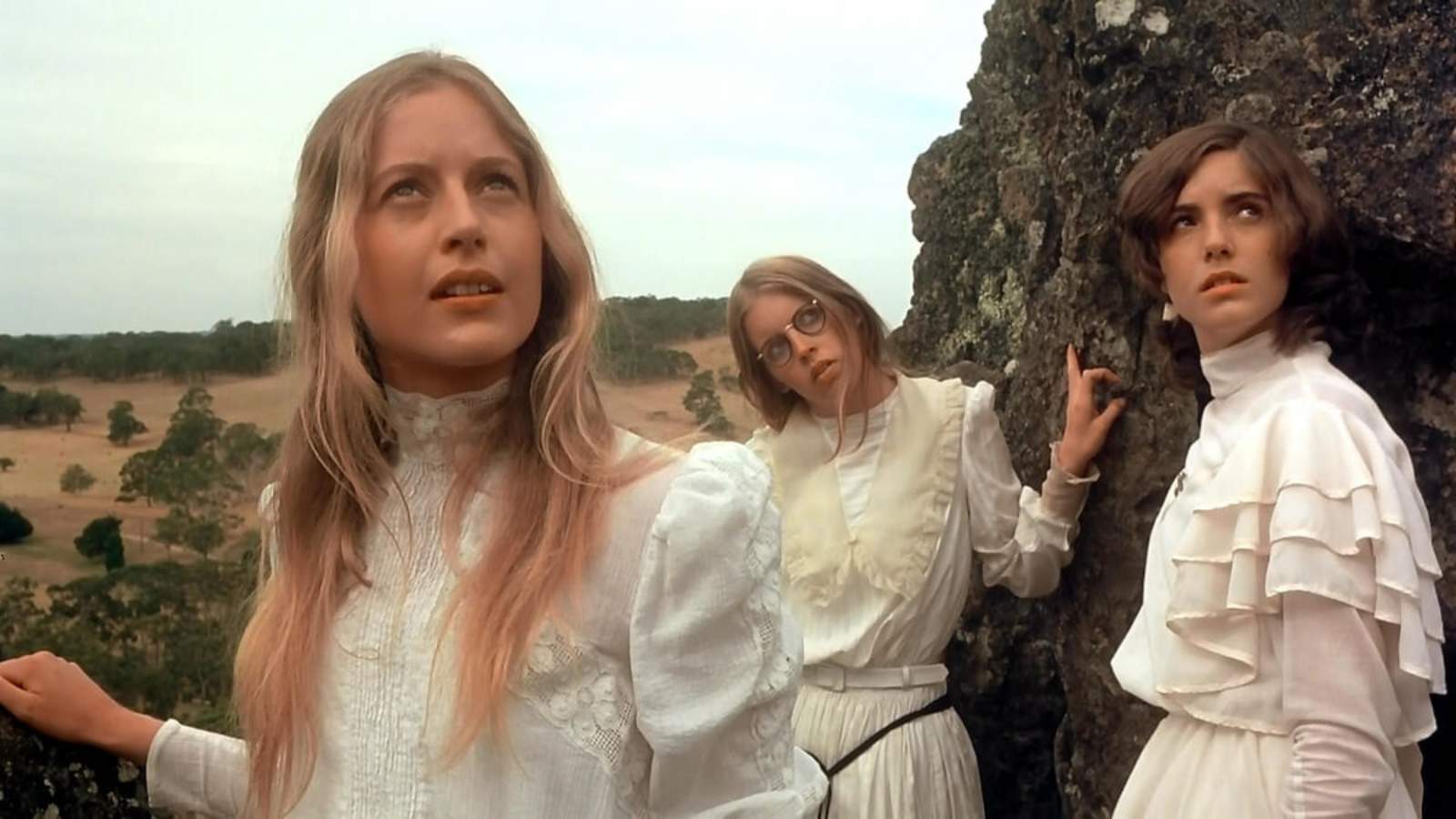
Picnic at Hanging Rock is a profound, atmospheric, and cryptically vague Australian suspense-horror film and adaptation of Joan Lindsay’s novel and potentially true story. On Valentine’s Day, 1900, a group of students from Appleyard College, a girls’ private school in Victoria, Australia, hike for a picnic at nearby Hanging Rock with their teachers. Whilst there, students Miranda St. Clare (Anne Louise-Lambert), Irma Leopold (Karen Robson), and Marion go missing under strange circumstances higher up the rock, along with one of their two attending teachers, Miss Greta McCraw (Vivean Gray). With nothing but vague memories of a red cloud and a skirtless Miss McCraw from a scratched up Edith, the only student who went with the others before they disappeared further up the rock, policé, head principal Mrs. Appleyard (Rachel Roberts), Miranda’s closest orphan friend Sarah (Margaret Nelson), and passerby Michael Fitzhubert (Dominic Guard) must cope with these mysterious losses as it affects their surrounding community and livelihoods.
Calling Picnic at Hanging Rock surreal in its effectually demonstrable horror is an understatement. Director Peter Weir wondrously encapsulates the innocence-stripping nature of death, balancing it with awe-inducing shots of Australian wildlife and nature to keep audiences thinking without getting overwhelmed. Appleyard College and its Victorian wooded surroundings appear eerie and almost otherworldly from the get-go. As Miranda leads her smaller group through different parts of Hanging Rock’s many scenic views, the camera captures them through a mist from nooks and crannies, almost as if the viewer were a Peeping Tom. Combined with a nearly daedric score matching the breathtaking greenery and unsettling close-ups and disturbed monologues from kids and adults alike—”Everything begins and ends at exactly the right time and place,” a blank-staring, in-trance-appearing Irma says just before she and the other girls exit the film, a line one would expect more from the likes of an adult depressed artist—and these girls’ world immediately seems one of balance between psychological treachery and distractingly picturesque landscapes. It’s the perfect place for such sudden, unexplainable missing persons cases to arise.
Part of Picnic‘s mealworthy suspense is precisely the idea of the mystery; how the girls disappeared is ultimately irrelevant, as the true horror comes from how their school reacts. While a solidified answer to their disappearance would have made this film all the better, its absence isn’t the point. Weir and co. demonstrate a grouping of unique characters surrounding Picnic‘s missing subjects, demonstrating how their pre-ordained dysfunction heavily influences how they react to this larger issue and deal with its aftershock. The primary characters that illustrate this most are missing Miranda’s orphaned friend, Sarah, and the principal, Mrs. Appleyard. The former essentially loses her last lifeline in Miranda’s disappearance. Towards the beginning, a frozen-stiff Sarah stares at her friend’s reflection as Miranda tells her, “You must learn to love someone apart from me, Sarah. I won’t be here for much longer.” Foreshadowing aside, Sarah gets forced to deal with that reality; she shuts herself in and begins letting her larger financial problems wash away, as the grief is too much to bear. Whether or not Miranda was to be there for “much longer,” her absence only makes Sarah, as frightfully portrayed by Margaret Nelson, further detached from her world, even as she’s threatened with going back to the orphanage.
Mrs. Appleyard, conversely, deals only with the financial burden of it all. As word gets out about the tragedies and news swarms in, Mrs. Appleyard essentially falls apart: “This tragedy is little more than a week old, and already three—three, mark you, sets of parents have written advising me that their daughters will not be here next term. And the newspapers have something further to sensationalize about,” she lectures to one of the few remaining teachers. Once the first domino falls, with remaining students getting pulled and the inside environment growing increasingly hostile—Sarah’s quite literally constrained against a wall by a teacher to fix her posture towards the film’s end, supposedly—Mrs. Appleyard feels every bit of the pressure fall on her, which is thus released on the school’s most vulnerable pupil: Sarah. As she slowly befriends alcohol and drifts away from the horror of the missing pupils and teacher, Sarah and the rest of the school get the brunt of her growing anger and dismay: “How could [Miss McCraw] allow herself to be spirited away? Lost. Raped. Murdered in cold blood like a silly schoolgirl,” she at point drunkenly rambles. Combined with the dreamy mystery of their missing comrades, Picnic at Hanging Rock’s horror comes through in its characters’ almost unworldly reactions to devastating loss, making the film a dreary, awe-inspiring journey through mental woe. For psychological horror film fans, Weir fans, and those looking for an artfully defined (and nationally defining) gem of Australian cinema, Picnic is undoubtedly a feast of varying feelings, even if the ending could be more concrete.
1975
dir. Peter Weir
115 min.
Digital 4k restoration screens Monday, 5/19, 7:00 p.m. Coolidge Corner Theatre
Part of the ongoing repertory series: Big Screen Classics