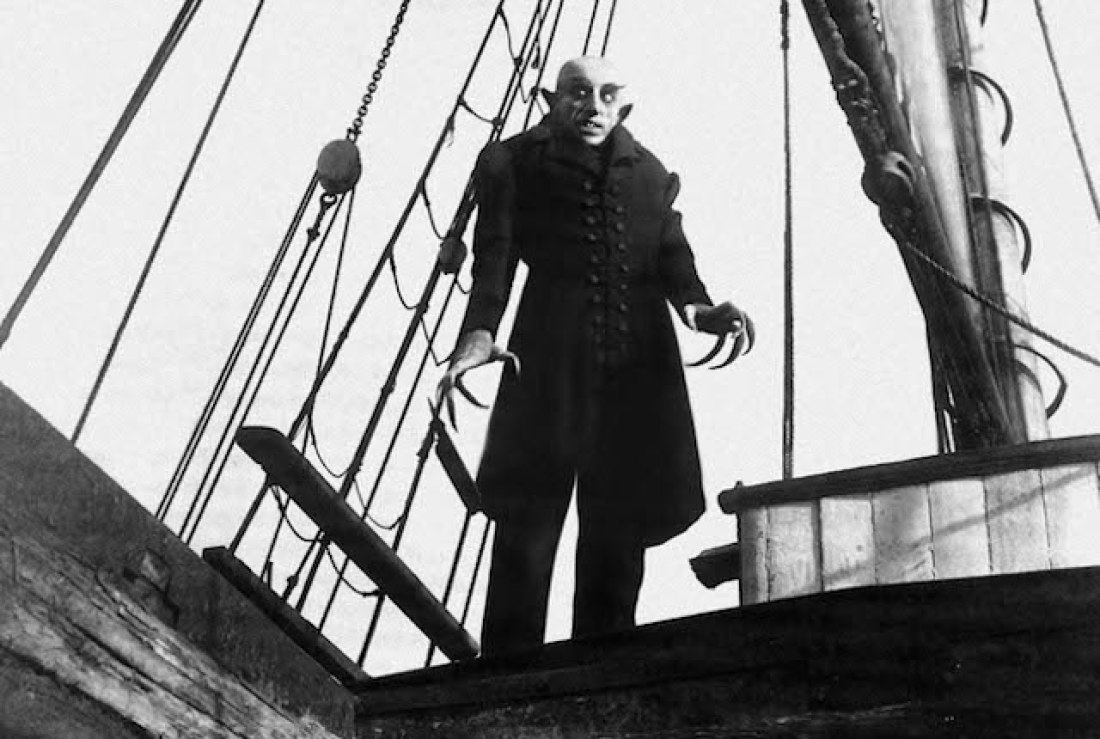
Nosferatu is a dynamic, jumpy vampire flick of old that stands taller than many modern-day attempts. Transylvanian castle resident Count Orlok (Max Schreck) becomes a new client for real estate manager and maniac Knock (Alexander Granach). Knock sends real estate agent underling Thomas Hutter (Gustav von Wangenheim), a happily married man whose wife Ellen (Greta Schröder) fears for his life upon departure. When Orlok and Thomas meet, things quickly tumble south; with warnings from local bargoers and written knowledge about shadowy vampires, Thomas learns Orlok’s true identity to be the infamous Nosferatu. Trapped by an evil force with no help beyond his wife’s telepathic knowledge of Nosferatu’s plans hours away, he must escape and stop this blood-sucker before he plagues the earth.
Nosferatu is a classic because of an artistically inclined lens used in articulating the Black Death plague’s devastations. Looking just at Nosferatu’s name, Orlok stands for many different ideas. Orlok means terror in German and war in Dutch, making Orlok both the terror of the film and a humanized reference to Black Death’s impact during World War I. He slowly spreads around populations as a sickness, being quite literally misdiagnosed as a plague that leaves mysterious puncture wounds on victims’ necks. Thomas and Ellen represent a (colonialist and European Christian-nationalist oriented) civilization’s survivors then, with Thomas the working man-turned-victim and Ellen the woman “wholly without sin” whose duty it is to stop Nosferatu through self-sacrifice—a reflection of their gendered societal roles. Knock and Nosferatu also represent the fear of “the Other,” with the former being ostracized before becoming the scapegoat for the town’s anger over their miseries. Aside from its feat as maybe the oldest surviving vamp-flick, Nosferatu is a combination of such layered symbolism and metaphors, contrasting shots of nature with human-rooted chaos to up the already effective chills and thrills the fanged foe brings. It’s cumbersome because you have to read a lot—regardless of personal words-per-minute counts—and less theatrical direction for the actors would’ve made it more realistic, but the original Nosferatu is a beautifully rendered horror symphony. For vampire, intellectual horror and old cinema fans, Nosferatu provides plenty of bite.
Nosferatu
1922
dir. F.W. Murnau
89 min.
Screens Wednesday, 10/30, 7:00 pm @ Brattle Theatre
Live musical accompaniment by the Andrew Alden Ensemble!