Diractors is an ongoing series in which Hassle writer Jack Draper examines films, new and old, whose directors are better known for their work in front of the camera.
As a rule of thumb, to qualify for a spot on Diractors, you have to act in other people’s films being directing your own. As diractors go, Kenneth Branagh feels in line with Clint Eastwood; both of their careers are seemingly dedicated to directing themselves. This is, of course, not to mention the both of them are national treasures of their respective countries. Wow, can I make more connections between the two? We take Branagh for granted the same way we do Clint, as they’ve been in the public consciousness for decades (okay, I’ll stop). But it’s Branagh’s continuing passion for bringing Shakespeare to screen that gives him more purpose as a filmmaker than an actor. Being able to visualize some of the great works of theatre– my favorite being Much Ado– reminds me of being unable to think of D-Day without a visual guide like in Saving Private Ryan. It helps that Branagh worked in the era of Merchant Ivory Productions; the romance takes on a lush exterior, and every person is at their prettiest. When your film is set in Sicily and shot in Tuscany, you’re bound to come out with a film which feels like sunshine and prosecco. Everything feels just right for a production that’s at its most ahead of its time, an adaption of what’s essentially the original romcom. It’s one of the more modern romances that center foolish young people, which is ripe for reevaluation.
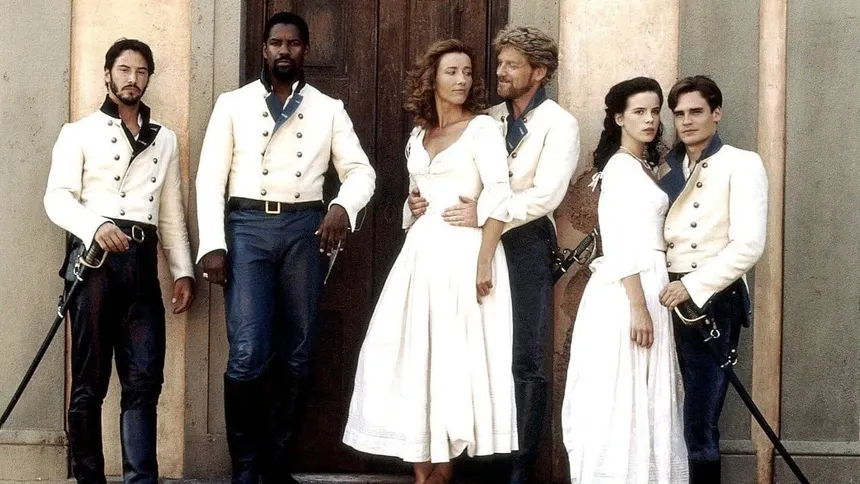
Ironically enough, the last attempt to bring this play to the screen was from Joss Whedon, who admitted that he doesn’t even understand the play. Following in the footsteps of Branagh’s masterwork is already a high bar to clear, yet it still feels like there’s unfinished business to do with putting Much Ado on screen. There are two couples in the story. Claudio and Hero, the first, are destined to be nearly split apart by the betrayal of others. The betrayal of their own hearts nearly keeps the second, Benedick and Beatrice, apart. The miscommunications that occur when individuals are constantly listening in on important discussions are what propel the plot, which centers on a few pivotal days in the life of the supporters of Don Pedro (Denzel Washington), Prince of Arragon, following his triumph over his half-brother Don John (Keanu Reeves) in combat. Now that they seem to be able to communicate, Don John, who has a sinister black beard, mopes around the screen’s margins while glaring at the revelers. When Don Pedro’s follower Claudio (Robert Sean Leonard) sees the stunning Hero (Kate Beckinsale, with an “introducing” credit), he is instantly overcome with love. She reciprocates, as evidenced by her gaze. In the meantime, Beatrice (Emma Thompson) and the elder Benedick (Branagh) both experience intense affection, but it manifests itself in verbal sparring. Mock hostility is sometimes the result of people being afraid of the love they feel.
In his review, Roger Ebert compares Branagh’s pacing to the slapstick comedies of the Marx Brothers. This speaks to the cinematic nature of the play, with all of its moving parts and happy ending. The film moves on such a level that you don’t find the Shakespeare language alienating, but rather communicating from the performance. Everyone is cast perfectly, especially Denzel’s online fav Don Pedro. It shows the strength of Branagh’s filmmaking that not even the actors who are clearly Shakespeare novices (sorry, Keanu) slow down the production, figuring out how to add some razzle dazzle to the dialogue. As in the most accomplished satires, all of this simmers down to the idiocy of the rich and wealthy and how it takes a sole mover and shaker, like Dogberry, to spin things in a different direction.
Brangah never shies away from grand scale and ambition. He loves not only Shakespeare, but also Ernst Lubitsch, Orson Welles, and Powell and Pressburger. Nobody will try to replicate the “Branagh approach” of sparkly filmmaking, but since the release of 1989’s Henry V, we’ve been in steady hands. Branagh is perhaps first known now to my younger generation for more mainstream Hollywood hits like Thor, Cinderella, and Murder on the Orient Express, all films which are the best versions of what they can be despite his expertise being in translating Shakespeare to screen. Because of Branagh’s proficiency, there’s a temptation to undervalue his filmmaking (and even his acting), which can feel unremarkable at times. But like Clint Eastwood (one more), there is more that meets the eye, which is to be appreciated more as we mature with their work.
Much Ado About Nothing
1993
dir Kenneth Branagh
111 min.
Currently streaming on Tubi, Kanopy, Hoopla, Amazon Prime, MGM+, and the Roku Channel